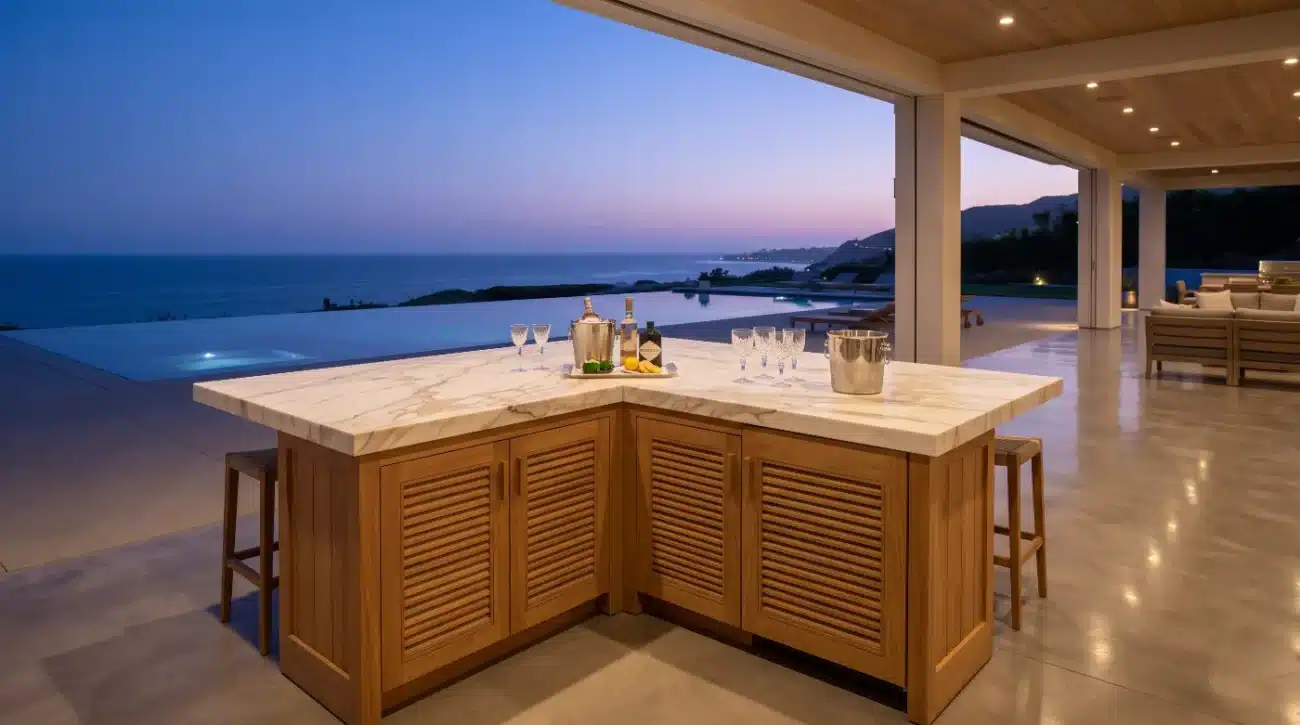
Executive Summary:
-
Minimalist Aesthetic Integration: Clean lines, functional geometric framing, and natural timber hues define Scandinavian exterior architecture while eliminating visual clutter.
-
Marine-Grade Structural Integrity: Solid Grade-A teak combined with mortise-and-tenon joinery ensures long-term dimensional stability across extreme climate conditions.
-
Trade Specifier Workflows: Integrating CAD/BIM modeling, weight-load calculations, and ventilation profiles guarantees seamless installation for custom outdoor kitchens.
-
Material Longevity Protocols: Balancing natural oil preservation with controlled UV oxidation allows designers to achieve either golden-warm tones or a silvery-grey patina.
Specifying Solid Teak Millwork for Modern Scandinavian Exterior Remodels
When a coastal Malibu estate owner presented a series of minimalist Danish architectural renders to her lead landscape architect, the initial vision centered on raw light timber surfaces, continuous horizontal grain matching, and invisible hardware. The design firm initially specified a lower-grade composite wood product with a synthetic film-forming sealer to maintain that pristine blonde hue against the salt air. Within eight months, the coastal humidity caused internal moisture trapping, leading to severe surface delamination, hairline finish cracking, and visible structural sag beneath a heavy quartzite countertop. This costly failure highlights a fundamental truth in luxury exterior design: achieving the serene simplicity of Scandinavian architecture requires uncompromising material science and precision millwork engineering, rather than superficial coatings or inferior substrates.
How Does Scandinavian Exterior Design Translate into High-Performance Teak Millwork?
Scandinavian outdoor design harmonizes functional minimalism, clean geometric forms, and natural material palettes to create serene exterior living spaces that bridge indoor and outdoor environments. In luxury residential architecture, bringing this aesthetic outdoors requires high-grade solid teak millwork engineered to endure environmental exposure without sacrificing visual lightness.
The foundational design principles of Scandinavian exterior cabinetry are structured around three core pillars:
-
Architectural Geometry: Employs handle-free, slab-front profiles, continuous horizontal grain matching, and flush, integrated face frames to minimize visual noise.
-
Environmental Durability: Leverages high natural rubber and silica density for exceptional dimensional stability under severe thermal swings, alongside innate resistance to fungal decay and saltwater rot.
-
Material Integration: Engineered for high-load capacity beneath heavy stone slabs, hidden ventilation channels for high-BTU outdoor appliances, and 316 marine-grade stainless steel joinery hardware.
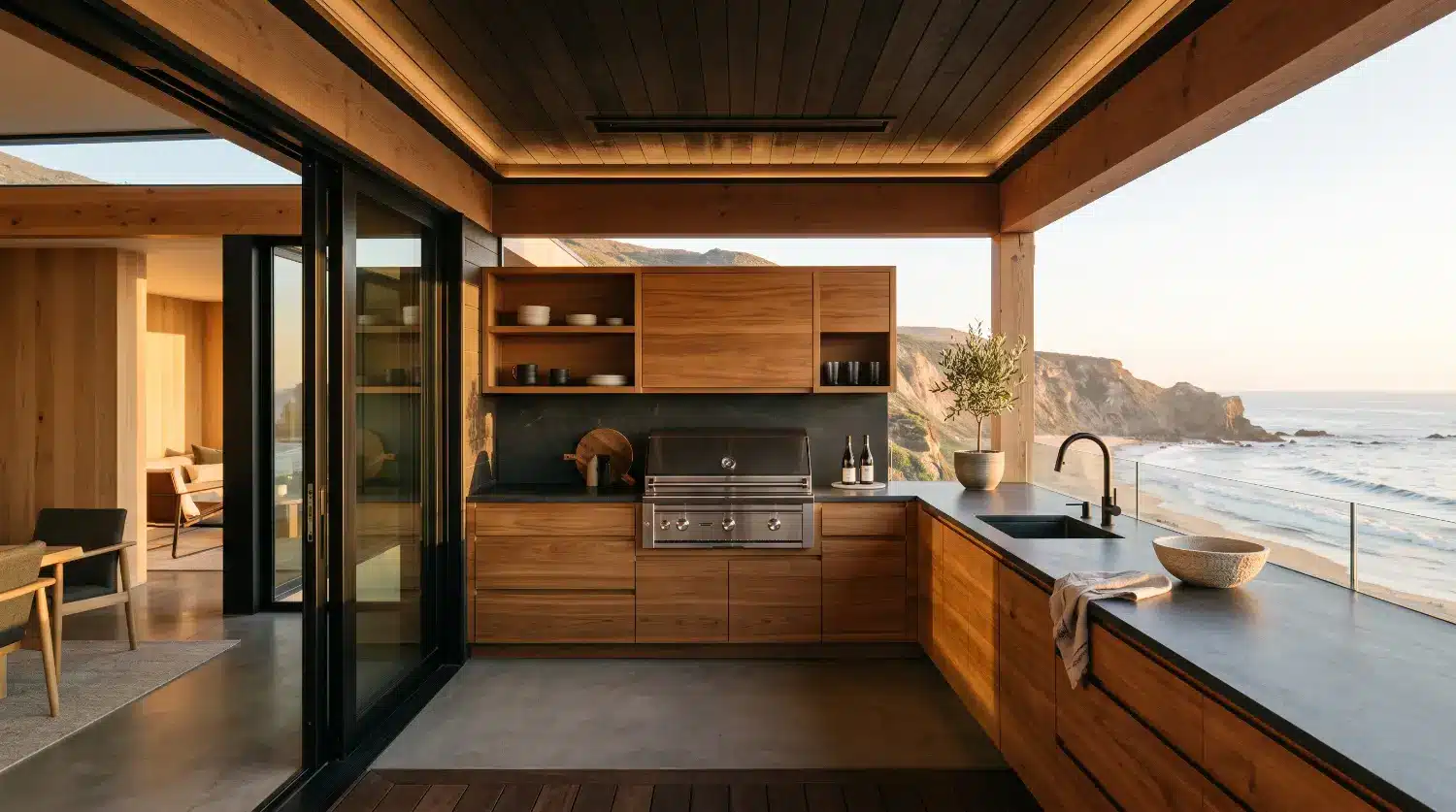
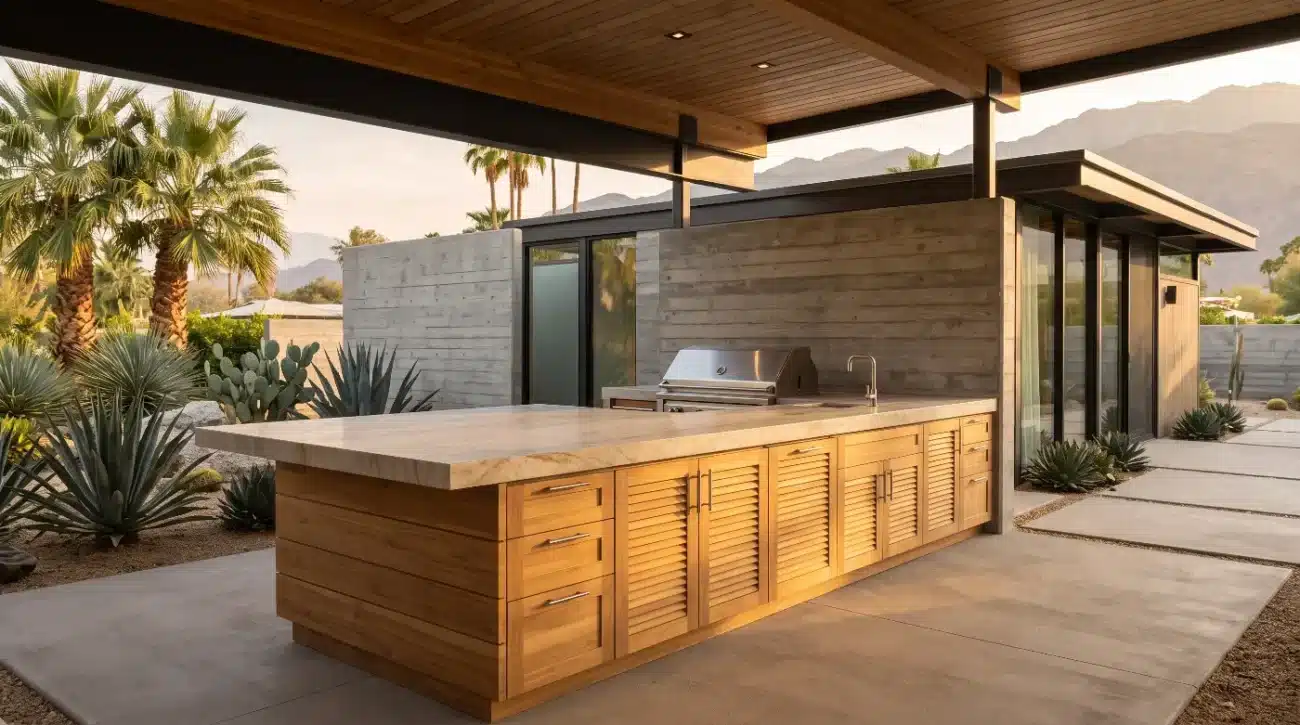
The core ethos of Nordic architecture rests on functionalism, warmth, and an unyielding respect for natural materials. Translating this philosophy into an outdoor kitchen loggia in Palm Springs or a rooftop terrace in the Pacific Northwest demands strict attention to grain selection and structural execution. True Scandinavian style avoids ornate moldings and heavy decorative trim, relying instead on revealing the pure beauty of the wood grain through flush faces, narrow shadow lines, and precise reveals.
Achieving this seamless aesthetic requires millwork that remains dimensionally stable despite drastic humidity fluctuations, intense UV radiation, and direct precipitation. While interior Scandinavian cabinetry often utilizes light woods like pine, ash, or birch, these softwoods quickly decay when exposed to exterior weather elements. Grade-A teak (Tectona grandis) provides the ideal solution for luxury exterior spaces, offering rich natural warm tones along with the structural density required for outdoor endurance.
Evaluating material performance metrics highlights the clear operational superiority of solid teak over alternative exterior substrates:
-
Grade-A Solid Teak: Features exceptionally high natural oil and rubber content, superior dimensional stability, and natural rot and insect resistance, providing an expected exterior lifespan of 30 to 50 years or more.
-
Exterior Marine Plywood or Veneer: Contains medium oil content with a persistent risk of delamination over time and moderate moisture resistance, yielding an expected exterior lifespan of 5 to 10 years.
-
Softwoods (Pine, Cedar, Ash): Exhibit low natural oil content and are highly prone to swelling, shrinking, and warping, requiring frequent chemical sealers and yielding an exterior lifespan of only 3 to 7 years.
Using solid wood in an exterior environment introduces natural expansion and contraction dynamics. As ambient moisture shifts, solid wood naturally expands and contracts across its grain. To execute handle-free slab cabinet doors and flush face-frames characteristic of Scandinavian design, custom cabinetry must incorporate internal tension reliefs, precise joinery tolerances, and expansion gaps. Without these structural considerations, tightly fit cabinet doors will bind during humid summers or create unsightly uneven gaps during dry winter months.
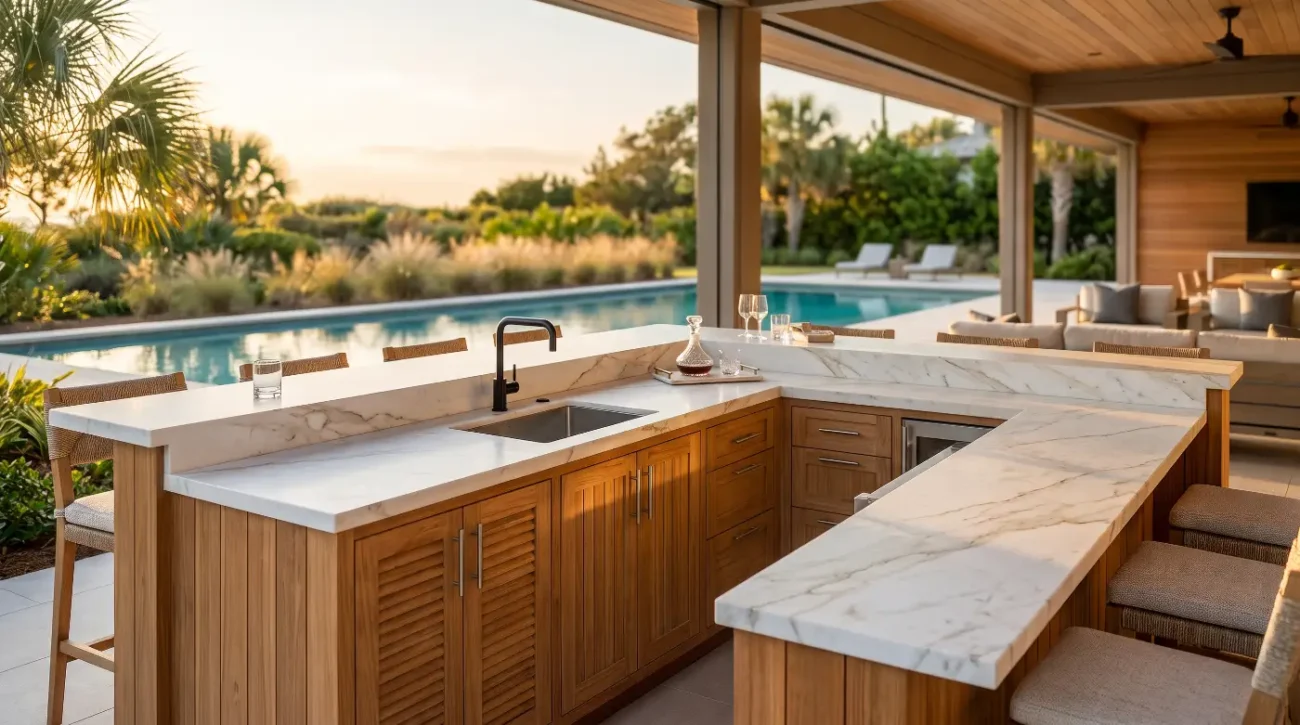
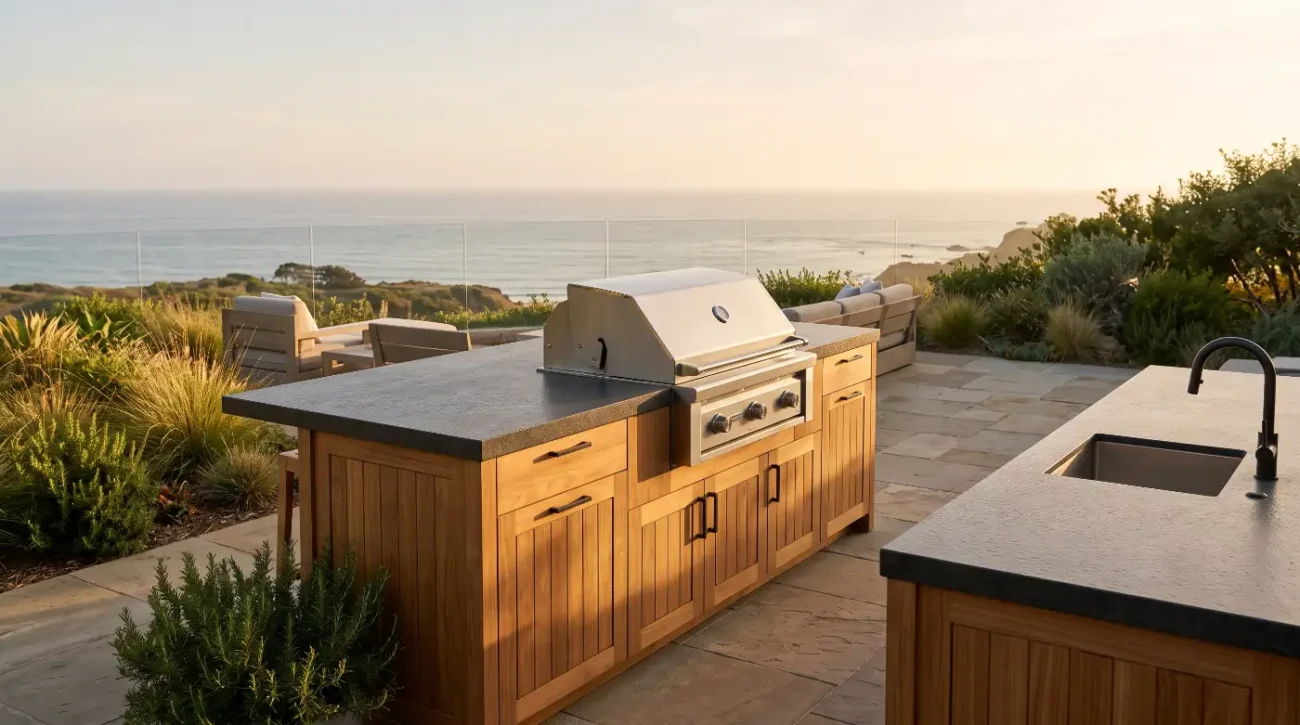
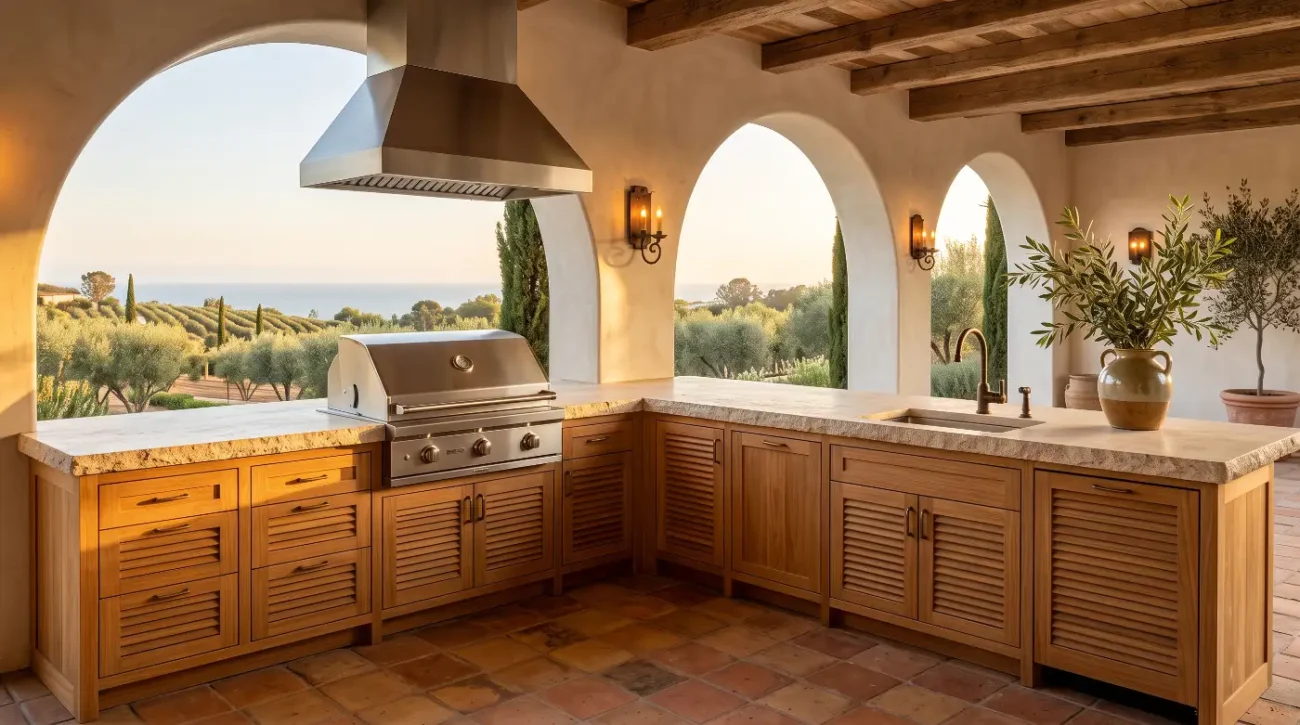
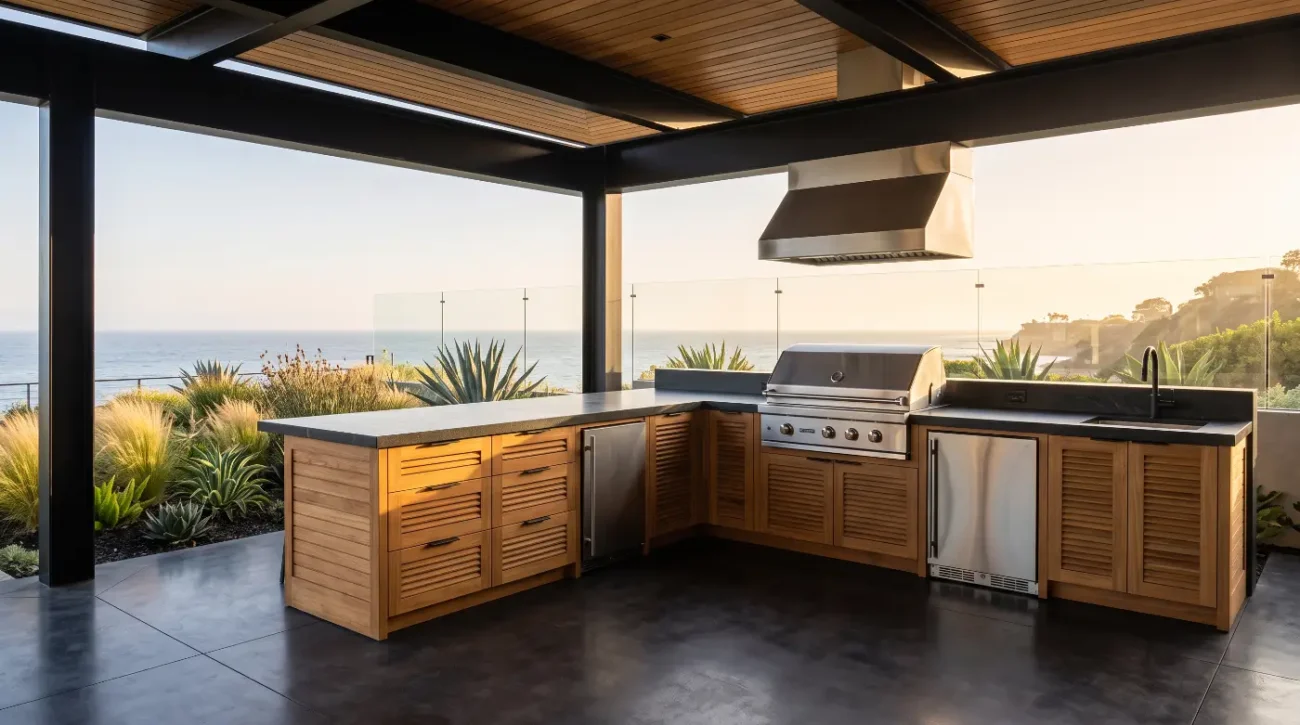
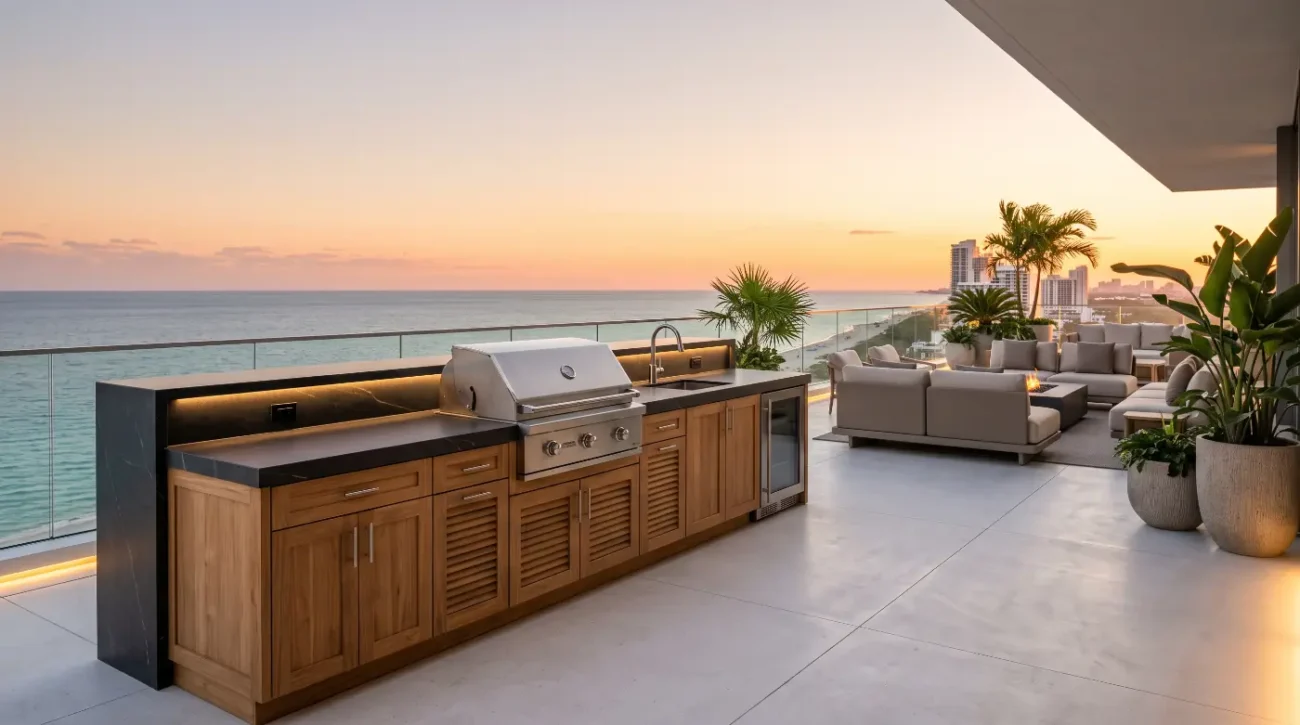
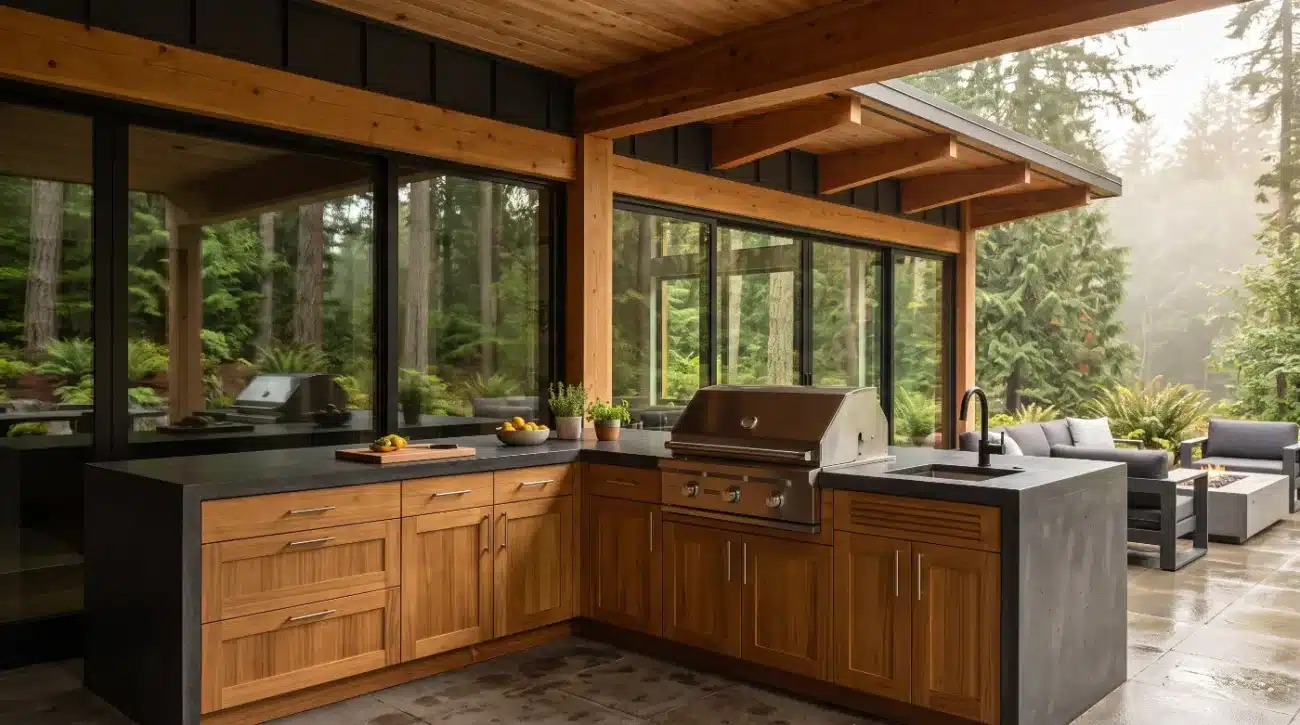
Designing a Scandinavian-inspired outdoor kitchen island requires balancing lightweight visual aesthetics with heavy load-bearing capabilities. Modern luxury outdoor spaces frequently feature heavy, thick-edge countertops made from materials like dark soapstone, honed granite, or ultra-compact porcelain slabs. Custom solid teak base cabinets must support these heavy stone loads while preserving thin reveal lines and effortless hardware operation. By incorporating internal load-bearing pilasters and mortise-and-tenon framing, wood specialists ensure the cabinet structure remains perfectly rigid and level over time.
To explore engineered base layouts that maintain these structural tolerances, review the Pacific Teak Millworks Base Cabinets Collection.
Specifying cabinetry for high-end exterior projects requires coordinating design aesthetics with precise architectural engineering. When trade professionals collaborate early with specialist millwork manufacturers, they avoid common specification pitfalls like inadequate appliance heat dissipation, improper drainage paths, and misaligned utility rough-ins. By relying on comprehensive technical documentation and standardized trade CAD files, architects can confidently integrate solid teak millwork into complex exterior wall assemblies, custom loggias, and sunken patio structures.
How Do Material Science and Joinery Engineering Ensure Lifetime Exterior Durability?
Grade-A teak possesses an exceptional internal cellular structure rich in natural rubber polymers and silica, creating built-in water repellency, dimensional stability, and natural resistance to fungal decay without requiring synthetic film coatings. Combined with traditional mortise-and-tenon joinery and 316 marine-grade hardware, this material science allows solid teak millwork to withstand severe coastal, desert, and freezing environments for decades.
The anatomical composition of Grade-A heartwood provides three distinct layers of natural defense:
-
High Tectonic Silica Content: Forms a microscopic natural water barrier throughout the cellulose structure that resists liquid absorption.
-
Oleoresin and Natural Rubber Density: Acts as an internal bio-fungicide and repellent, preventing rot, wood-boring insects, and mold growth.
-
Dense Growth Rings: Provides structural stiffness that prevents surface checking, grain splitting, and long-term timber warping.
The superior durability of plantation-grown Grade-A teak stems directly from its anatomical composition. Harvested exclusively from the mature heartwood of the tree, Grade-A teak contains a high concentration of natural teak oil, resin, and silica. This dense concentration acts as a natural hydraulic barrier, preventing liquid water from penetrating deep into the wood fibers. According to research from the USDA Forest Products Laboratory, teak exhibits one of the lowest shrinkage and swelling coefficients among commercial hardwoods, making it uniquely qualified for outdoor architectural environments where weather swings cause inferior woods to crack, check, and warp.
Using synthetic film-forming polyurethane or epoxy coatings on exterior teak often leads to premature wood failure. The failure sequence follows a predictable path: intense sunlight exposure degrades the clear coating, causing microscopic cracking in the polyurethane layer. Moisture then enters through screw holes or end-grain joints and becomes trapped beneath the vapor-impermeable plastic film. Unable to evaporate, this trapped moisture fosters rapid internal fungal rot and wood decay, culminating in severe surface peeling and wood discoloration.
Instead of applying vapor-blocking surface coatings, proper teak care relies on letting the wood breathe or nourishing it with penetrating, non-film-forming natural oils. When left untreated in outdoor environments, the wood’s surface undergoes a natural oxidation process, gradually developing an elegant silvery-grey patina over 6 to 12 months. This weathered patina consists of a micro-thin layer of oxidized lignin that shields the underlying wood fibers from further UV degradation without compromising its structural strength. Homeowners seeking to preserve the warm golden-brown tone can apply specialized penetrating teak oils that absorb deep into the pores without forming a brittle surface film. For detailed maintenance protocols and finishing schedules, refer to the Teak Care & Maintenance Guide.
The structural longevity of luxury exterior cabinetry depends directly on traditional joinery methods engineered for outdoor wood movement. Simple butt joints fastened with standard screws inevitably loosen over time due to cyclical swelling and shrinking. High-end exterior millwork relies on deep mortise-and-tenon joinery, secured with waterproof structural adhesives formulated specifically for oily hardwoods. In a mortise-and-tenon joint, the tenon tongue inserts directly into the mortise slot of the adjoining frame member, distributing stress and structural loads evenly across the entire cabinet chassis rather than concentrating strain on metal fasteners.
Hardware selection is equally critical for long-term outdoor performance. Coastal environments with high atmospheric salt content rapidly corrode standard 304-grade stainless steel hardware, leading to rust stains and mechanical failure. Superior exterior millwork exclusively uses 316 marine-grade stainless steel for all soft-close hinges, full-extension drawer glides, structural brackets, and fasteners. Containing added molybdenum, 316-grade stainless steel provides exceptional resistance to chloride pitting, ensuring smooth door operation and structural integrity even in beachfront ocean air.
For projects featuring wall-mounted storage configurations beneath covered loggias or cabana roofs, explore the Pacific Teak Millworks Wall Cabinets Collection.
Integrating gas grills, side burners, and outdoor refrigeration units into solid wood cabinetry requires careful thermal and moisture management. High-performance gas grills produce intense radiant heat that can warp adjacent wooden side panels or pose safety hazards if improperly isolated. Installing protective insulated heat jackets around grill bodies prevents direct thermal transfer to surrounding wood framing. Furthermore, outdoor cabinetry must feature concealed rear ventilation louvers to allow combustion gases and trapped heat to vent safely, fully complying with local building codes and standards established by the National Kitchen & Bath Association.
The mechanical isolation of a custom grill enclosure depends on three key structural boundaries:
-
Gas Grill Insert Frame: Houses the primary heat source and requires precise cutouts.
-
Insulated Heat Jacket Air Gap: Provides a non-combustible barrier that shields the timber frame from extreme temperatures.
-
Solid Teak Cabinet Frame with Concealed Rear Louvers: Delivers structural support while continuously venting trapped combustion gases to the exterior.
To review complete mechanical specifications, clearance tolerances, and construction guarantees, consult the official Pacific Teak Millworks Warranty Documentation.
Mastering Scandinavian Design Details for Luxury Exterior Spaces
Integrating Scandinavian exterior design principles into high-end residential remodels requires balancing clean geometric lines, organic wood tones, and high-performance exterior materials. Designers can achieve a timeless Nordic aesthetic by pairing fine teak millwork with sleek modern finishes, integrating smart functional storage solutions, and specifying sustainable building materials that endure harsh outdoor environments.
Design Elements for Scandinavian Outdoor Kitchens
-
Clean Flat-Panel Slab Doors: Specify handle-free, edge-routed slab cabinet fronts to maintain uninterrupted horizontal grain patterns and minimal sightlines.
-
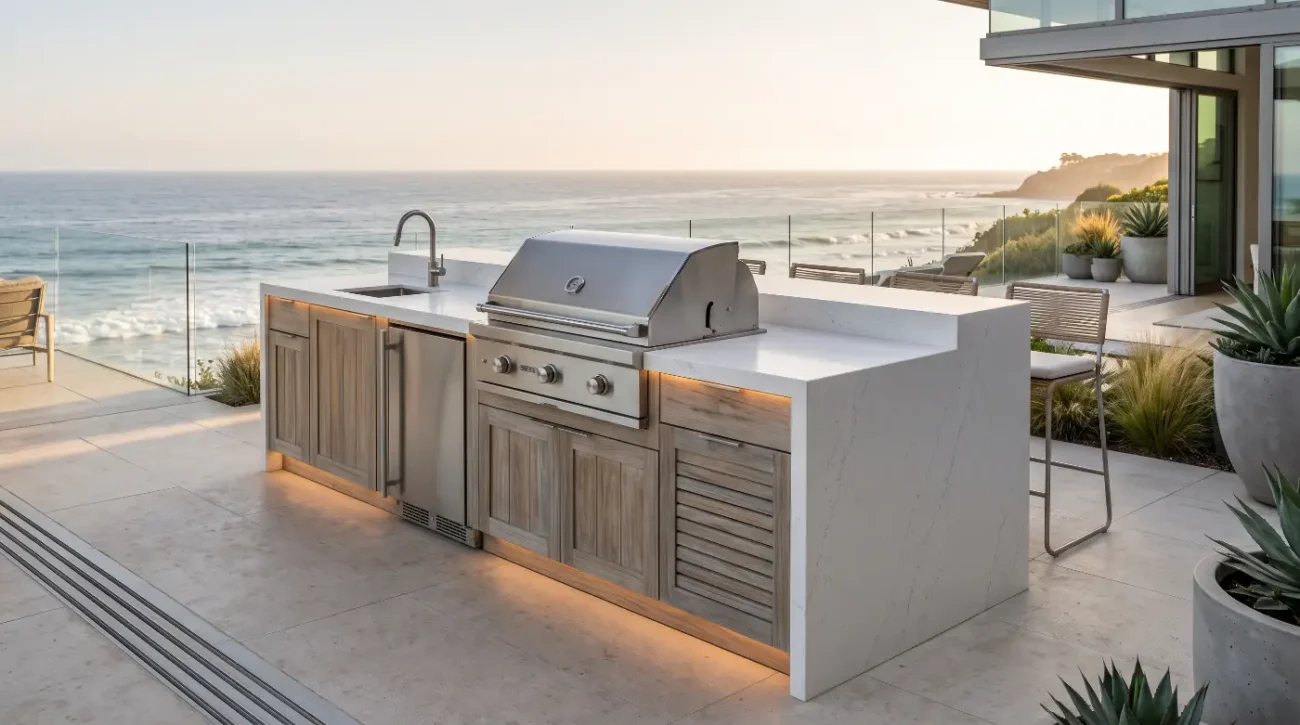
Textural Material Contrast: Pair golden-brown teak cabinetry with dark honed granite, concrete, or matte black fixture accents to balance organic warmth with modern structure.
-
Integrated Concealed Storage: Incorporate full-extension pull-out trash systems, hidden appliance bays, and soft-close drawers to keep countertops free of visual clutter.
-
Flush-Mount Hardware Integration: Utilize touch-latch mechanisms or understated recessed finger pulls crafted from 316 marine-grade stainless steel for a smooth, handle-less look.
-
Biophilic Lighting Integration: Install warm 2700K LED task lighting underneath wall cabinets and counters to highlight the rich wood grain during evening gatherings.
-
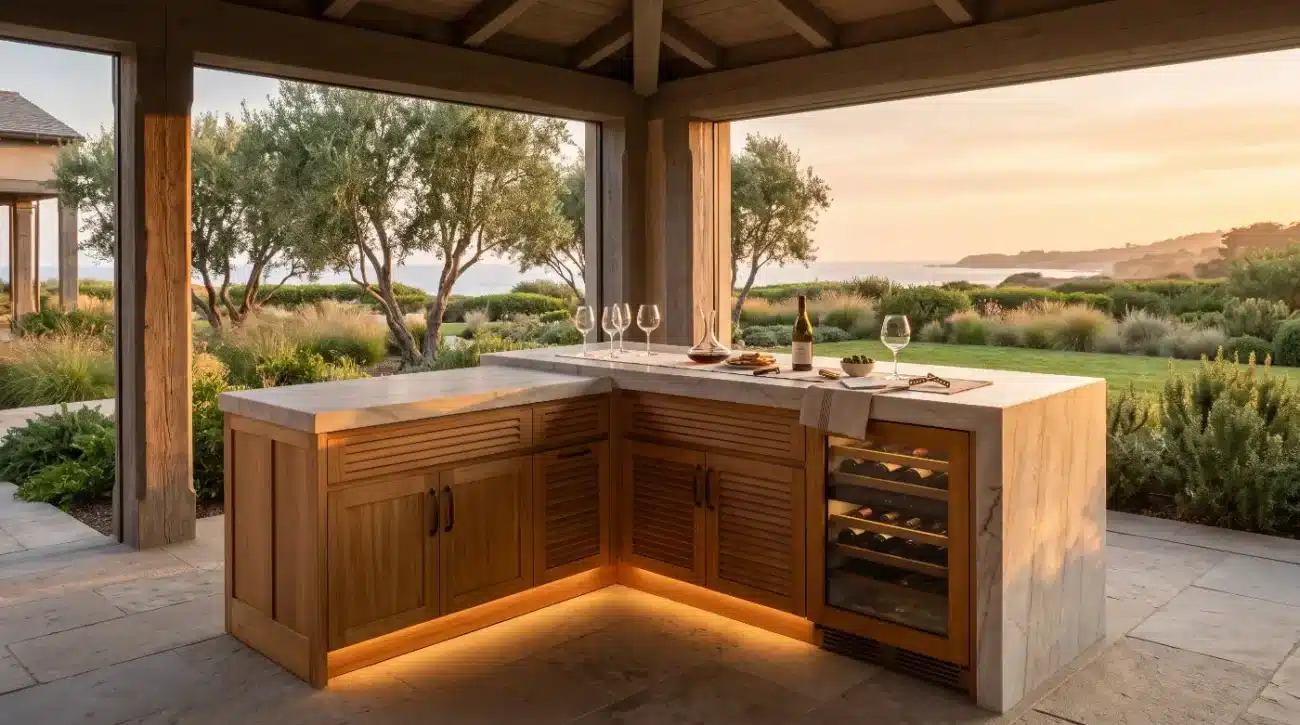
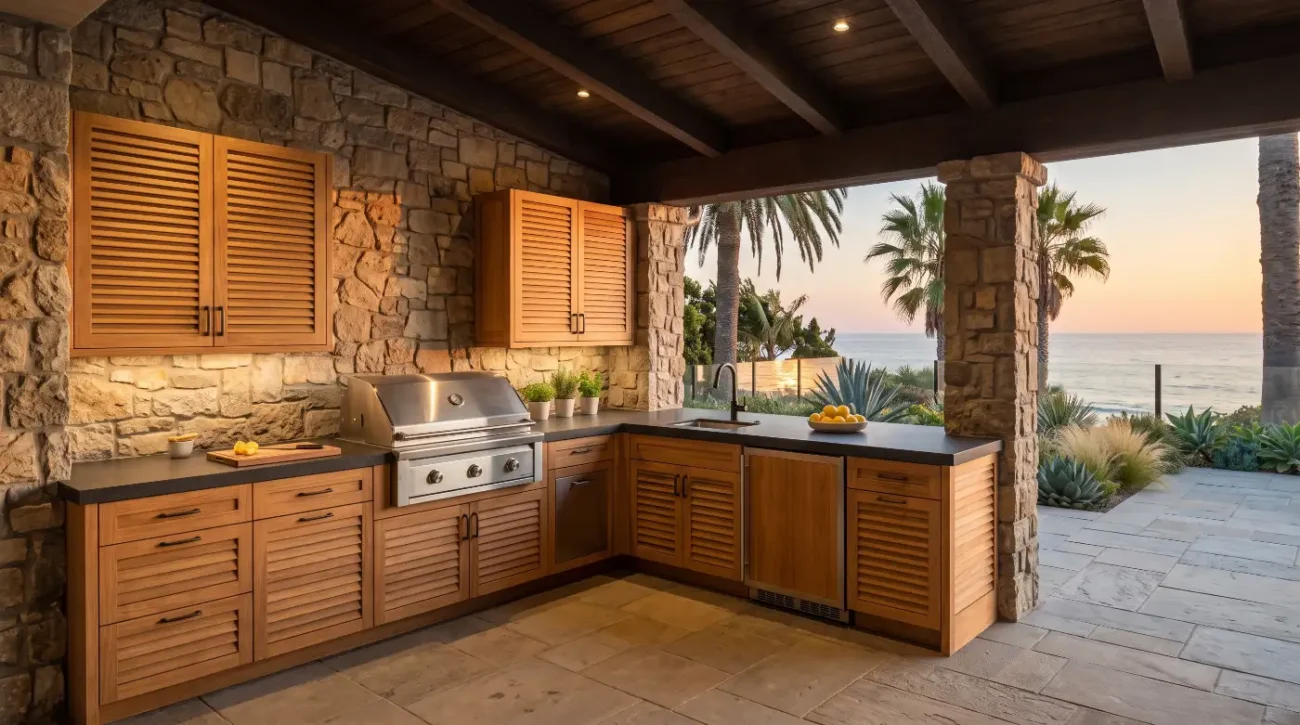
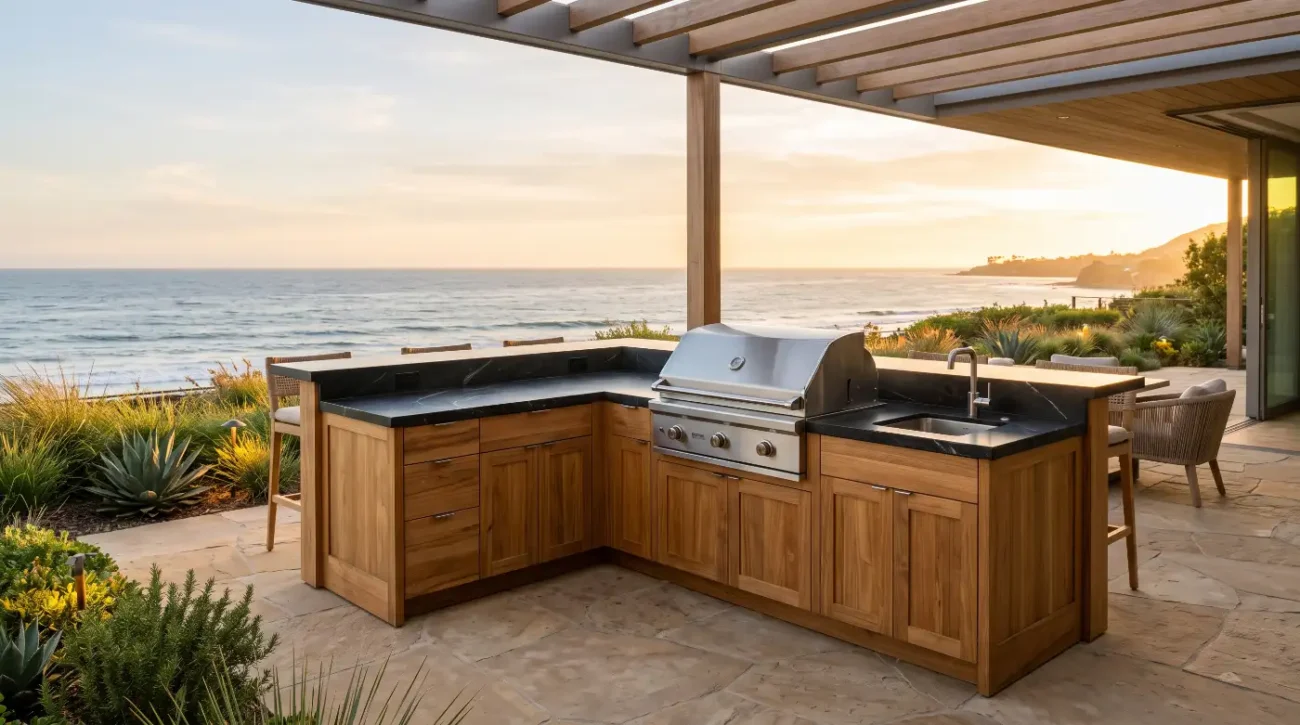
Covered Transitional Layouts: Position teak island inserts under protective loggias, overhangs, or timber pergolas to create functional year-round outdoor cooking spaces.
Executing these refined design details requires precise trade coordination during the early planning stages. To explore seamless built-in options designed for custom island enclosures, browse the Pacific Teak Millworks Island Inserts Collection.
Trade Specification Checklist for Exterior Millwork Integration
-
Verify Site Microclimate Conditions: Assess property wind patterns, ocean salt exposure, direct UV contact, and local temperature ranges to establish correct finish schedules.
-
Review Appliance Cutout Specs: Cross-reference appliance manufacturer specification sheets with CAD cabinet drawings to confirm precise cutout dimensions and required heat clearances.
-
Confirm Load-Bearing Framing: Verify that cabinet base frames and leveling legs can support heavy stone countertop materials like concrete, quartzite, or 2cm porcelain slabs.
-
Plan Utility Rough-In Locations: Coordinate plumbing, electrical, and gas line stub-outs with internal cabinet void clearances prior to setting base frames on site.
-
Incorporate Proper Heat Isolation: Ensure high-heat appliances feature insulated jackets and rear ventilation louvers to protect nearby teak frame members.
-
Integrate Sub-Base Drainage Systems: Verify that base cabinets feature adjustable marine-grade legs to lift wood frames off standing deck water and encourage airflow.
-
Cross-Check Certification Standards: Confirm that specified teak materials carry chain-of-custody credentials from recognized forestry organizations like the Forest Stewardship Council.
When trade professionals need deeper answers regarding custom sizing tolerances, lead times, or trade program pricing structure, review the comprehensive Pacific Teak Millworks Resource Center or download the direct Frequently Asked Questions Guide.
By prioritizing advanced material science, traditional joinery techniques, and minimalist Scandinavian design principles, architects and builders can create outdoor living environments that deliver exceptional beauty and long-lasting performance.
External References
Key Takeaways
-
Minimalist Nordic Aesthetics: Scandinavian exterior design relies on clean geometry, handle-free slab door profiles, continuous grain matching, and minimal visual clutter.
-
Grade-A Teak Performance: Rich natural rubber, oil, and silica content make Grade-A teak exceptionally stable, naturally water-repellent, and highly resistant to rot.
-
Avoid Film-Forming Coatings: Applying acrylic or polyurethane sealers traps internal wood moisture under UV exposure, leading to surface peeling and fungal decay.
-
Precision Joinery Standards: Traditional mortise-and-tenon construction combined with 316 marine-grade stainless steel hardware prevents frame racking and corrosion in coastal settings.
-
Comprehensive Trade Coordination: Success requires pre-planning utility rough-ins, integrating insulated appliance heat jackets, and ensuring adequate base cabinet drainage pathways.
Bringing a Scandinavian-inspired outdoor living vision to life requires accurate technical specification, precise craftsmanship, and dedicated trade support. Whether you are an interior designer crafting a residential mood board, an architect detailing CAD layouts, or a custom builder managing job-site installation, Pacific Teak Millworks provides the expertise and solid teak cabinetry solutions your project demands. Contact our team today at (949) 365-6513, email darin@pacificteakmillworks.com, or visit our Contact Us Page to request material samples, download specifier resources, or discuss trade program benefits for your next luxury project.