Executive Summary:
-
Marine Atmospheric Vulnerability: Standard 304 stainless steel hardware rapidly degrades in coastal salt air,causing unsightly tea-staining, galvanic pitting, and eventual mechanical seizure.
-
The Molybdenum Advantage: Specifying 316 marine-grade stainless steel introduces a minimum of two percent molybdenum, creating an impervious passive chromium oxide layer that withstands aggressive chloride attacks.
-
Structural Load Integrity: Solid teak outdoor cabinetry requires heavy-duty hinge mechanisms and concealed slide tracks that maintain micro-adjustability and soft-close damping under extreme dead loads from stone countertops.
-
Trade Specification Standards: Leading landscape architects, custom home builders, and exterior design specifiers rely on marine-grade alloys to eliminate warranty callbacks and safeguard luxury residential millwork.
Why 316 Marine-Grade Stainless Steel Hardware Is Essential for Coastal Teak Cabinets
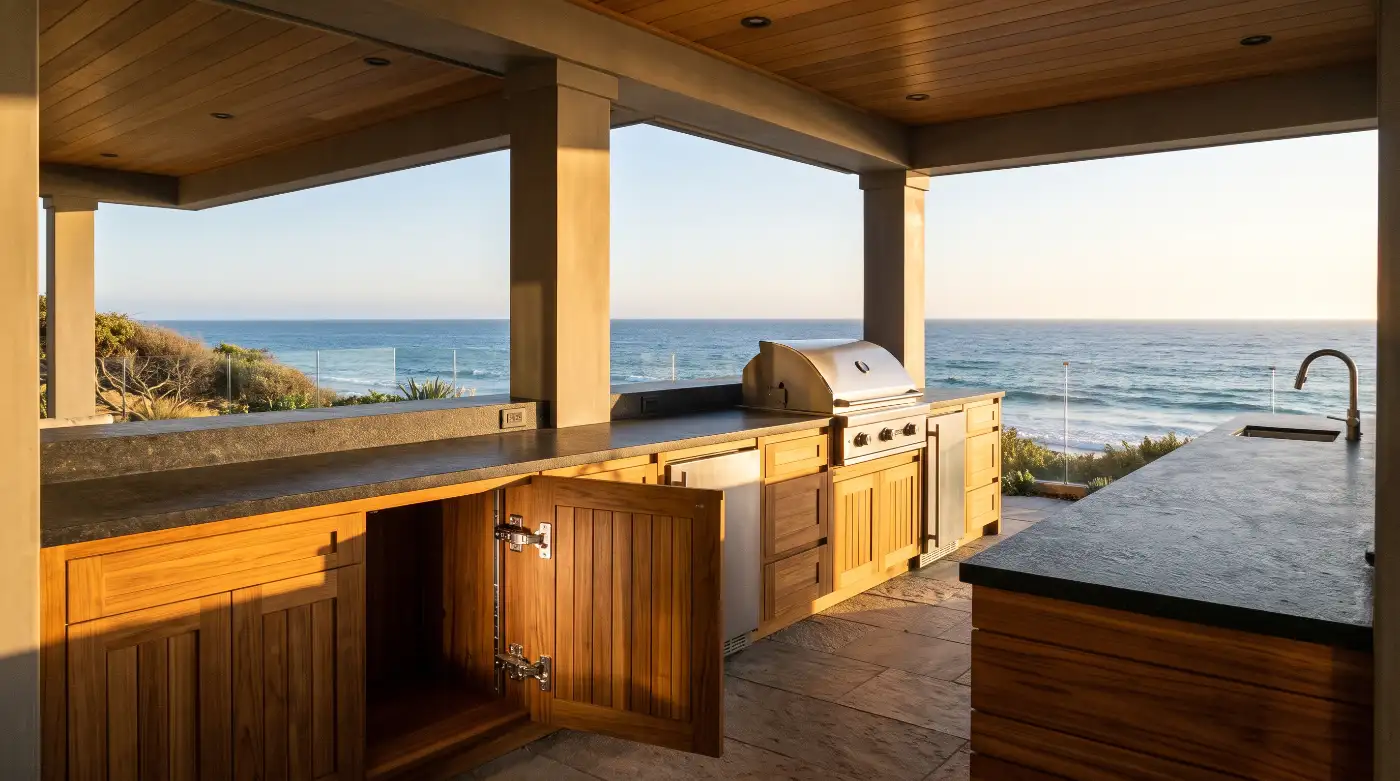
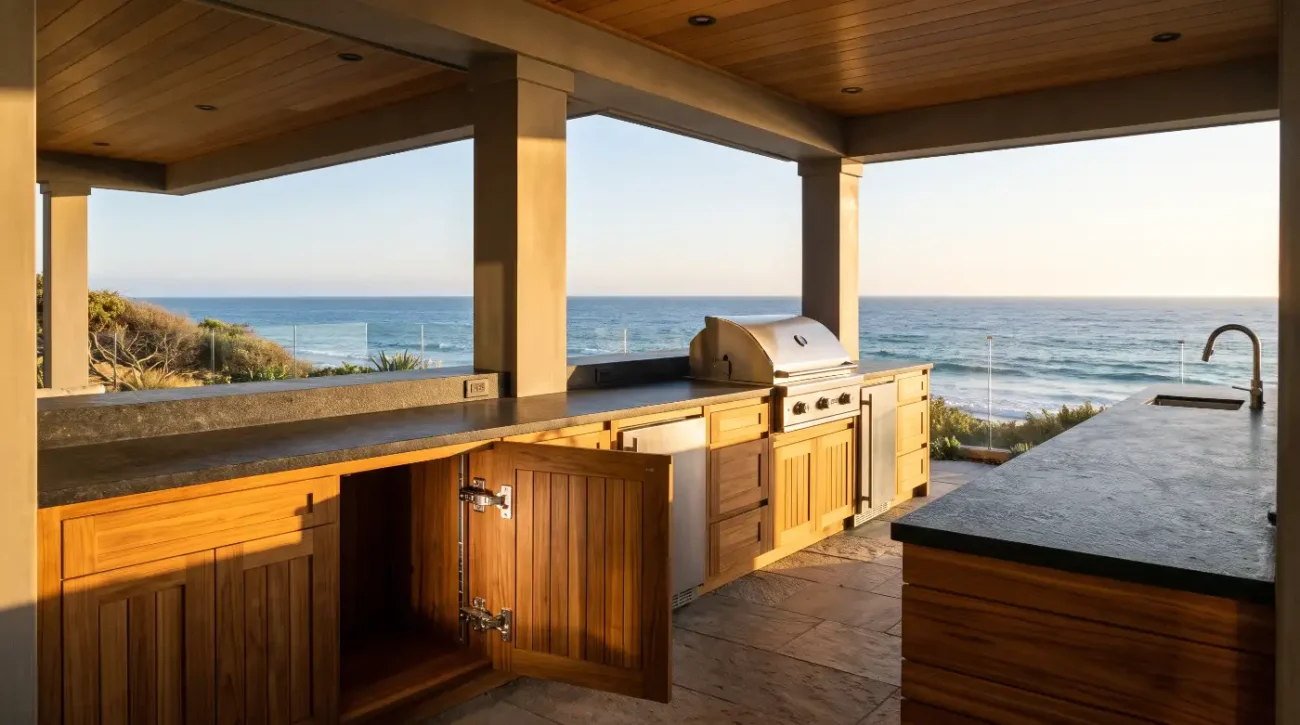
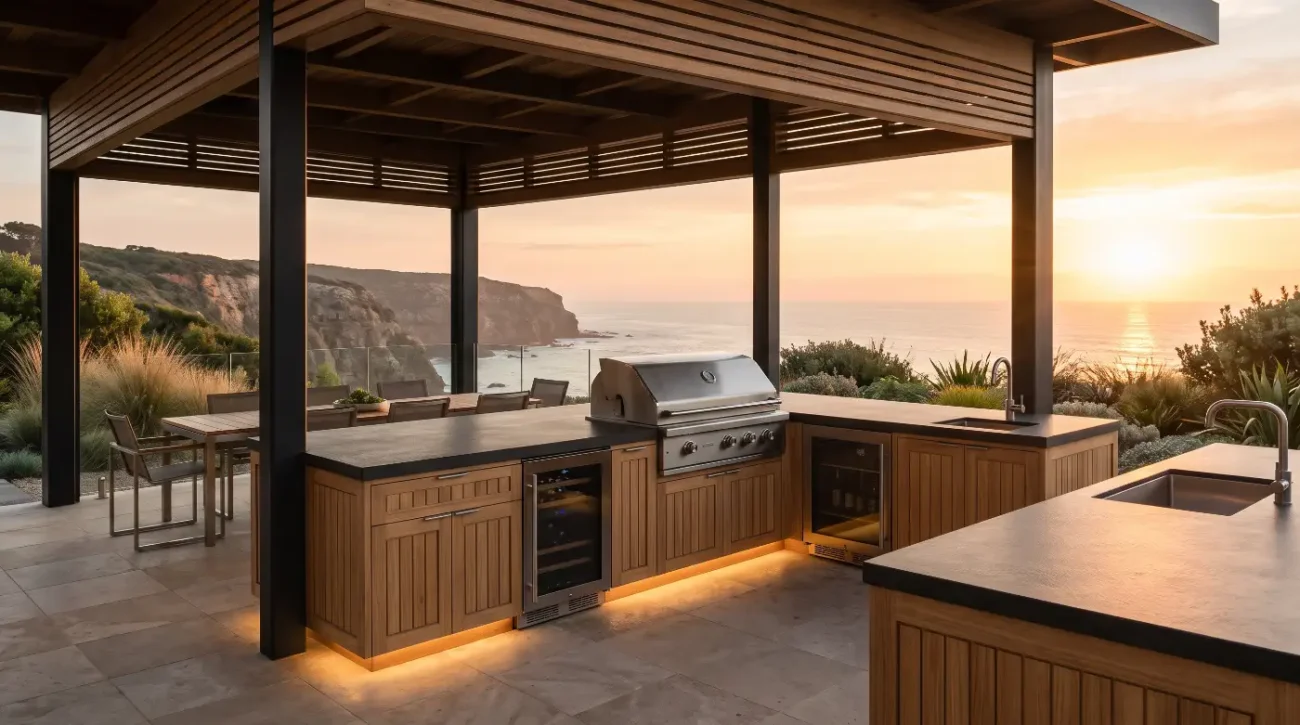
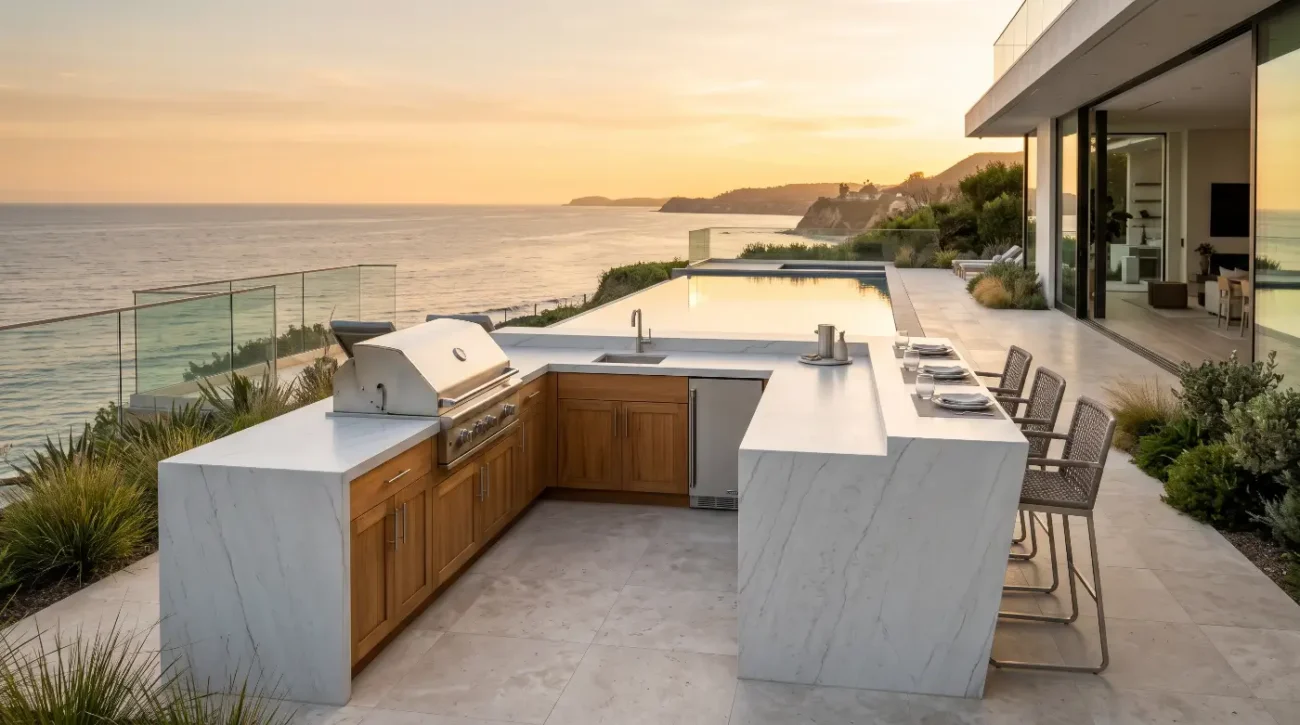
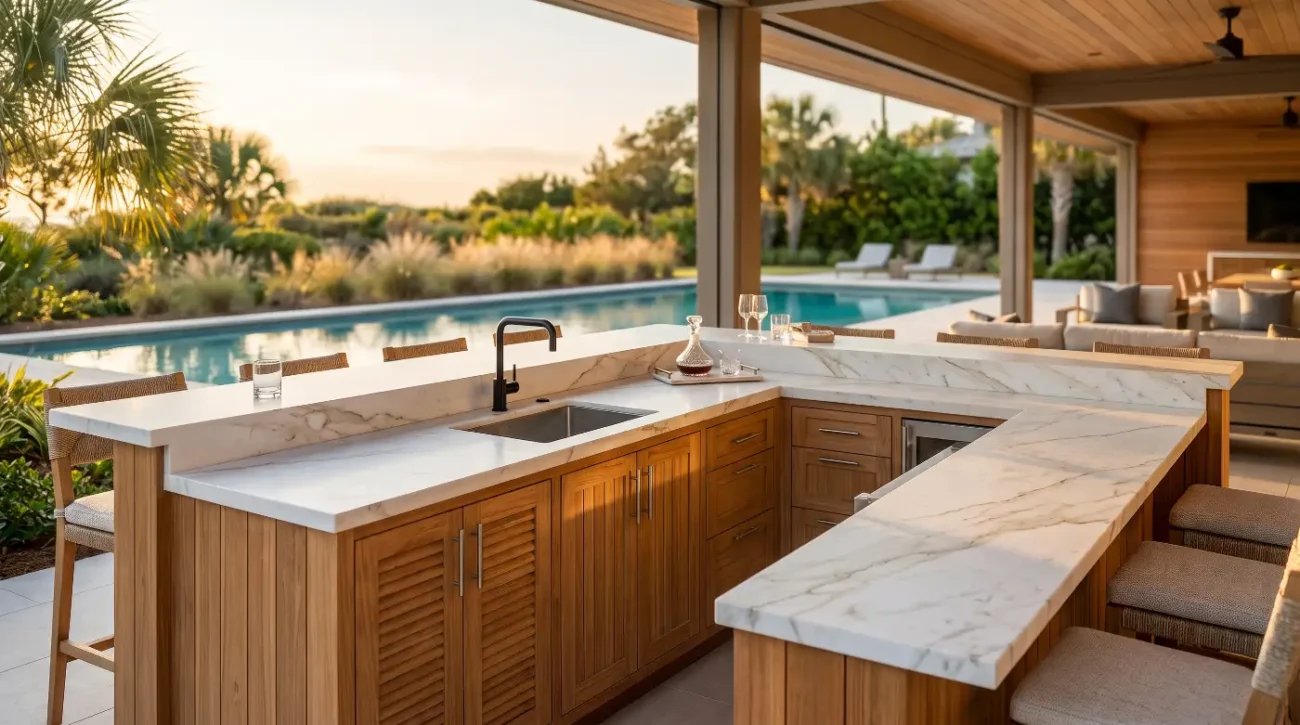
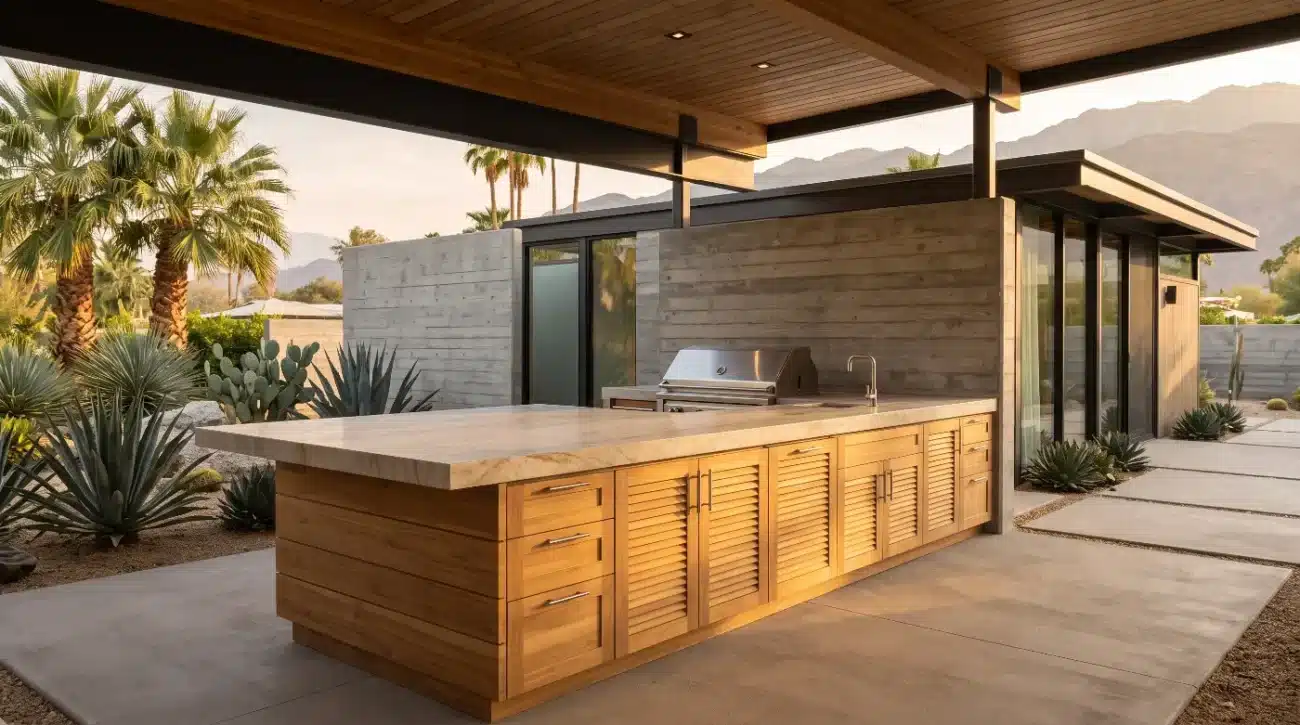
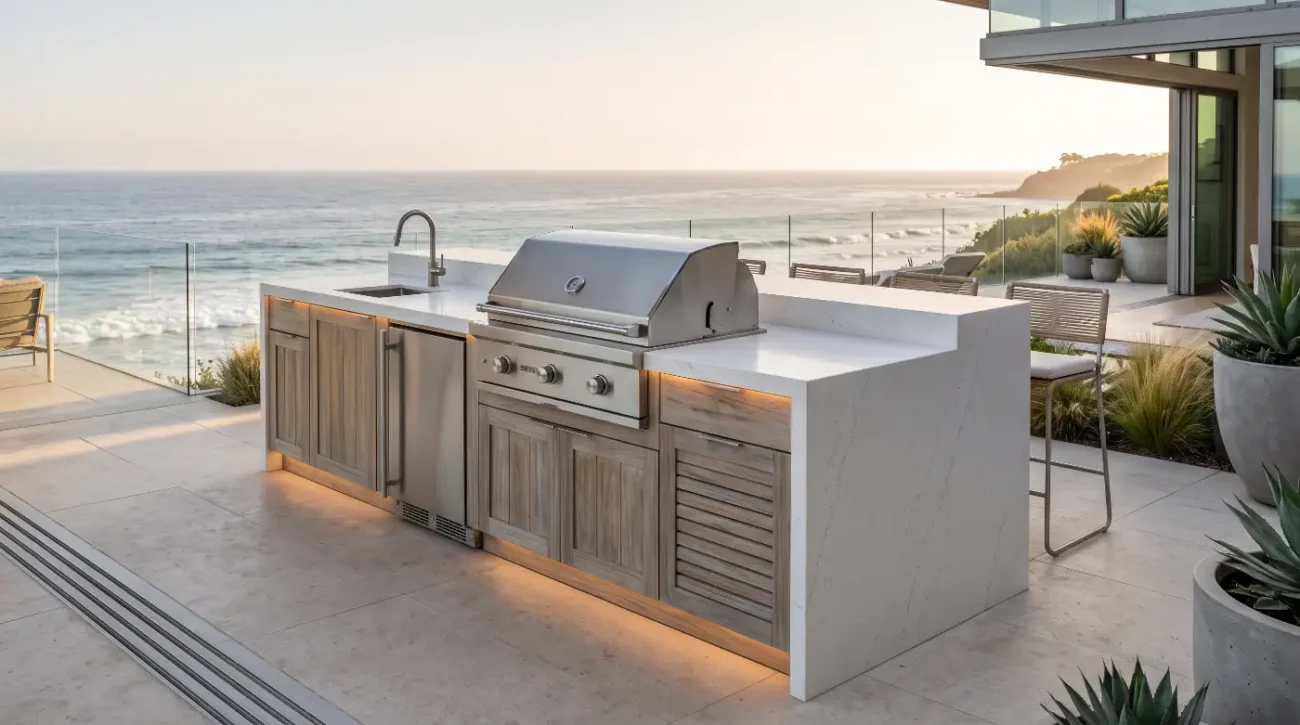
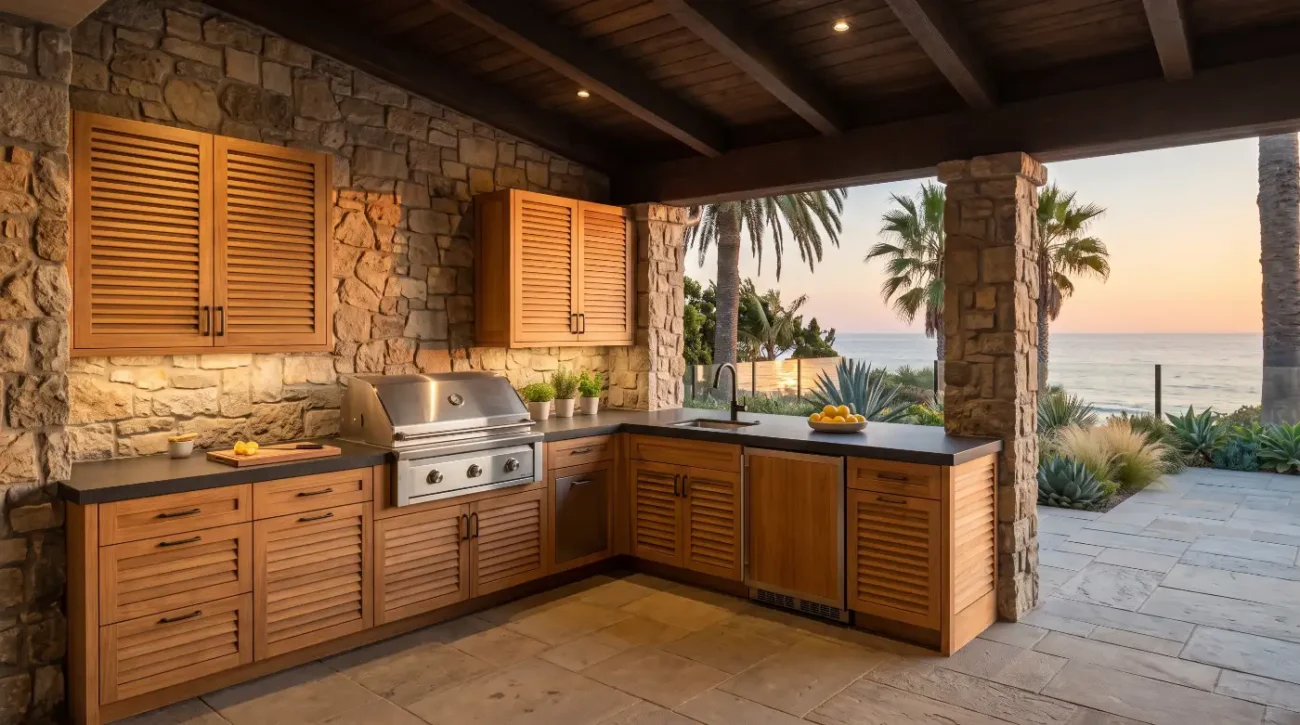
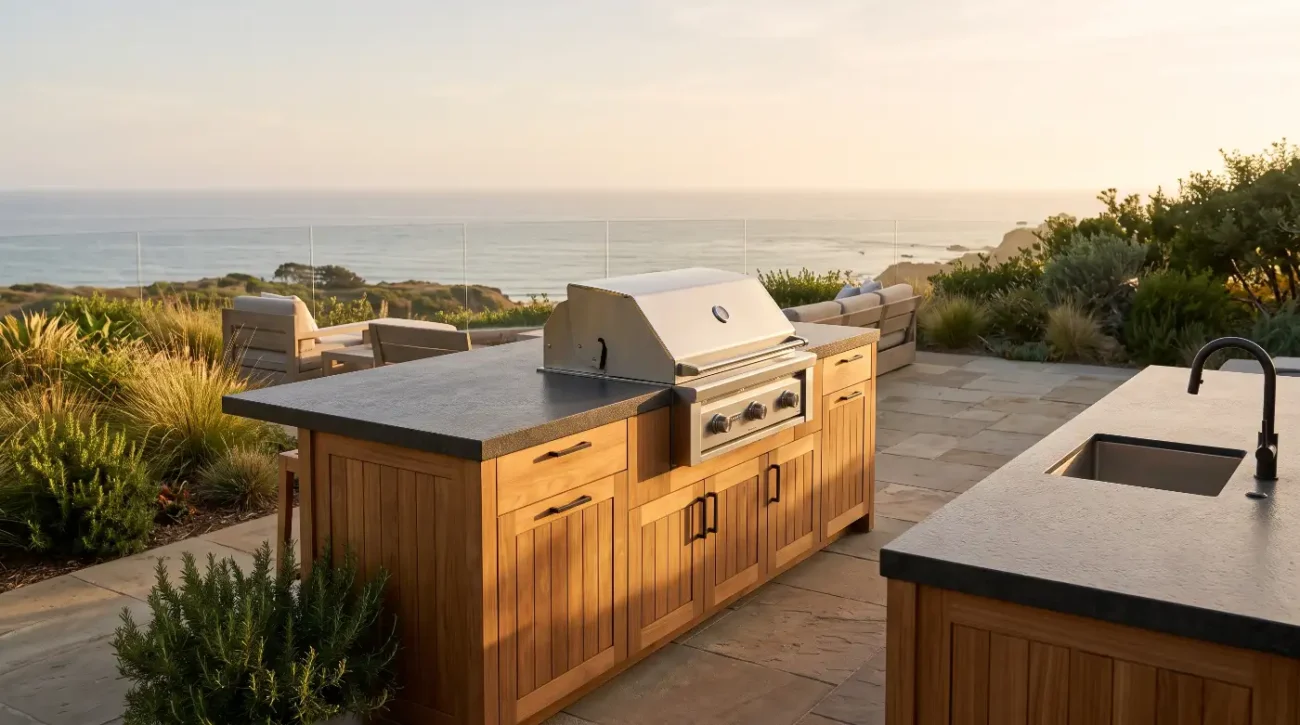
A multi-million-dollar waterfront residence perched above the crashing surf of Malibu or Newport Beach represents the pinnacle of residential design. The exterior space often features sweeping stone countertops, integrated gas grills, and premium outdoor kitchen joinery. Yet, within eighteen months of handover, an unexpected failure frequently compromises the entire installation.
The solid wood casework remains structurally pristine, but the cabinet doors begin to sag, bind, and squeak. Reddish-brown stains bleed across the golden grain beneath the hinge cups, weeping down the finished face frames.
The culprit is almost never the wood. The failure stems from an overlooked detail buried within the specification sheet:the metallurgical grade of the mechanical hardware.
Specifying standard commercial hardware in proximity to saltwater environments is a guaranteed path to component failure. When moisture, ambient sea salt, and thermal cycles converge, inadequate metals oxidize rapidly.
To bridge the gap between architectural vision and generational permanence, designers must understand the physical and chemical symbiosis between exterior millwork and marine-grade mechanical components.
-
Fast Track Summary: Standard exterior hardware fails in marine zones because chloride ions penetrate the chromium oxide barrier of conventional alloys.
-
Fast Track Summary: Grade 316 stainless steel integrates molybdenum to prevent localized pitting and aesthetic tea-staining.
-
Fast Track Summary: Solid teak cabinetry demands high-load mechanical hardware capable of supporting dense timber doors without binding.
-
Fast Track Summary: Rigorous specification workflows protect design reputations, eliminate costly warranty callbacks, and preserve architectural beauty.
How Marine Chloride Exposure Destroys Standard Cabinet Hardware Near Coastal Environments
Type 304 stainless steel fails rapidly in coastal environments because airborne chloride ions breach its passive surface film, causing localized pitting, crevice corrosion, and mechanical seizure. Specifying 316 marine-grade hinges for teak cabinetry halts this degradation because the addition of two to three percent molybdenum creates a self-healing barrier against saltwater attack, preserving structural alignment and aesthetic excellence over decades of shoreline exposure.
To understand why ordinary exterior hardware breaks down, specifiers must evaluate the micro-environment of an outdoor kitchen island. Salt spray does not simply wash over a cabinet door; it atomizes into airborne marine aerosols that travel miles inland.
These microscopic salt particles settle deep into the mechanical joints, mortises, and concealed hinge cups of exterior millwork. In coastal California, South Florida, and the Hamptons, ambient relative humidity routinely exceeds seventy percent.
When humidity rises and falls, salt deposits cycle between liquid brine and crystalline states. This cyclic wetting and drying concentrates chlorides within the micro-crevices of hinge pivot pins, internal dampening cylinders, and mounting plates.
The Metallurgy of Stainless Steel: Grade 304 Versus Grade 316
Stainless steel derives its corrosion resistance from chromium. When raw steel contains at least ten and a half percent chromium, exposure to oxygen forms an invisible, self-healing chromium oxide film across the surface.
In standard Grade 304 stainless steel, this protective layer consists of approximately eighteen percent chromium and eight percent nickel. This composition performs admirably in sheltered inland environments such as Austin or suburban Dallas.
Place that same alloy within five miles of an ocean, and the environmental chemistry changes drastically. Chloride ions are exceptionally small and chemically aggressive.
They actively penetrate micro-fissures in the chromium oxide layer of 304 steel. Once past the surface barrier, chlorides react with iron molecules to initiate rapid oxidation, known universally in maritime trades as tea-staining.
-
Pitting Corrosion Dynamics: Chloride ions concentrate in microscopic surface defects, boring deep structural cavities into hinge knuckles and mounting plates while leaving the surrounding surface deceptively intact.
-
Crevice Corrosion Traps: The narrow spaces between hinge plates, wood screws, and cabinet carcasses restrict fresh oxygen flow, preventing the passive oxide layer from regenerating.
-
Galvanic Oxidation Vectors: Fastening lower-grade steel screws into distinct metallic plates accelerates electron transfer, causing rapid degradation of the softest metal alloy.
-
Mechanical Stress Cracking: Residual internal stresses from stamped metal fabrication combine with persistent salt exposure, causing hinge arms to fracture under everyday door-swing loads.
Grade 316 stainless steel resolves this chemical vulnerability through the deliberate addition of two to three percent molybdenum. Molybdenum fundamentally alters the microscopic stability of the passive film.
It increases resistance to chloride pitting by a factor of more than two, which material engineers quantify via the Pitting Resistance Equivalent Number. While 304 stainless steel possesses an average rating of nineteen, true 316 marine-grade alloys achieve a rating between twenty-three and twenty-five.
This metallurgical distinction ensures that 316 marine grade hinges teak cabinetry maintain their structural integrity and mirror-clean aesthetic, even when subjected to relentless offshore winds.
Counterintuitive Sealing Mistakes and Chemical Interactions
A frequent misstep among landscape contractors and residential builders involves applying topical spray lubricants,protective lacquers, or automotive wax coatings over standard 304 hinges in an attempt to winterize coastal installations.
Film-forming surface sealers inevitably crack under the rotational shear stress of working hinges. Once moisture penetrates these hairline fractures, the coating acts as a moisture trap, entirely starving the underlying stainless steel of ambient atmospheric oxygen.
Without oxygen, the passive chromium oxide film cannot chemically regenerate, accelerating catastrophic crevice corrosion out of sight.
A parallel error occurs when millworkers fail to separate the wood chemistry of teak from the metal hardware.Premium Grade-A plantation teak, botanically classified as Tectona grandis, possesses an extraordinary volume of natural silica, rubber polymers, and protective organic oils.
According to technical research published by the USDA Forest Products Laboratory, teak exhibits natural resistance to rot, fungal decay, and water absorption due to its dense cellular structure and closed-grain resin deposits.
However, when lower-grade metals corrode against teak, weeping iron oxide reacts directly with the wood’s natural tannins and organic moisture, leaving dark chemical stains that permanently discolor the timber grain.
Engineers and builders can review baseline guidelines via American Society of Landscape Architects resources to align their exterior living spaces with institutional hardscape standards.
Engineering Custom Solid Teak Millwork for Heavy Structural Loads and Coastal Longevity
Custom solid teak outdoor cabinetry demands high-tensile 316 marine-grade hardware to counteract significant dead-load forces from natural stone countertops, seasonal wood movement, and constant environmental stress. By integrating precision mortise-and-tenon casework joinery with marine-grade concealed hinges, architects achieve precise reveal lines, smooth self-closing articulation, and lifetime resistance to mechanical sagging.
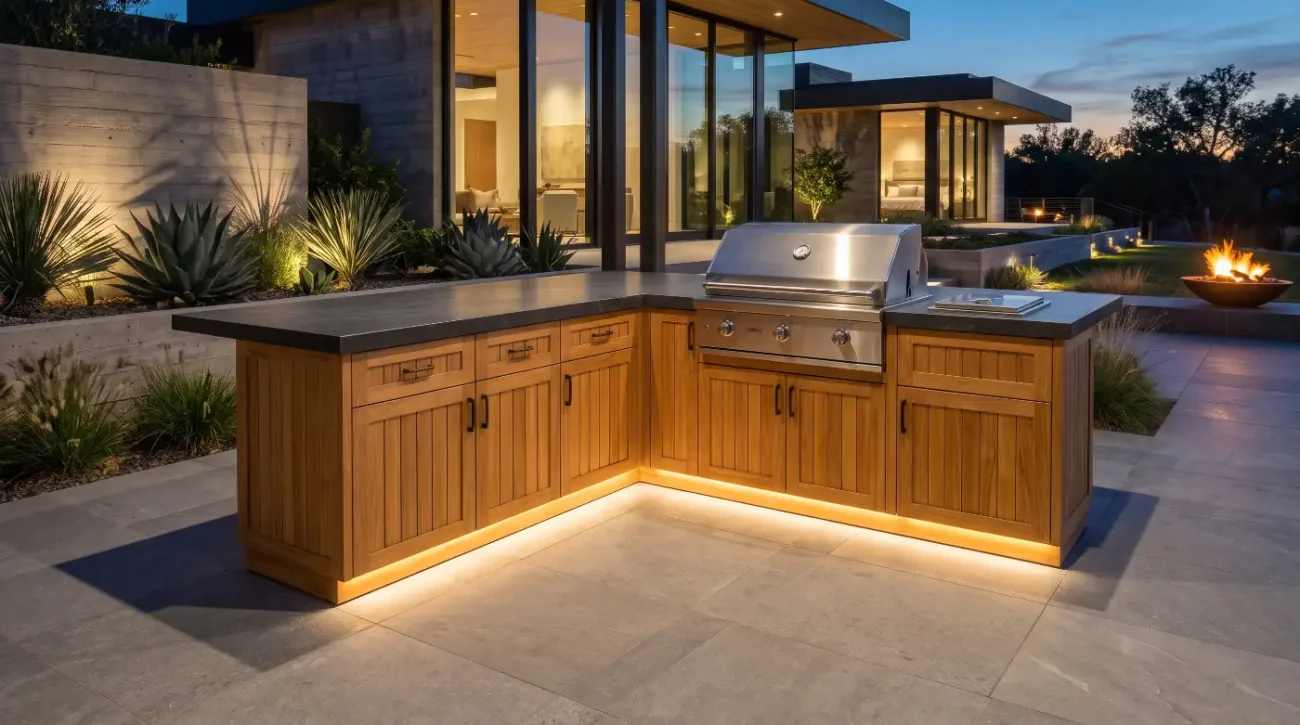
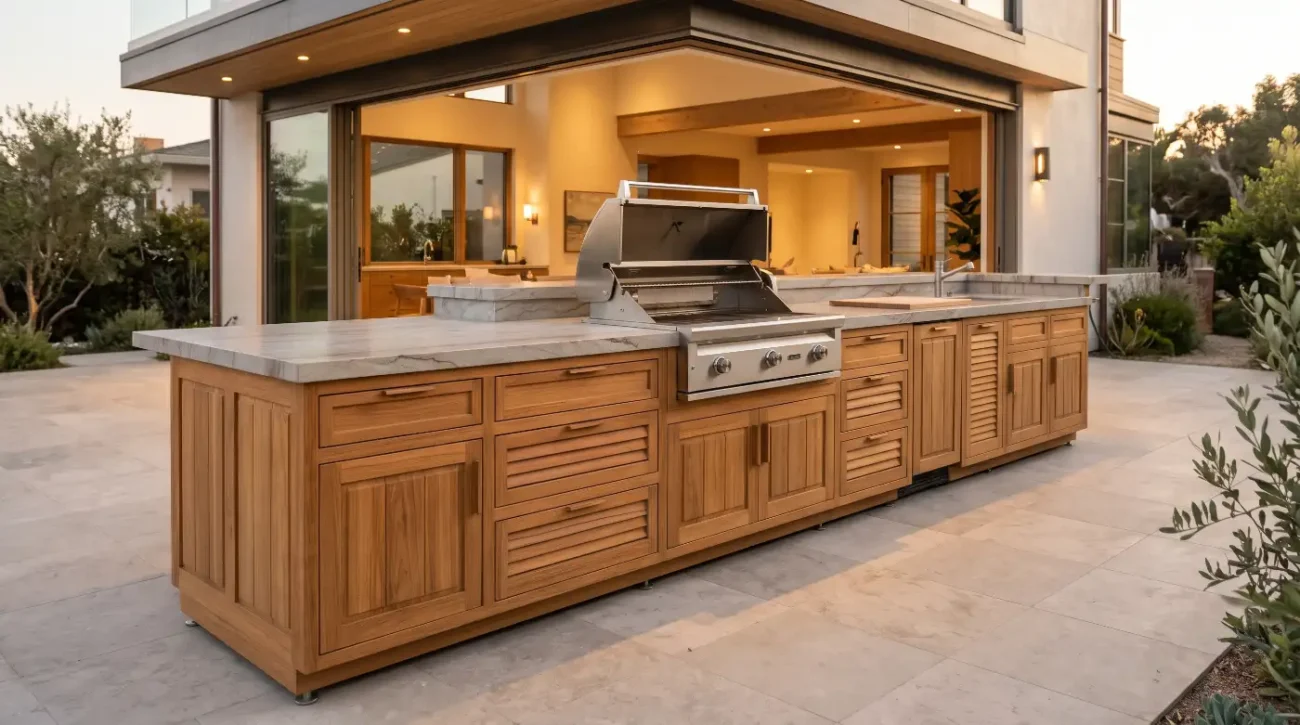
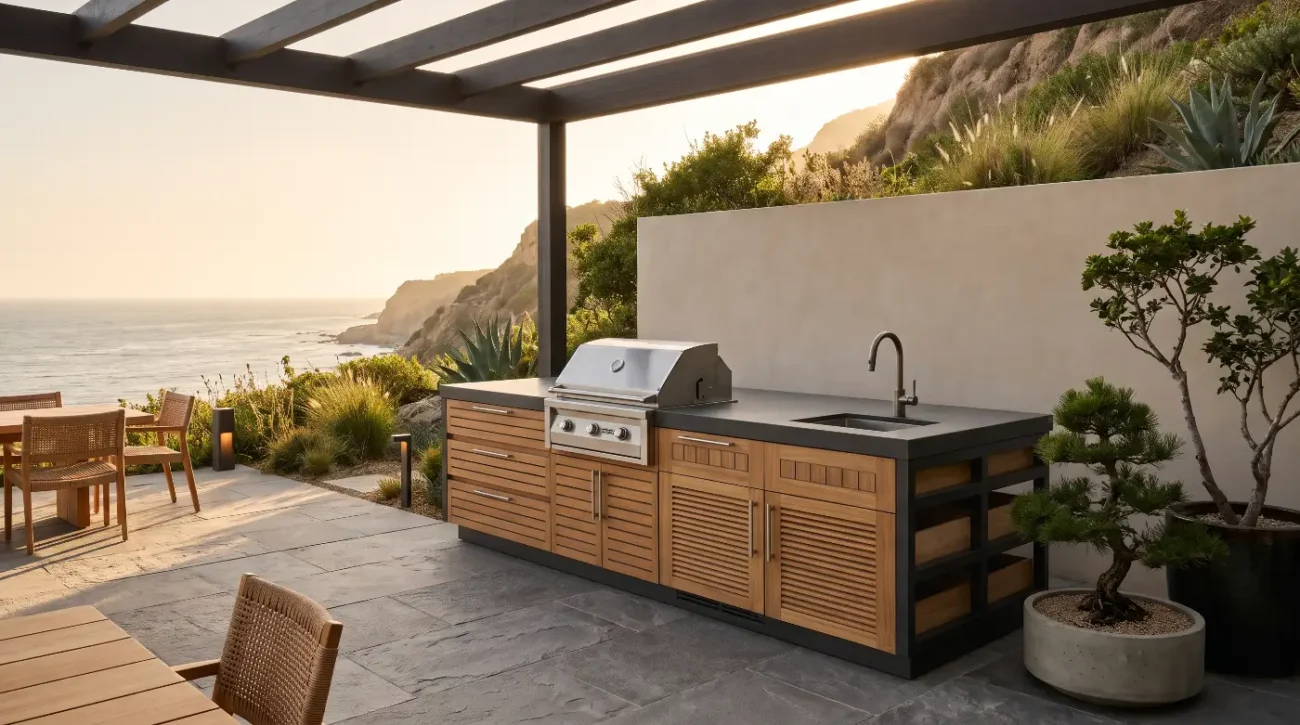
The design philosophy behind luxury exterior kitchens has evolved from rudimentary masonry blocks covered in stone veneer to bespoke, freestanding architectural millwork. Discerning homeowners demand seamless indoor-outdoor continuity.
They expect the exterior cooking suite to reflect the refined tolerances, soft-close sensory feedback, and concealed utility of an ultra-luxury interior kitchen.
Achieving this aesthetic standard requires master-level joinery. Solid teak expands and contracts across its tangential and radial grain dimensions in response to fluctuating atmospheric humidity.
While teak displays exceptional dimensional stability compared to domestic hardwoods like white oak or walnut,exterior millwork must be engineered to accommodate subtle micro-movements without pinching hinge pockets or throwing door reveals out of square.
Structural Joinery Meets Marine Mechanics
In the fabrication of our custom outdoor kitchen island suites, structural integrity begins with mortise-and-tenon construction. Mortise-and-tenon joinery mechanically locks solid teak rails and stiles together, transferring weight loads through the timber itself rather than relying on chemical adhesives or surface fasteners.
When heavy outdoor countertops—such as three-centimeter granite slabs, soapstone, or thick cast-concrete surfaces—are set atop exterior cabinets, the casework must carry substantial compressive loads without deflecting.
-
Heavy-Duty Base Support: Premium base cabinet collections are engineered with structural corner blocking and solid teak face-frames that distribute multi-hundred-pound stone loads evenly to the foundation.
-
Integrated Wall Stability: Cantilevered wall cabinet collections utilize marine-grade hanging cleat systems to resist pulling forces driven by coastal gust winds.
-
Island Insert Precision: Dedicated island inserts accommodate heavy drop-in warming drawers, refrigeration units, and custom storage partitions without racking.
-
Thermal Deflection Clearance: Engineered expansion reveals allow solid teak door panels to expand during humid summer months without binding against the cabinet frame.
When an outdoor cabinet door swings open, it generates rotational torque that concentrates entirely on the mounting plate screws and hinge arm. A solid teak slab door can weigh between fifteen and thirty-five pounds, depending on height, thickness, and profile.
If the hardware is cast from weak alloys or features lightweight stamped pins, the door will inevitably drop, scraping the bottom frame and ruining the visual alignment.
Grade 316 soft-close hinges employ forged alloy components, heavy-gauge steel arms, and precision hydraulic dampening cartridges filled with marine-grade synthetic fluids that do not degrade or leak under high summer temperatures.
Harmonizing Wood Patina with Marine Hardware Maintenance
One of the most compelling aesthetic qualities of genuine teak is its dynamic aging process. When left unfinished and exposed to direct sun and rain, ultraviolet rays break down surface cellulose, allowing the wood to transition into an iconic, silvery-grey patina.
This silvering is an organic shield; the dense interior wood remains thoroughly saturated with natural oils and silica,impervious to structural rot.
Alternatively, homeowners who prefer the vibrant, golden-brown warmth of newly milled teak can preserve that tone through regular maintenance.
Our comprehensive teak care and maintenance guide outlines the exact cleaning routines and specialized oiling procedures required to sustain golden hues without creating sticky surface buildup that attracts ocean dust.
Regardless of whether the client chooses a natural silver patina or an oiled golden finish, the hardware must remain visually and mechanically pristine.
Lower-grade hardware bleeds rust streaks that ruin the silvery patina, creating unsightly stains that are difficult to extract from the wood fibers without aggressive sanding.
Grade 316 stainless steel avoids this risk entirely. It requires only an occasional fresh-water rinse during seasonal patio washdowns to flush away accumulated salt crusts and maintain effortless motion.
Strategic Tradeoffs: Hardware Selection and Design Coordination
Specifying luxury exterior millwork requires balancing design ambition with practical site realities. Trade professionals routinely navigate complex structural trade-offs when selecting materials and hardware configurations:
-
Concealed Elegance Versus Pivot Simplicity: European-style concealed cup hinges provide sleek, uninterrupted visual lines across cabinet faces with three-way micro-adjustability, but they require precision CNC boring into the door stile that must be sealed against standing water. Exposed marine butt hinges offer traditional maritime character and straightforward installation, but sacrifice soft-close convenience and on-site door alignment flexibility.
-
Golden Finish Preservation Versus Weathered Patina: Maintaining a rich golden-brown luster requires bi-annual reapplication of breathable exterior wood oils, demanding committed site maintenance. Allowing teak to weather naturally to a silver-grey patina eliminates repetitive labor, yet requires designers to select hardware finishes and countertop stone tones that complement cooler, muted gray timber.
-
Soft-Close Damper Lifespan: Hydraulic soft-close cylinders provide an exquisite, tactile luxury experience, but they represent an active mechanical assembly. Specifying 316-encased internal dampeners guarantees that coastal salt humidity will not corrode the internal springs or crack the synthetic seals, ensuring long-term performance.
Streamlining the Architectural Specification Workflow
For exterior architects, interior designers, and general contractors, executing an outdoor kitchen project involves bridging high-level client expectations with technical site coordination.
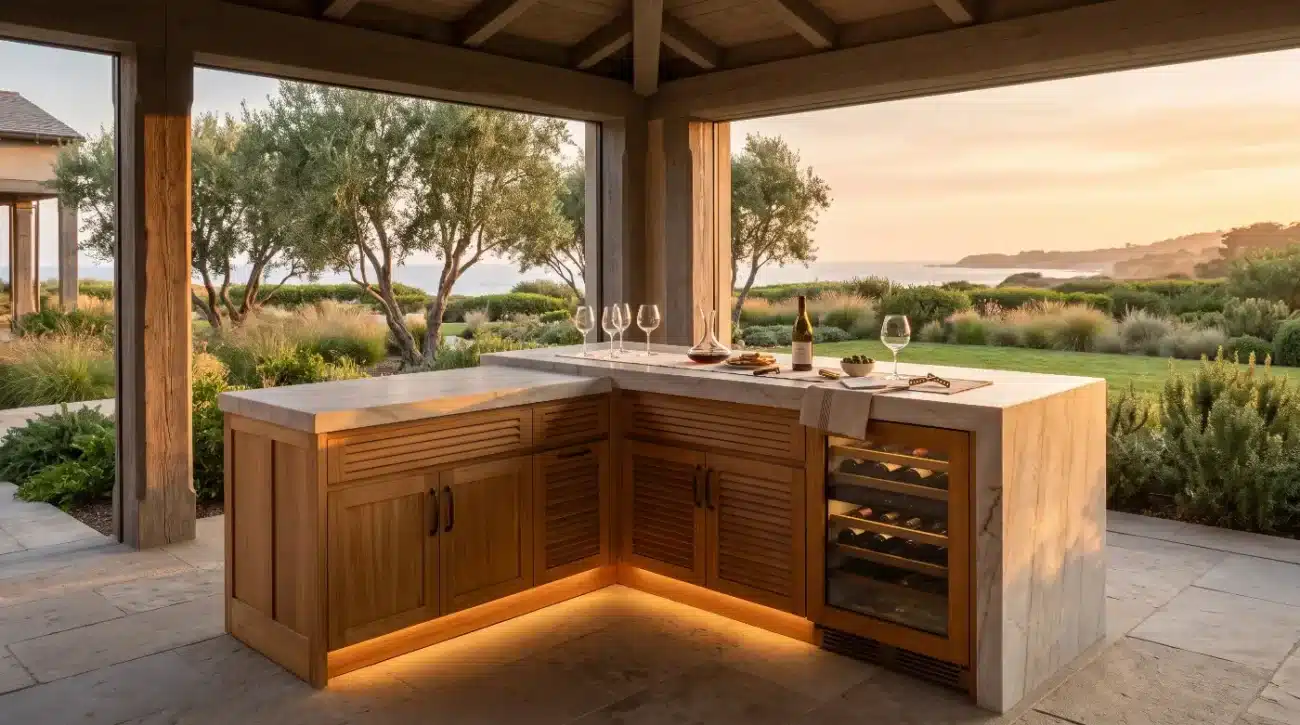
The client typically starts by curating mood boards filled with striking coastal outdoor pavilions.
When those concepts are handed to the design team, the conversation shifts to real-world technical requirements:appliance cutout clearances, gas line routing, electrical drops for refrigeration, and stone countertop support limits.
This is where custom millwork coordination becomes paramount. Specifiers must account for ventilation cutouts when installing high-BTU gas grills into solid wood casework.
Without proper rear venting and insulated heat jackets, trapped thermal energy can dry out wood joinery prematurely.
Furthermore, designers must request comprehensive CAD and BIM details to verify that hinge swing angles clear adjacent appliances, masonry returns, and plumbing lines.
By sourcing cabinetry from specialists who prioritize marine-grade engineering, design firms safeguard their professional reputations.
Pacific Teak Millworks engineers every casework module with structural integrity and material durability at the forefront. Every hinge mounting hole, drawer glide anchor, and structural rail is built to marine specifications.
This technical precision gives specifiers total peace of mind, backed by clear warranty documentation that stands firmly behind our materials and craftsmanship.
Key Takeaways:
-
Chloride Defense: Grade 316 stainless steel contains two to three percent molybdenum, providing vital chemical resistance against saltwater pitting and tea-staining that rapidly destroys standard 304 hardware.
-
Structural Stability: Solid teak casework paired with heavy-duty 316 mechanical hinges supports dense door panels and heavy natural stone countertops without sagging or binding over time.
-
Material Chemistry: High-silica, naturally oiled Grade-A teak resists weather and decay, but pairing it with substandard metal fasteners can cause severe chemical tannin staining.
-
Avoid Film Coatings: Topical sprays and lacquer coatings trap moisture and starve stainless steel of ambient oxygen, accelerating subsurface crevice corrosion.
-
Architectural Integration: Successful coastal installations rely on early trade coordination, precise CAD tolerances, proper grill ventilation, and rigorous marine hardware specifications.
Transform your coastal residential concepts into enduring architectural reality. Whether you are an architect detailing a waterfront loggia, a landscape designer curating an outdoor entertaining suite, or a homeowner seeking timeless custom millwork, Pacific Teak Millworks delivers unmatched craftsmanship and marine-grade longevity.
Contact our team directly to discuss custom project dimensions, request timber samples, or obtain CAD libraries for your next installation by connecting with our trade coordination specialists.