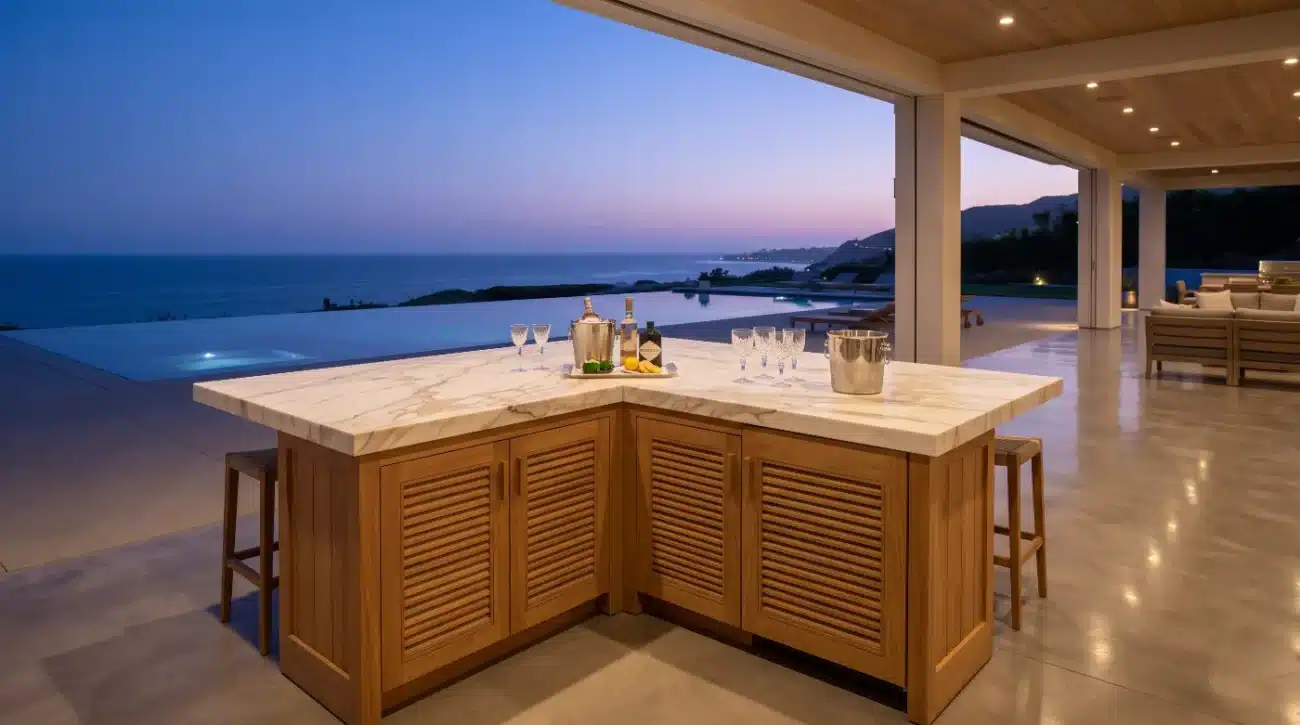
Executive Summary:
-
Unrivaled Material Science: Grade-A plantation teak contains dense natural rubber, silica, and protective oils that shield custom outdoor cabinetry from moisture absorption and salt air rot.
-
Architectural Engineering Integrity: Precision mortise-and-tenon joinery combined with marine-grade 316 stainless steel hardware ensures long-term structural load capacity under heavy stone countertops.
-
Patina Versatility: Property owners can maintain a vibrant golden-brown luster through periodic oil application or permit the timber to gracefully oxidize into a silver-grey architectural patina.
-
Trade Specifier Integration: Direct CAD/BIM compatibility, custom face-frame tailoring, and proper thermal ventilation protocols simplify luxury residential installations.
Why Grade-A Plantation Teak Is the Gold Standard for Marine and Architectural Millwork
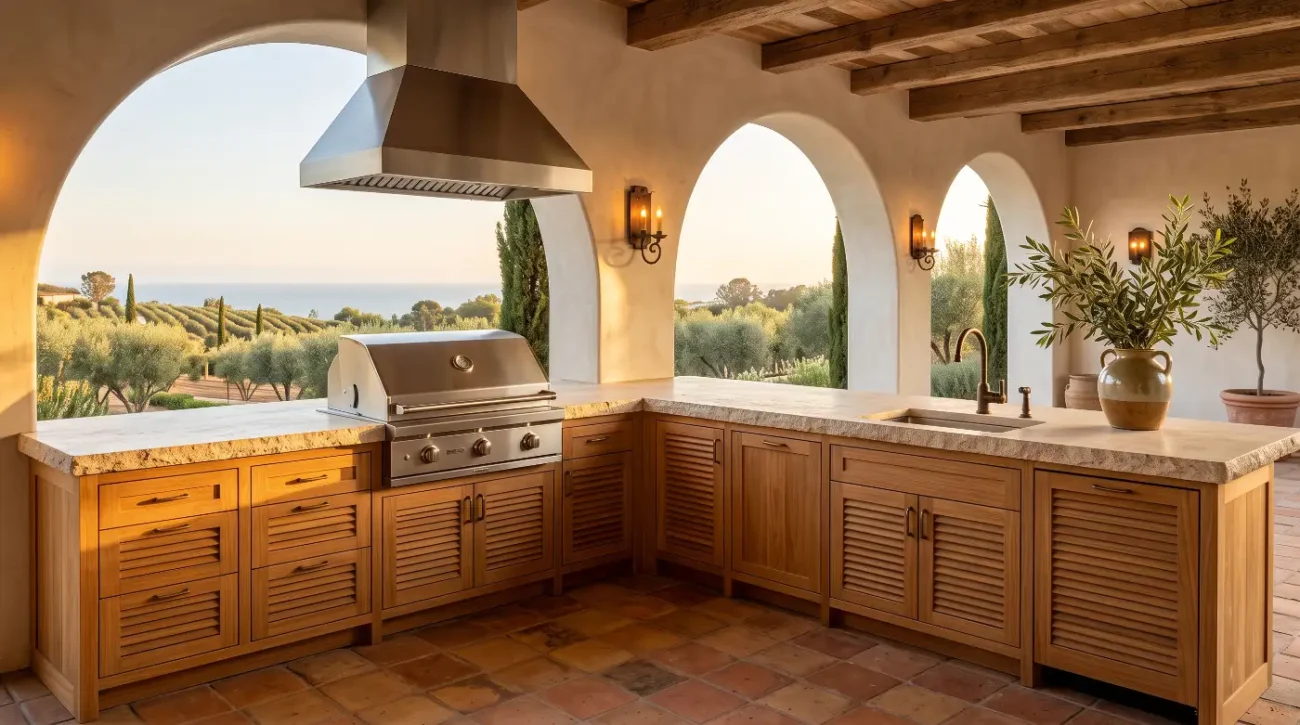
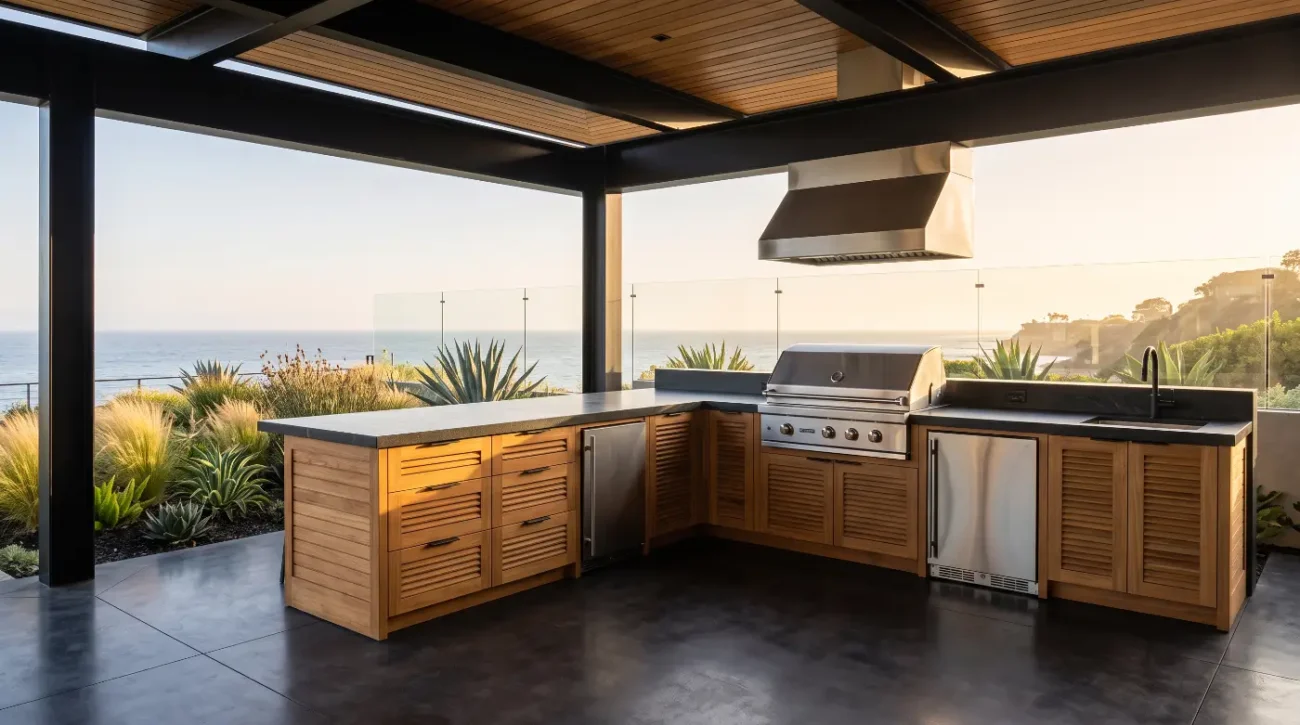
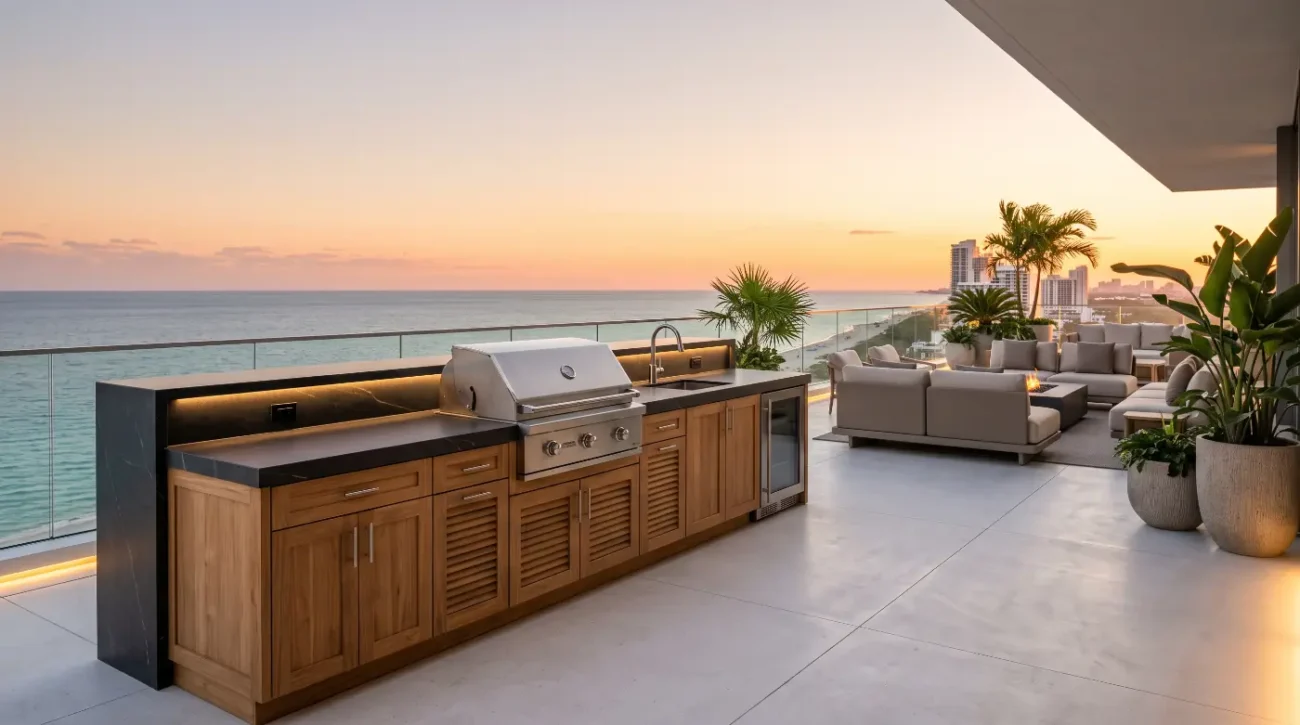
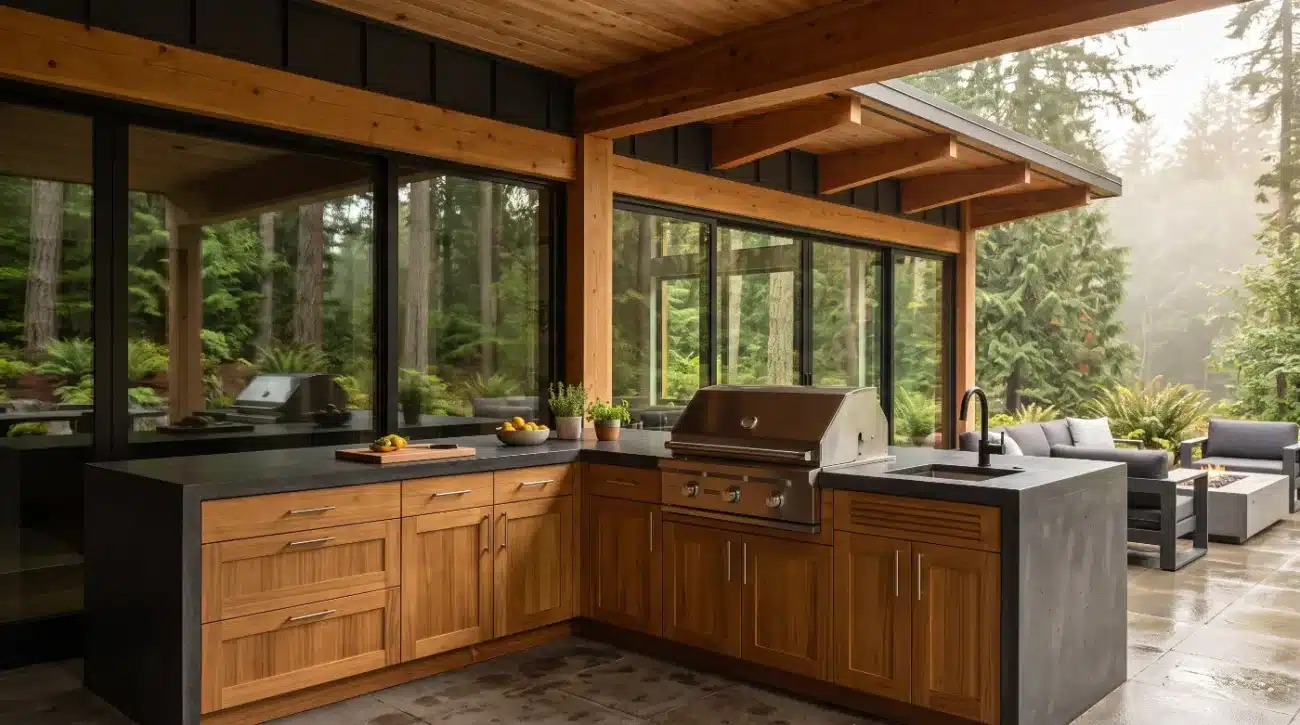
A high-net-worth homeowner in Malibu recently replaced a three-year-old outdoor kitchen after its luxury powder-coated aluminum cabinetry oxidized, pitted, and delaminated under continuous salt spray exposure. What was marketed as an impervious, maintenance-free solution rapidly failed because metal structures lack the natural expansion mechanics required to handle coastal thermal cycling. When the homeowner brought their revised architectural plans to their landscape architect, the conversation shifted from synthetic coatings to organic material science: Grade-A plantation teak (Tectona grandis).
An investment in exterior cabinetry requires an understanding of structural durability, timber anatomy, and microclimate performance. Synthetic composites, pressure-treated softwoods, and metal enclosures frequently fail to endure intense UV exposure, freezing dampness, or coastal humidity. Grade-A teak remains the premier choice for architects, luxury builders, and discerning homeowners seeking timeless elegance and structural reliability.
-
Superior Timber Selection: Sourced strictly from the heartwood of mature trees, Grade-A teak delivers maximum oil density and structural stability.
-
Proven Marine Performance: Decades of maritime usage confirm that natural rubber resins resist water penetration, swelling, and fungal decay.
-
Precision Architectural Joinery: Traditional mortise-and-tenon construction accommodates micro-movements caused by ambient humidity shifts without compromising load capacity.
-
Elevated Aesthetics: The wood transitions seamlessly between warm golden-brown tones and a distinguished silver-grey weathered patina.
How Grade-A Teak Natural Oils Prevent Saltwater Delamination and Moisture Rot
Grade-A teak prevents water intrusion and chemical decay because its dense heartwood contains high concentrations of natural tectoquinones, silica, and rubber resins that create an internal hydrophobic barrier.
The biological structural breakdown of Tectona grandis timber progresses from the vulnerable outer sapwood down to the dense inner heartwood core:
-
Outer Sapwood Layer: The living, outer boundary of the tree consists of young cells with high moisture content, low structural density, and negligible natural protective oils. This layer is classified commercially as Grade-B or Grade-C material and remains highly vulnerable to fungal rot, insect intrusion, and rapid dimensional warping.
-
Inner Heartwood Core: Sourced from mature trees grown for several decades, the heartwood core contains concentrated natural oils, tectoquinones, and embedded silica particles. The maximum grain density found in this core forms the foundation of true Grade-A teak, supplying unmatched resistance against decay and moisture absorption.
Understanding the distinction between teak grades requires examining the cross-section of a mature Tectona grandislog. Sapwood contains high moisture levels, lower density, and negligible natural oils. While inexpensive, sapwood rapidly absorbs moisture, cracks under thermal strain, and remains highly susceptible to fungal rot and insect infestation. Applying film-forming polyurethane sealers to low-grade teak often traps internal moisture, causing premature rot and peeling coatings within months.
Grade-A teak is extracted exclusively from the heartwood core of mature plantation trees, typically grown for 30 to 50 years. Research from the USDA Forest Products Laboratory confirms that heartwood exhibits significantly higher decay resistance and dimensional stability than sapwood due to organic extractives deposited during heartwood formation. The dense cellular structure of heartwood is saturated with natural oils and microscopic silica particles. These organic compounds act as internal water repellents, preventing moisture from entering cell walls and causing expansion, warping, or grain separation.
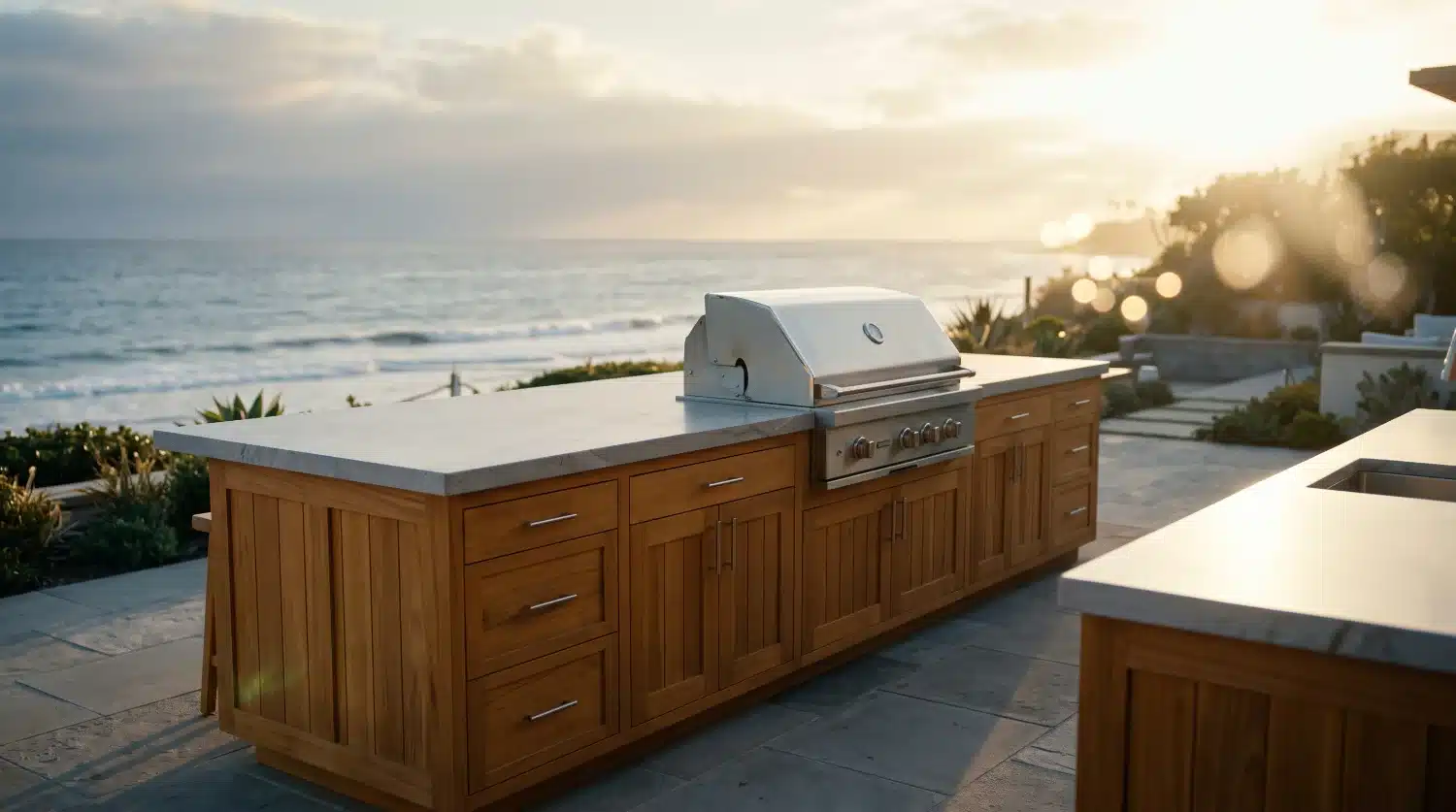
For coastal properties in Palm Springs, Miami, or Newport Beach, salt air creates an aggressive environment for exterior millwork. Microscopic salt crystals draw moisture out of conventional woods, causing deep cracks, while corroding metal components and degrading synthetic resins. The natural rubber content within Grade-A teak buffers the timber against salt-induced desiccation. Rainwater and ocean spray bead up on the wood surface rather than soaking into the interior grain.
-
High Tectoquinone Concentration: Serves as a natural preservative that deters wood-boring insects, termites, and fungal spores without chemical pressure treatments.
-
Integrated Silica Particles: Embedded within the cell walls, silica provides structural firmness and blunts mechanical wear from windblown sand and dust.
-
Natural Hydrophobic Oils: Retained deep within the tight grain, these internal oils lubricate wood fibers during temperature fluctuations, dramatically reducing checking and splitting.
-
Tight Grain Uniformity: High growth-ring density ensures that structural movement occurs uniformly across cabinet doors, drawers, and face-frames.
When selecting cabinetry for challenging outdoor settings, specifiers require material consistency. Exploring the Base Cabinets Collection illustrates how Grade-A heartwood delivers long-term durability across complex storage configurations.
Structural Engineering Practices for Heavy Stone Countertops and Outdoor Kitchen Appliances
Custom teak cabinetry supports heavy outdoor granite, quartzite, and concrete countertops through time-tested mortise-and-tenon joinery, custom face-frames, and integrated 316 marine-grade stainless steel hardware.
The structural load distribution framework in solid teak outdoor cabinetry operates through a continuous, rigid physical sequence:
-
Top Slab Dead Load: Heavy countertop materials such as quartzite, cast concrete, or granite exert concentrated downward vertical force upon the top framework.
-
Solid Teak Face-Frame and Stiles: The vertical wood stiles and solid face-frame capture the top load, preventing lateral bowing and maintaining square door openings.
-
Mortise-and-Tenon Interlocking Joints: Machine-milled mortise-and-tenon connections transfer tension and compression forces evenly across the cabinet box without relying on mechanical fasteners that can loosen over time.
-
Marine-Grade Hardware Integration: Corrosion-resistant 316 stainless steel hinges and drawer slides support internal dynamic loads while protecting the surrounding wood from chemical rust degradation.
-
Heavy-Duty Cabinet Leveling Legs: Integrated adjustable leveling assemblies distribute the entire cumulative weight safely down to the concrete or natural stone deck slab below.
Installing an outdoor kitchen involves balancing material weight, appliance heat, and structural loads. A standard four-foot run of 3-centimeter natural quartzite or cast concrete countertop can exert upwards of 400 pounds of dead weight onto underlying cabinetry. Modular, thin-walled aluminum or cabinet frames joined solely with mechanical pocket screws frequently sag under this weight, causing countertop seams to crack and cabinet doors to bind over time.
Solid teak construction handles heavy loads through traditional woodworking physics. Frame members are built with deep mortise-and-tenon joints secured by waterproof, structural polyurethane or resorcinol adhesives. This interlocking joinery transfers vertical weight down through solid timber stiles directly into heavy-duty leveling legs, preventing structural twisting or sagging. Custom face-frames reinforce the entire box construction, maintaining true square openings even under dynamic environmental loads.
Architectural integration also requires managing heat dissipation from high-Btu gas grills, smokers, and pizza ovens. Placing high-output cooking appliances directly against wood framing without heat shielding or proper ventilation creates a severe fire hazard and accelerates timber drying. High-end outdoor cabinetry incorporates generous cutout clearances, insulated stainless steel liner jackets, and rear ventilation channels. These features vent rising heat safely away from the wood structure, protecting both the cabinet box and internal gas lines.
Hardware selection is equally critical for structural integrity in oceanfront environments. Standard 304-grade stainless steel or zinc-plated hinges corrode when exposed to coastal air, eventually freezing up or staining the surrounding wood with rust streaks. Specifying 316 marine-grade stainless steel hardware—including soft-close hinges, full-extension drawer glides, and weather-sealed door gaskets—ensures smooth operation and prevents hardware failure.
-
Mortise-and-Tenon Interlocking Joinery: Provides optimal tensile and compressive strength, distributing countertop weight evenly across the entire frame.
-
316 Marine-Grade Stainless Steel Components: Contains added molybdenum to resist pitting corrosion caused by chlorides and ocean spray.
-
Thermal Expansion Gap Allowance: Engineered door panels and drawer fronts sit within frame channels, expanding and contracting safely during seasonal humidity changes.
-
Appliance Insulation Jackets: Stainless steel thermal barriers isolate high-temperature grills from solid wood walls, maintaining safe internal temperatures.
Architects and luxury builders working on precise kitchen layouts can review detailed hardware specifications and structural joinery guidelines in the Resource Center.
Maintaining Golden Luster Versus Embracing Architectural Patina
Property owners must choose between preserving the original golden-brown hue of Grade-A teak through routine oil applications or allowing the timber to naturally weather into a low-maintenance silver-grey patina.
The aesthetic lifecycle of exterior teak millwork offers two distinct architectural pathways depending on client preferences:
-
Freshly Milled Grade-A Teak: The original state of the wood features rich, warm golden-brown tones infused with deep natural oils and smooth natural grain highlights.
-
Preserved Golden Luster Pathway: Periodic light cleaning and application of specialized penetrating teak oils protect surface fibers from solar breakdown, maintaining the warm golden luster continuously over the life of the installation.
-
Natural Oxidation Silver-Grey Pathway: Exposing the bare timber to ultraviolet rays and moisture allows surface lignins to naturally dissipate, leaving pure cellulose fibers that form a soft, silver-grey architectural patina that requires virtually zero maintenance.
The decision to maintain golden teak or allow it to oxidize into a silvery-grey patina influences both aesthetics and long-term care routines. When left untreated outdoors, UV rays break down surface lignin molecules in the top layer of wood cells. As rain washes away these surface compounds, oxidized cellulose fibers remain, turning the timber a soft, refined silver-grey within 6 to 12 months.
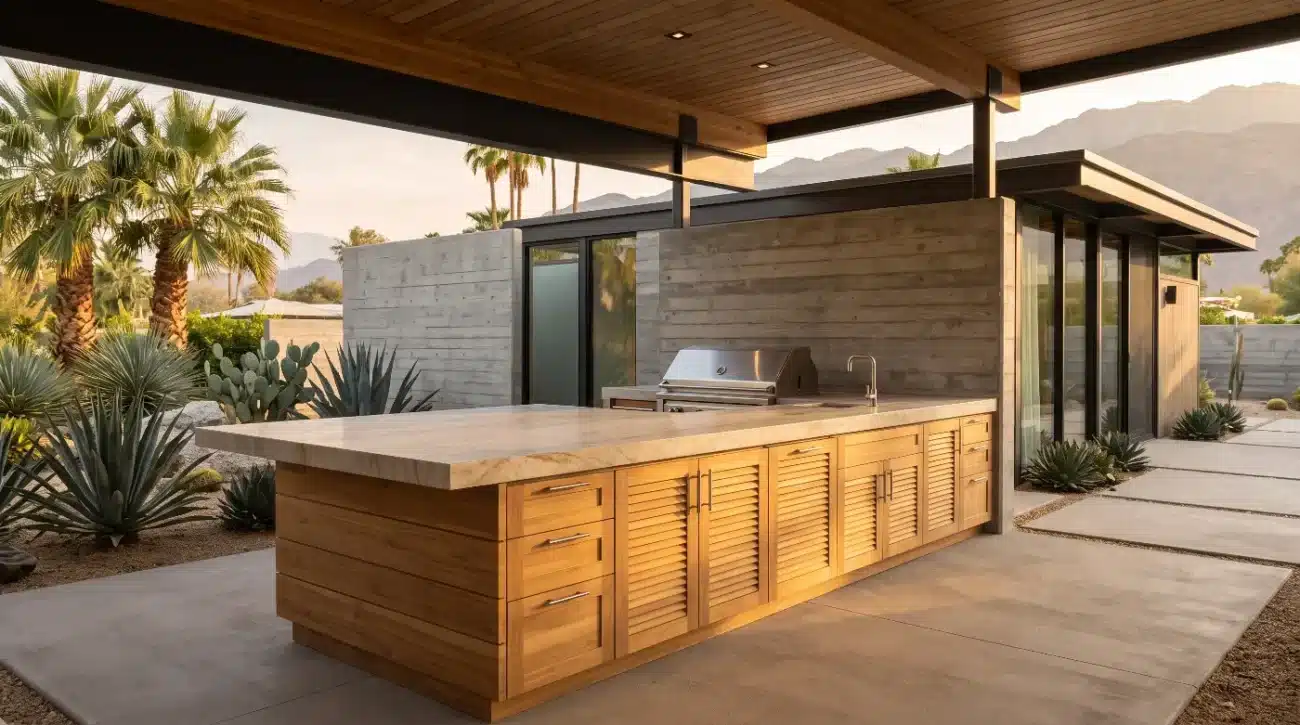
This weathering process is entirely cosmetic and does not compromise the wood’s structural strength or natural decay resistance. The inner grain retains its protective oil and silica matrix. Prominent landscape architects, such as members of the American Society of Landscape Architects (ASLA), frequently specify natural silver-grey teak to complement modern concrete, natural stone, and coastal plant palettes.
For homeowners who prefer the warm golden tones of newly milled teak, routine maintenance is required. Applying high-quality penetrating teak oils or specialized marine sealers replenishes surface oils stripped by sunlight. However, applying heavy varnish, polyurethane, or non-breathable clear coats should be strictly avoided. These surface-building films seal the wood’s exterior, trapping moisture beneath an impenetrable barrier. As the wood naturally moves with seasonal humidity, the film cracks, peels, and traps water, causing dark mildew spots and localized rot.
-
Golden Hue Preservation: Requires periodic light sanding and application of penetrating, non-film-forming teak oils every 6 to 12 months.
-
Natural Silver Patina: Requires minimal effort—simply wash the wood annually with mild soapy water and a soft-bristle brush to remove dirt and ambient pollen.
-
Patina Restoration: Weathered silver teak can easily be restored to its original golden-brown tone using a specialized two-part teak cleaner and light refinishing.
-
End-Grain Sealing: Protecting bottom cabinet edges with breathable marine sealers prevents moisture wicking from wet deck surfaces or stone patios.
Detailed care protocols, seasonal cleaning routines, and step-by-step restoration instructions are available in the downloadable Teak Care & Maintenance Guide (PDF).
Architectural Workflows and Specifier Protocols
Integrating custom teak millwork into luxury residential projects requires clear coordination between interior designers, landscape architects, and custom builders from early CAD planning through final installation.
Executing a successful outdoor millwork installation follows three sequential trade phases:
-
Design and CAD or BIM Specification Phase: The architectural team downloads exact 3D models and elevation files to map out utility rough-in locations, gas appliance clearances, and weight tolerances during initial spatial planning.
-
Sub-Contractor Coordination and Rough-In Phase: General contractors, plumbers, and electricians install utility conduits based on millimeter-accurate cabinet CAD files, preparing concrete pad footings and thermal insulation barriers before millwork arrives.
-
Site Acclimation, Installation, and Inspection Phase: Cabinet boxes arrive on site and acclimate to ambient outdoor humidity for 48 to 72 hours before fine installation, levelling, scribe fitting, and countertop placement take place.
Successful outdoor living spaces rely on seamless collaboration across trades. A common design challenge occurs when a homeowner falls in love with custom wooden cabinetry but presents the concept to their design team late in the construction process. Without pre-planned utility rough-ins, structural slab footings, and precise wall clearances, integrating custom cabinetry can cause costly delays.
Trade professionals require access to CAD/BIM block libraries, elevation drawings, and exact cutout tolerances during the schematic design phase. This ensures plumbing supply lines, electrical conduit, and gas hookups align perfectly within cabinet utility chases. When specifying elevated wall units, reviewing the Wall Cabinets Collection helps designers determine precise hanging heights, wall stud support structures, and integrated LED task lighting clearances.
Contractor scheduling must also account for site climate conditions during installation. Outdoor cabinetry should be unpacked and acclimated to local ambient humidity on site for 48 to 72 hours before final levelling and countertop placement. This allows the timber to adjust to atmospheric conditions, ensuring cabinet door margins and drawer reveals remain perfectly aligned.
-
CAD/BIM File Integration: Direct specifier access to detailed dimensional files eliminates field guesswork and prevents alignment conflicts with plumbing and electrical rough-ins.
-
Sub-Contractor Coordination: Clear communication between carpenters, masons, and plumbers ensures stone counter weights and gas line clearances meet design standards.
-
Custom Face-Frame Tailoring: Precision scribing capabilities allow cabinets to fit neatly against textured stone veneer, brick walls, or smooth stucco finishes.
-
Warranty and Protection Assurance: Specifying millwork backed by comprehensive coverage protects client investments against structural manufacturing defects.
Architects and trade professionals can review full coverage parameters, structural guarantees, and material compliance guidelines within the official Warranty Documentation (PDF).
Key Takeaways
-
Grade-A Heartwood Performance: Extracted exclusively from the inner core of mature Tectona grandis, Grade-A teak delivers high oil, rubber, and silica content for superior decay resistance.
-
Marine-Grade Hardware Standard: Using 316 stainless steel hinges and drawer glides prevents rust staining, binding, and structural failure in coastal environments.
-
Traditional Joinery Strength: Interlocking mortise-and-tenon construction supports heavy stone countertops without sagging or frame twisting over time.
-
Versatile Aesthetic Options: Property owners can maintain a vibrant golden-brown finish with regular oil application or allow the timber to weather into an elegant silver patina.
-
Trade-Focused CAD Integration: Early coordination using precise BIM blocks and utility specs ensures smooth installation across plumbing, electrical, and masonry trades.
Transform your luxury outdoor living project with custom solid teak millwork engineered for demanding marine environments. Whether you are a homeowner gathering architectural inspiration or a trade specifier preparing detailed CAD layouts, Pacific Teak Millworks offers expert guidance, material samples, and custom cabinetry solutions. Explore our product collections, request technical specifications, or schedule a design consultation today by visiting our Contact Us / Trade Inquiries page or calling Darin directly at (949) 365-6513.