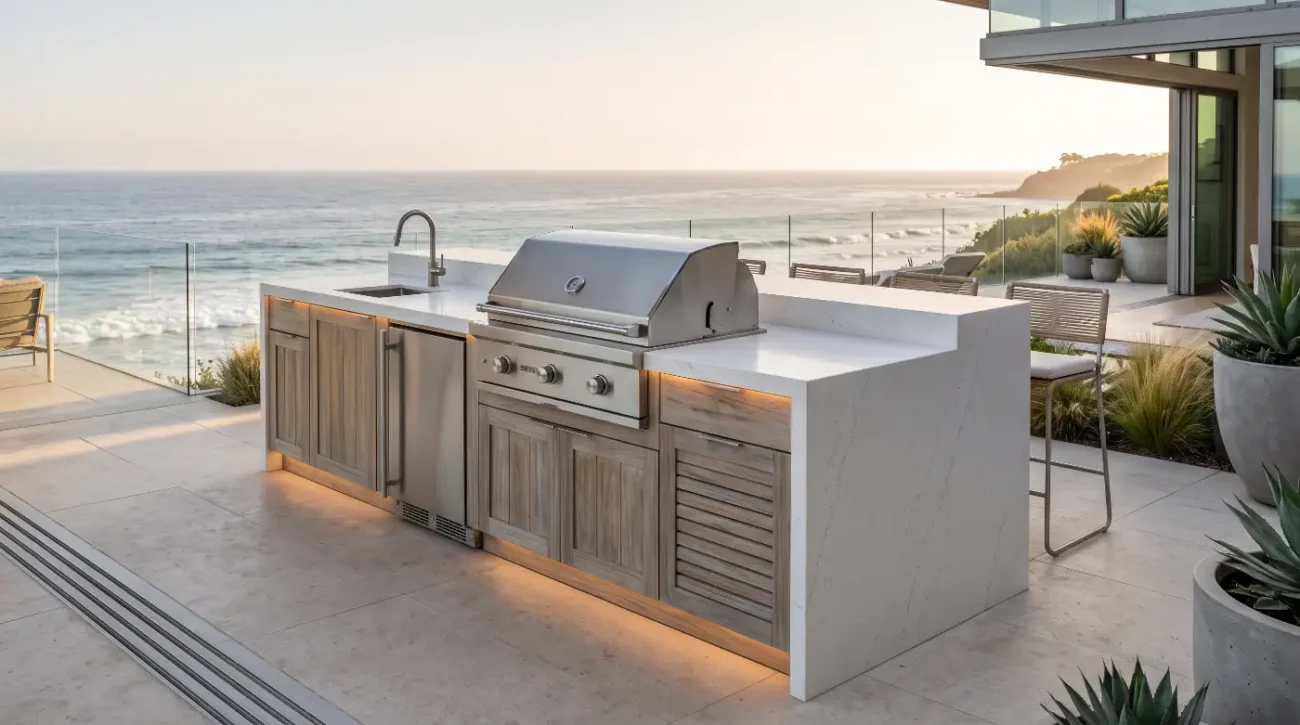
Executive Summary:
-
Unrivaled Dimensional Stability: Grade-A teak maintains the lowest volumetric shrinkage coefficient among luxury exterior woods, preventing joint failure and door misalignment.
-
Inherent Chemical Armor: Abundant natural rubber and high silica content create lifelong resistance against salt spray, marine delamination, and fungal rot without chemical treatment.
-
Trade Specification Precision: Mortise-and-tenon joinery paired with 316 marine-grade hardware supports heavy monolithic stone slabs while ensuring flawless indoor-outdoor transitions.
-
Lifecycle Value Performance: The predictable architectural aging from golden tones to a silvery patina protects property value while eliminating the high maintenance failure rate of alternative hardwoods.
Why Top Architectural Firms Consistently Specify Teak Over Other Hardwoods
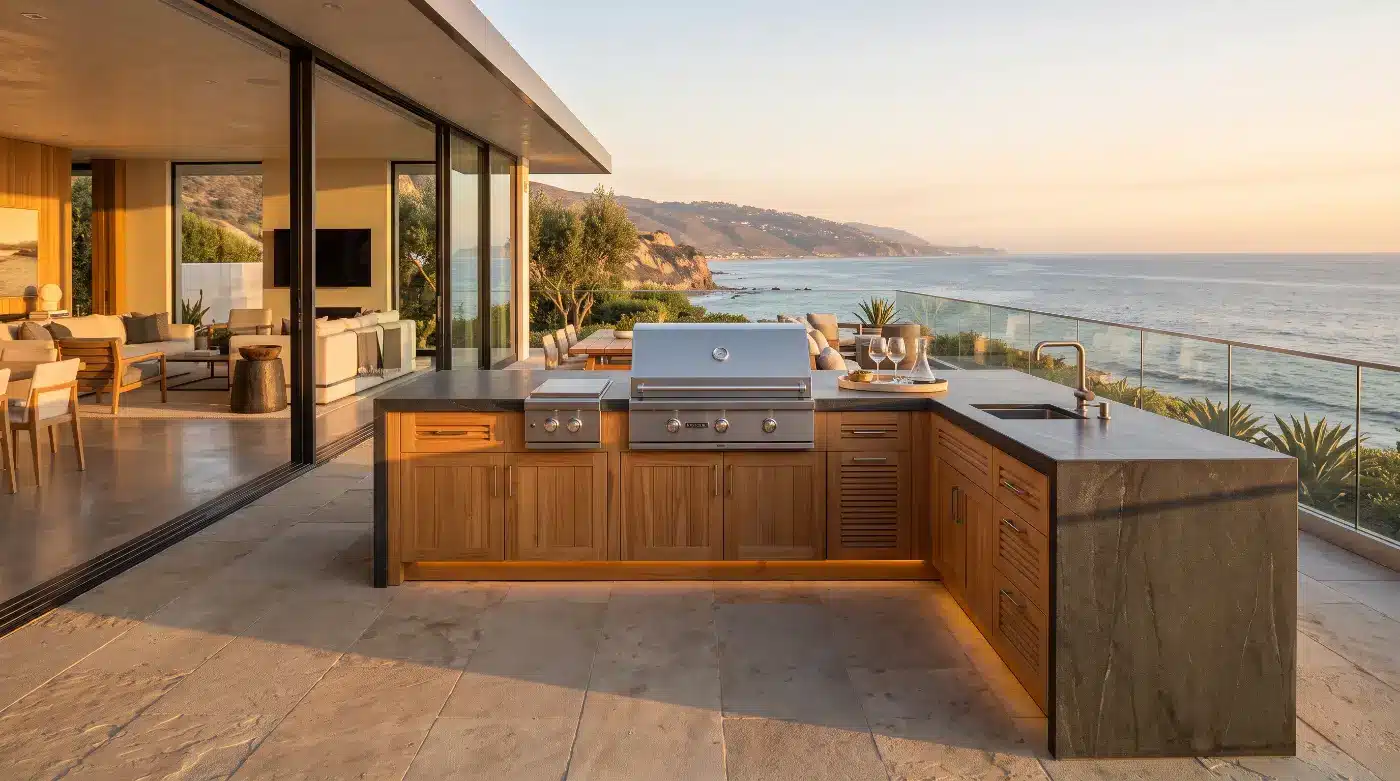
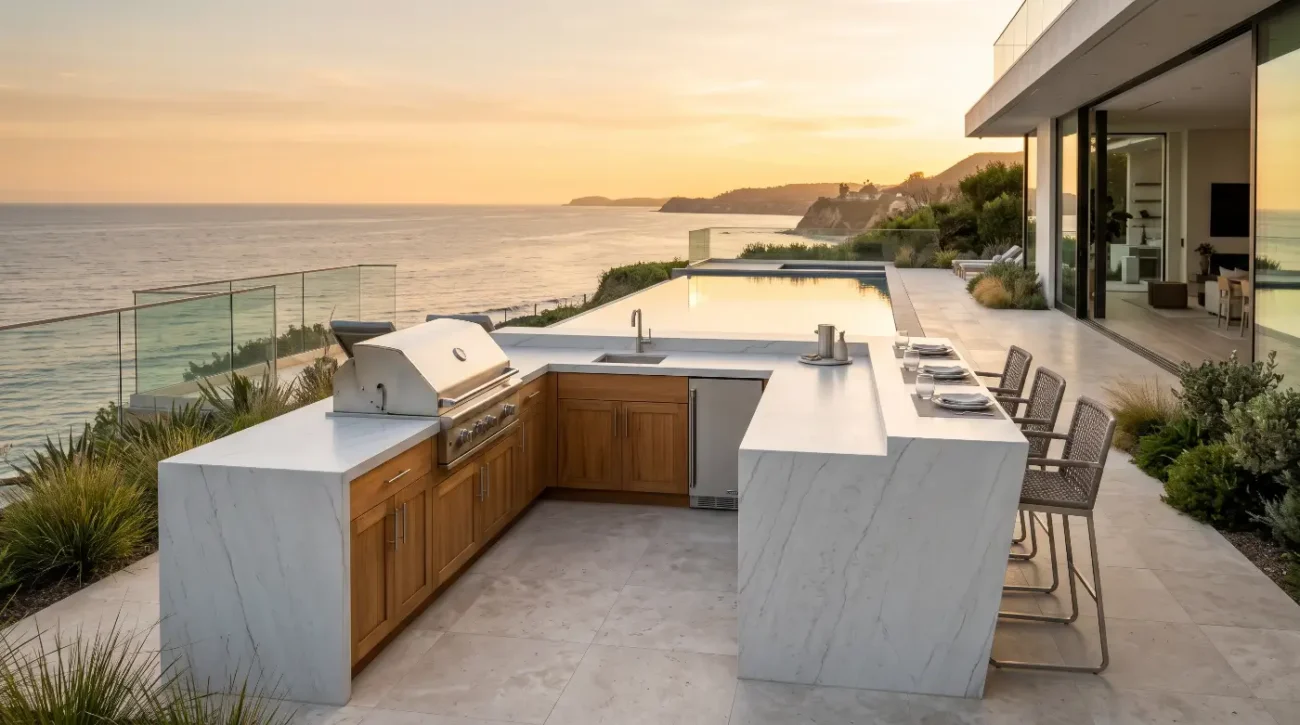
A multimillion-dollar residential renovation overlooking Paradise Cove in Malibu recently revealed the hidden danger of specifying the wrong exterior millwork. The homeowner fell in love with a dense, dark ipe outdoor kitchen island featured on a coastal mood board. Within twelve months of installation, the sheer tangential movement of the ipe broke every miter joint across the face frame.
The intense salt spray and relentless southern exposure caused unequal moisture loss, shearing the mechanical fasteners clean out of the casework. The three-inch quartzite waterfall slab cracked down its center seam due to uneven substructure settling. What was designed as an architectural centerpiece turned into a total structural loss.
Leading design professionals avoid this exact scenario by standardizing their exterior millwork schedules around one specific species. When exterior architects, landscape designers, and luxury builders program high-exposure coastal loggias or desert pavilions, they demand materials that maintain microscopic dimensional integrity under brutal environmental swings.
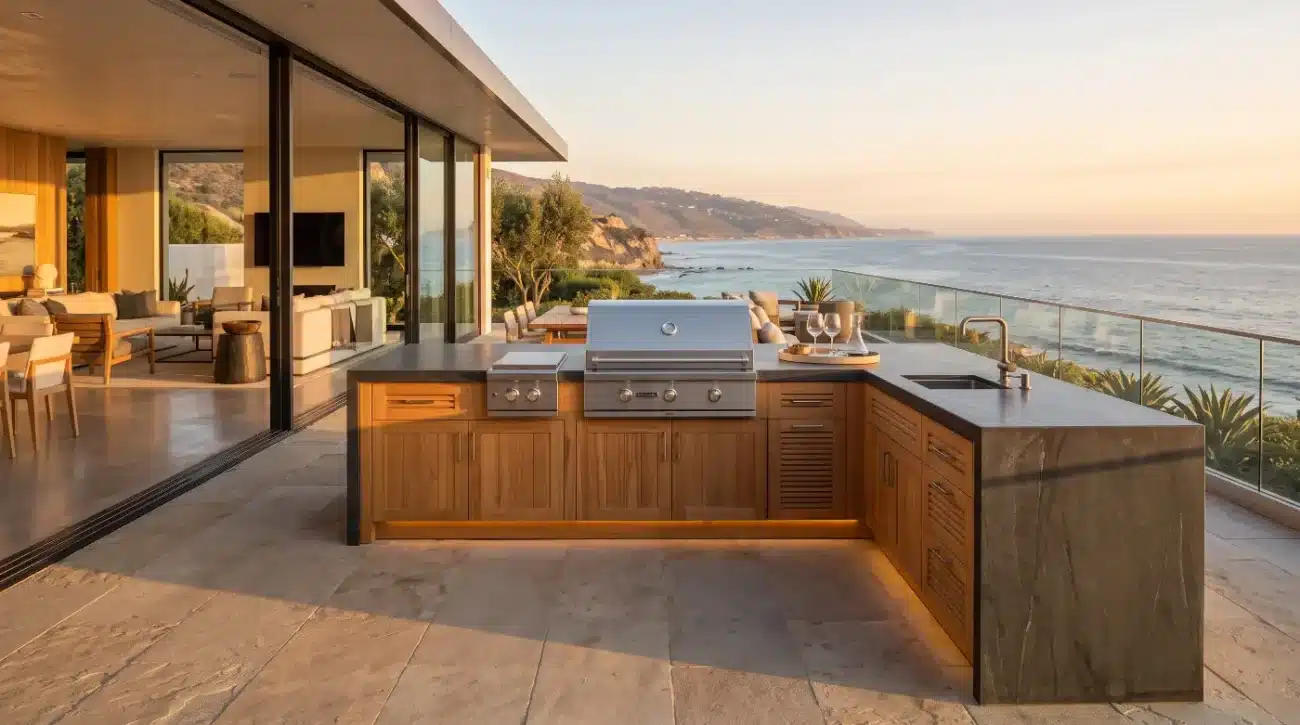
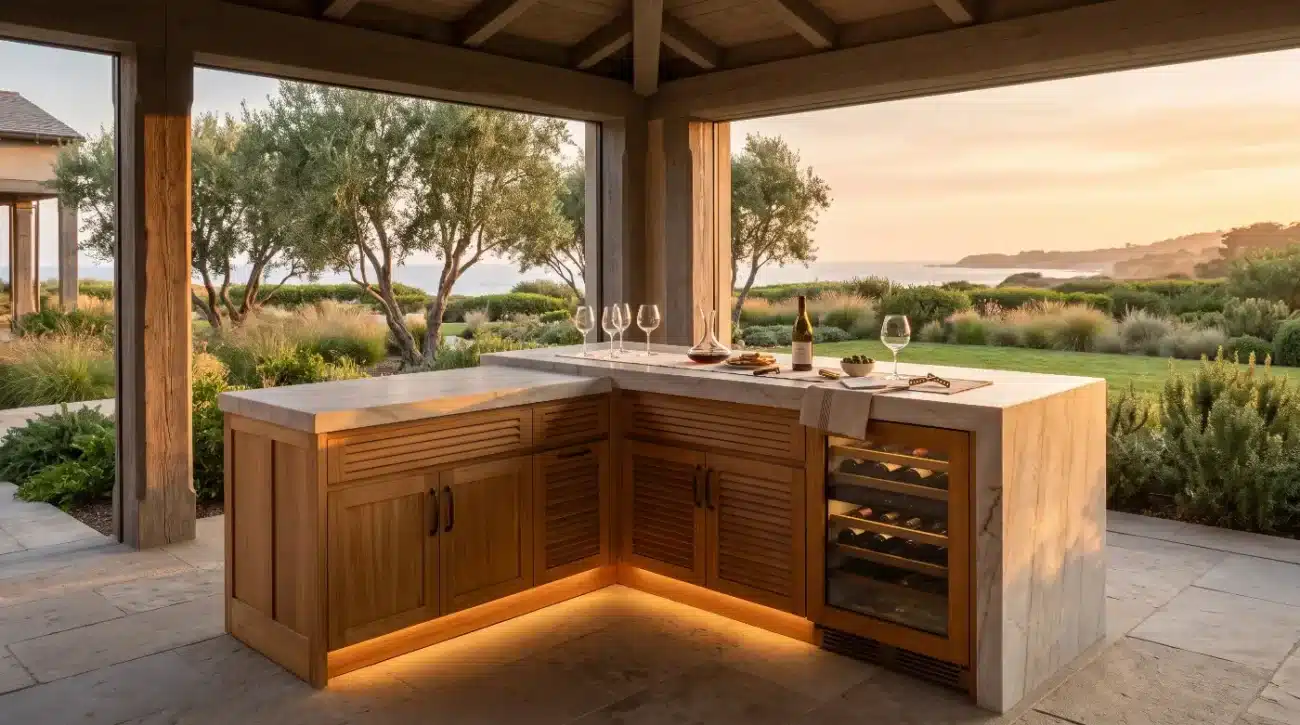
Specifying architect specified teak outdoor cabinetry provides an engineered structural certainty that other luxury hardwoods like ipe, white oak, and mahogany simply cannot match over decades of real-world exposure.
Material Science and Structural Engineering of Exterior Hardwoods
Grade-A teak (Tectona grandis) outperforms alternative hardwoods because its low tangential shrinkage coefficient,high silica density, and natural rubber content resist movement. While species like ipe and white oak react violently to seasonal humidity changes, teak maintains structural equilibrium. This protects complex mortise-and-tenon joinery and prevents the structural deflection of heavy stone countertops in extreme marine and desert environments.
Architectural specifiers working within standards from the American Institute of Architects (AIA) and the USDA Forest Products Laboratory (FPL) evaluate exterior millwork through dimensional movement rather than initial surface hardness alone. The Janka hardness rating measures resistance to denting, but excessive density often correlates with severe dimensional instability when exposed to moisture fluctuations.
Understanding this physical distinction is fundamental for master woodworkers and specifiers balancing aesthetic goals with mechanical reality.
-
Tangential Shrinkage Physics: Teak exhibits an exceptionally low tangential shrinkage rate of roughly 2.5 percent and a radial shrinkage rate of approximately 1.5 percent. Species like ipe and white oak exhibit volumetric shrinkage rates exceeding 12 to 13 percent, creating massive internal stress that twists doors, binds drawers, and pops joints when humidity drops.
-
Endogenous Rubber Composition: True plantation-grown Grade-A heartwood contains up to five percent natural latex and rubber within its cellular matrix. This internal emulsion seals the wood grain against atmospheric moisture uptake, rendering the wood dimensionally stable during torrential rains in the Pacific Northwest or coastal fog in Newport Beach.
-
Silica Content Defense: Mature teak heartwood absorbs free silica from the soil, petrifying the cell walls with mineral deposits. This mineral barrier blunts woodworking tooling, but it permanently blocks marine borers,termites, and fungal rot without requiring toxic pressurized chemicals.
-
Weight-to-Strength Optimization: Dense woods like cumaru and ipe exert massive dead loads on structural cantilevered decks and rooftop loggias. Teak achieves superior bending strength and modulus of elasticity at an average dried weight of forty to forty-five pounds per cubic foot, easing framing tolerances.
A counterintuitive insight that separates master exterior woodworkers from general carpenters centers on surface sealers. Specifiers often demand film-forming finishes like polyurethane, marine spar varnish, or acrylic topcoats to maintain a newly installed appearance. On teak, these coatings trap migrating interior moisture beneath an impermeable plastic film.
As the intense sun heats the wood, the trapped moisture vaporizes, popping the finish off the surface in peeling sheets while rot develops underneath. True architectural teak must breathe. Its internal oils protect the structural core whether the wood is washed periodically to develop a silvery patina or treated with breathable, penetrative teak oils to sustain its warm golden-brown tones.
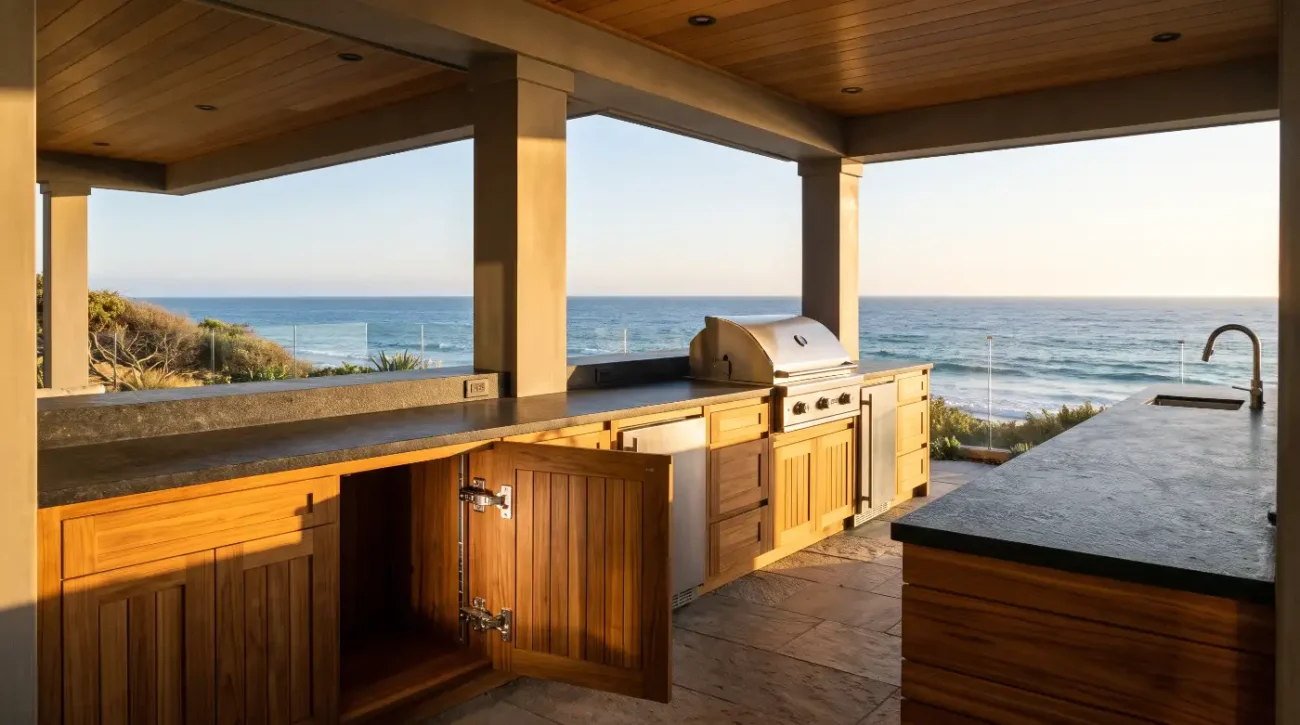
This chemical profile impacts the hardware that anchors the assembly. High natural oil content degrades inferior glues and corrodes lower-tier metals over time. High-performance installations pair solid casework with 316 marine-grade stainless steel soft-close hinges, full-extension undermount drawer slides, and architectural gaskets.
Selecting precision-engineered units from the Pacific Teak Millworks base cabinets collection guarantees that internal joinery, structural backs, and hardware mountings resist both chemical extraction and coastal salt-spray corrosion.
A common post-installation mistake occurs when builders fail to anticipate live and dead loads across long cabinet runs. When a project specifies two-inch-thick solid granite, soapstone, or concrete slab countertops, a run of base cabinets can carry thousands of pounds of dead weight.
If the casework relies on modular dowel construction or pocket screws without traditional mortise-and-tenon frame assemblies, the carcass slowly wracks. The drawer reveals shift out of alignment, soft-close mechanisms jam, and the stone above risks structural fracture. Solid teak frames joined with true mortise-and-tenon geometry absorb these compressive loads across the full length of the grain without creeping.
Architectural Workflows, Spatial Integration, and Trade Specification Protocols
Specifying custom teak cabinetry requires precise architectural workflows that align CAD drawings, sub-trade clearances, and ventilation requirements for built-in cooking appliances. Coordinating custom face frames with marine-grade hardware and surrounding masonry eliminates spatial clashes and ensures long-term building code compliance.These detailed specification protocols protect project timelines and guarantee unified indoor-outdoor aesthetic continuity across high-end residential estates.
Bridging the gap between a client’s aspirational mood board and a constructible architectural set requires rigorous coordination across trades. When high-net-worth clients bring images of minimalist, seamless outdoor cabinetry to their interior designer or landscape architect, the design team must translate those forms into buildable assemblies. The millwork must align with surrounding hardscape, masonry transitions, and plumbing runs.
-
BIM and CAD Integration: Specifying precise digital assets into Revit and Vectorworks workflows allows exterior architects to verify framing reveals, countertop overhangs, and plumbing pathways before breaking ground. Discovering a spatial clash between a waste pipe and a trash pull-out after delivery stalls sub-contractor scheduling and inflates general condition costs.
-
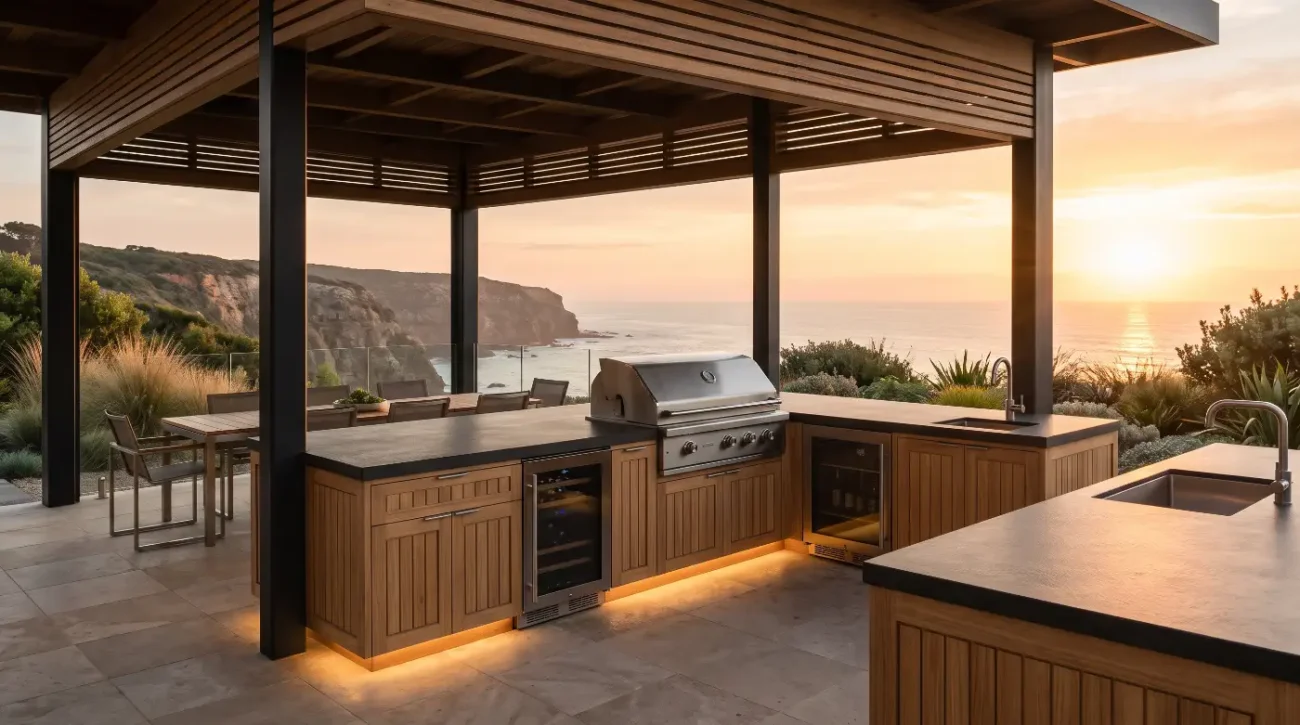
Appliance Cutout Clearances: Integrating high-BTU gas grills, power burners, and commercial warming drawers directly into solid wood casework requires insulated safety jackets and engineered airflow channels.Trapping radiant grill heat against unventilated wooden cabinet walls poses a serious fire hazard and bakes the moisture out of adjacent joinery.
-
Combustion Ventilation Planning: Modern exterior building codes require dedicated low-and-high venting cutouts for outdoor kitchen islands that house liquid propane or natural gas utilities. Propane is heavier than air and pools along the cabinet floor; specifying precision venting inserts maintains both fire safety and visual balance across the cabinetry run.
-
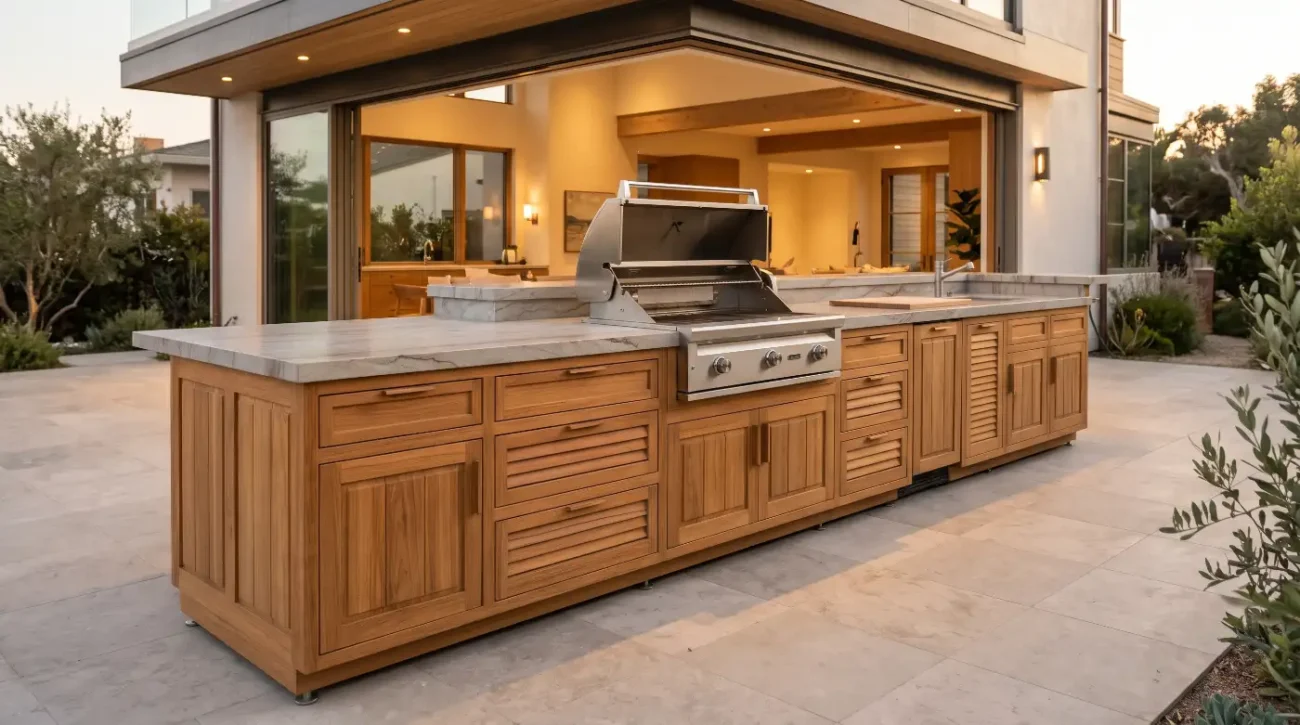
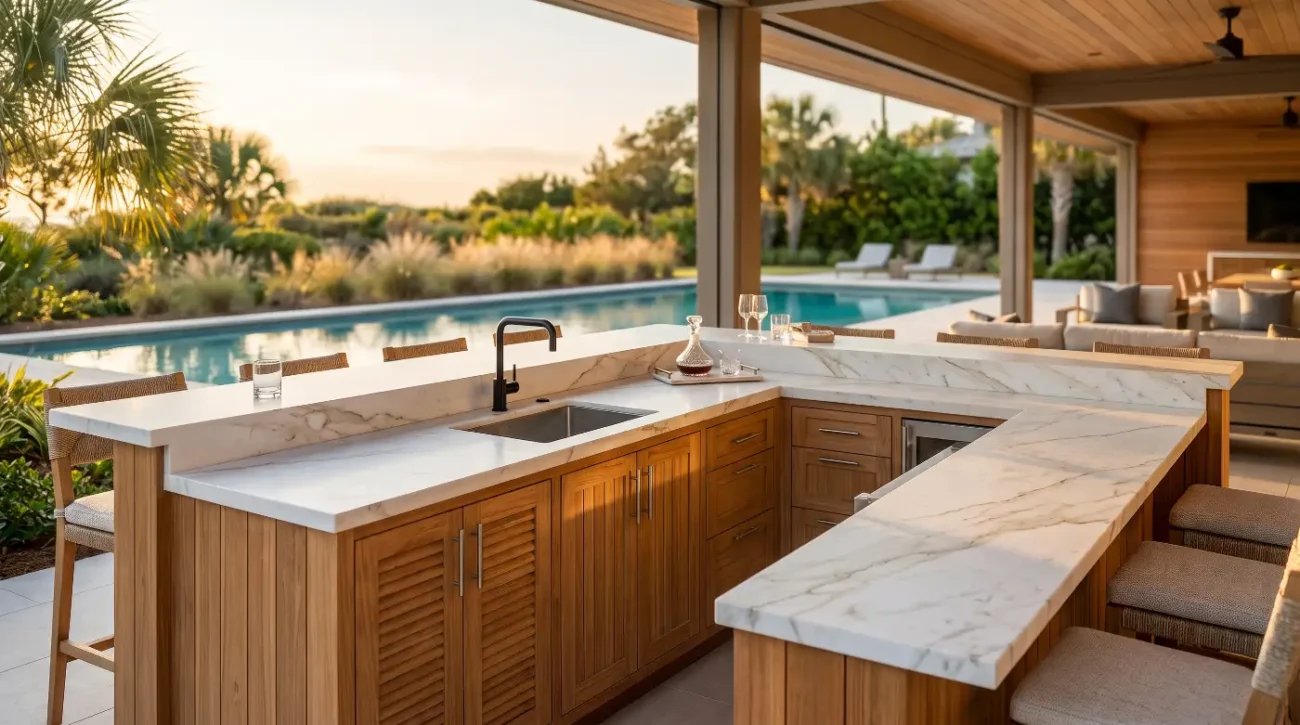
Transitional Architectural Flow: Aligning exterior cabinet reveals, grain directions, and stile widths with interior kitchen casework unifies the visual language across sliding glass pocket doors. Specifying complementary upper storage from the Pacific Teak Millworks wall cabinets collection carries that warm,biophilic architectural flow onto covered outdoor living loggias.
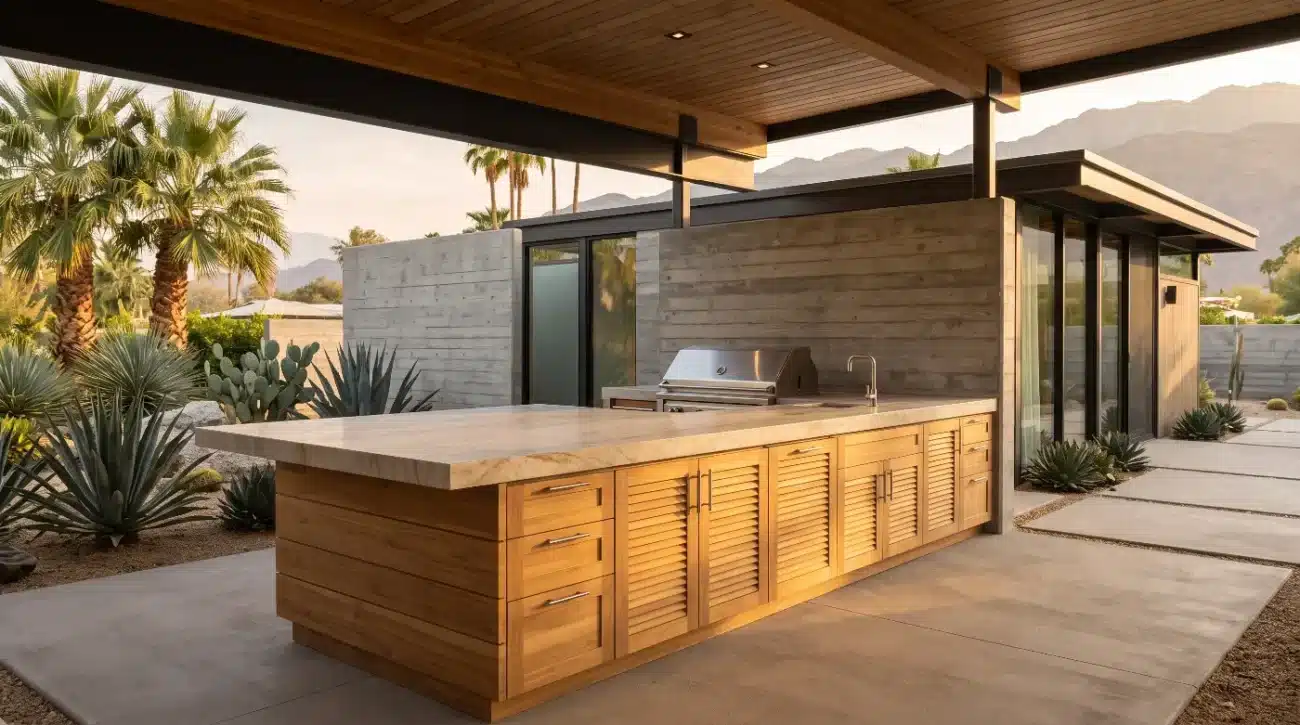
Trade professionals often encounter a significant environmental risk in extreme sunbelt climates like Palm Springs,Scottsdale, or Austin. When radiant heat exceeds 110 degrees Fahrenheit, dark stone countertops absorb and transfer massive thermal energy into the cabinet carcasses below.
If the cabinetry lacks expansion joints and floating panel construction, the heat differential between the top edges and the shaded cabinet floor creates thermal bowing. Floating panel doors accommodate this internal dimensional movement, staying flat against their face frames regardless of ambient surface temperatures.
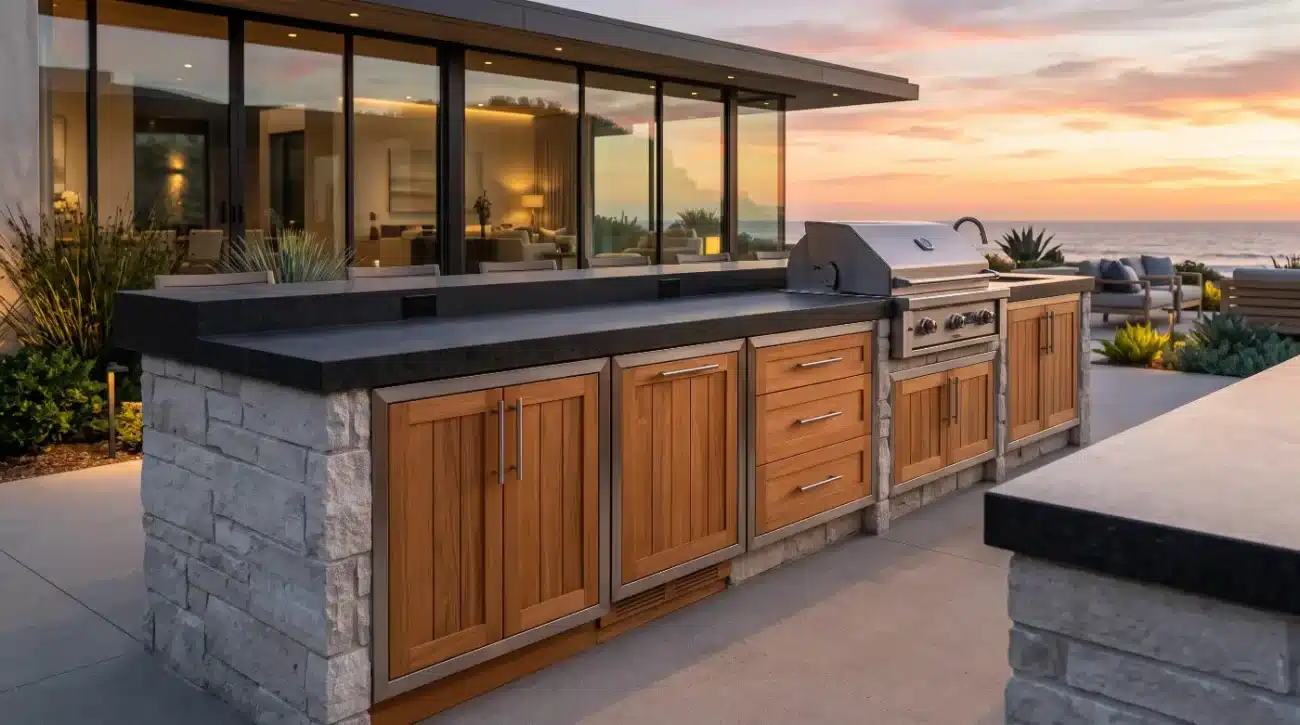
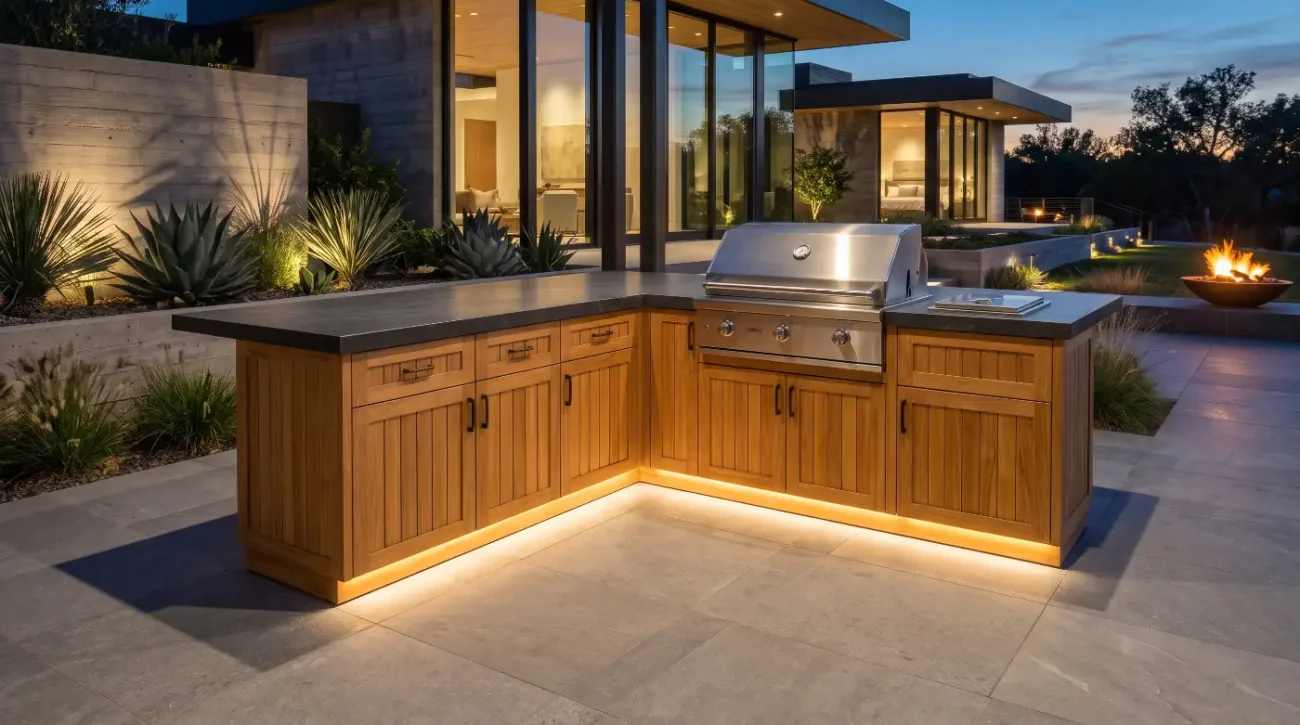
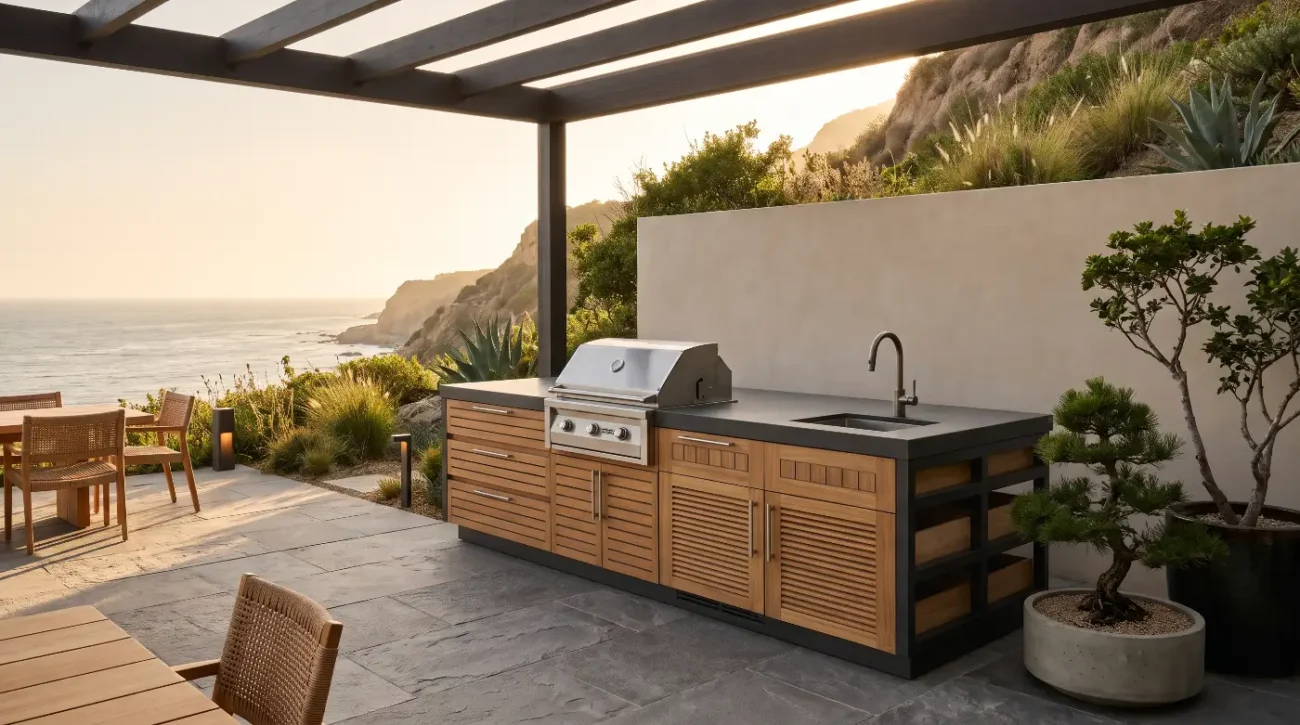
A powerful design opportunity lies in contrasting the rich, tactile grain of solid teak with sleek, modern materials.Balancing the natural organic warmth of golden-brown teak against honed black porcelain slabs, raw board-formed concrete, or blackened steel elements elevates an outdoor kitchen from an ordinary cooking patio to an authentic architectural destination.
Integrating custom Pacific Teak Millworks island inserts into a poured concrete foundation allows designers to introduce the organic beauty of genuine wood into otherwise cold, industrial architectural forms.
Trade practitioners managing commercial or multi-family residential portfolios must also navigate strict material chain-of-custody requirements. Environmental leadership requires sourcing timber certified under standards set by the Forest Stewardship Council (FSC). This ensures that large-scale timber procurement supports legal forestry operations and ecological management.
To guarantee that a design translates faithfully from schematic sketches to final punch-list completion, design firms should lean directly on specialized manufacturing resources. Reviewing technical millwork details and installation parameters via the Pacific Teak Millworks resource center provides specifiers with the exact structural guidelines required to secure engineering approvals.
The strategic tradeoff between preservation and natural weathering remains a core discussion point for the project team.When a client desires the low-maintenance, organic aesthetic popular in Hamptons shingle-style retreats or modern Pacific Northwest homes, allowing the wood to naturally oxidize into an architectural silver-grey patina eliminates ongoing refinishing.
If the client prefers the warm, amber luster of fresh-milled timber, the design team must build recurring teak cleansing and oil replenishment into the property’s estate management plan.
Clear communication surrounding these maintenance obligations protects trade reputations, honors craftsmanship, and ensures the outdoor installation delivers timeless luxury for decades.
External References:
-
American Institute of Architects: https://www.aia.org
-
USDA Forest Products Laboratory: https://www.fpl.fs.usda.gov
-
Forest Stewardship Council: https://fsc.org
Key Takeaways:
-
Unmatched Stability Under Exposure: Teak exhibits volumetric shrinkage of only 5.4 percent, dramatically outperforming ipe, white oak, and mahogany to eliminate joint separation, sticking doors, and stone cracking.
-
Natural Biochemical Defense: High endogenous rubber content and mineral silica deposits provide permanent resistance to rot, termites, and salt-air delamination without chemical pressure-treating.
-
Traditional Joinery Integrity: Mortise-and-tenon construction distributes massive dead loads from heavy quartzite, concrete, and granite slabs, maintaining perfect structural alignment over decades.
-
Rigorous Ventilation Requirements: Integrating high-BTU outdoor cooking appliances demands certified insulating jackets and intentional cabinet venting to prevent gas pooling and heat-induced timber warping.
-
Aesthetic Trajectory Control: Specifiers can plan for a natural, zero-finish weathering to a soft silver-grey patina or establish a routine oiling schedule to preserve the warm, golden-brown grain.
Elevate your firm’s exterior living projects with the structural certainty, timeless beauty, and uncompromising joinery of custom solid teak millwork. Whether you are developing CAD millwork packages for a coastal estate or specifying durable materials for a resort loggia, our architectural team is here to assist. Connect with our principal, Darin, by calling (949) 365-6513, emailing darin@pacificteakmillworks.com, or submitting your project specifications directly through the Pacific Teak Millworks trade inquiry portal. We look forward to collaborating on your next architectural milestone.