Executive Summary:
-
Thermal Isolation Engineering: Integrating high-output commercial gas appliances into solid wood cabinetry demands specialized insulated jackets, ventilation channels, and explicit clearance to combustible materials to eliminate fire hazards and structural thermal degradation.
-
Material Science and Load Distribution: Grade-A plantation teak provides unyielding natural oil and resin density to resist marine environments, while precision mortise-and-tenon joinery easily accommodates heavy natural stone and concrete countertops.
-
Seamless Architectural Workflows: Success relies on early alignment between homeowners, architects, and custom builders using detailed CAD specifications, custom appliance cutouts, and marine-grade 316 stainless steel hardware for long-term luxury performance.
Architectural Integration of High-BTU Appliances and Solid Teak Cabinetry
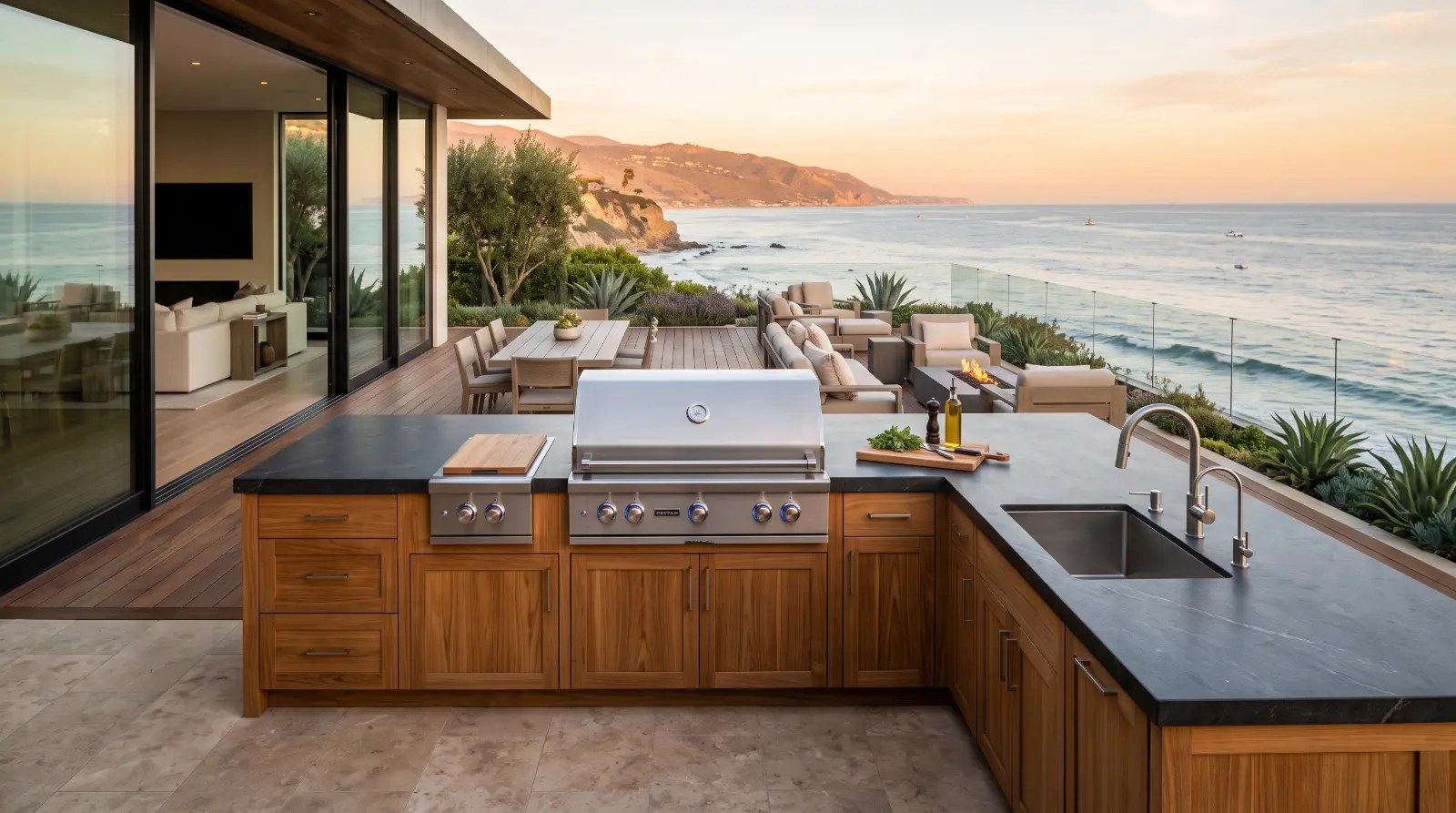
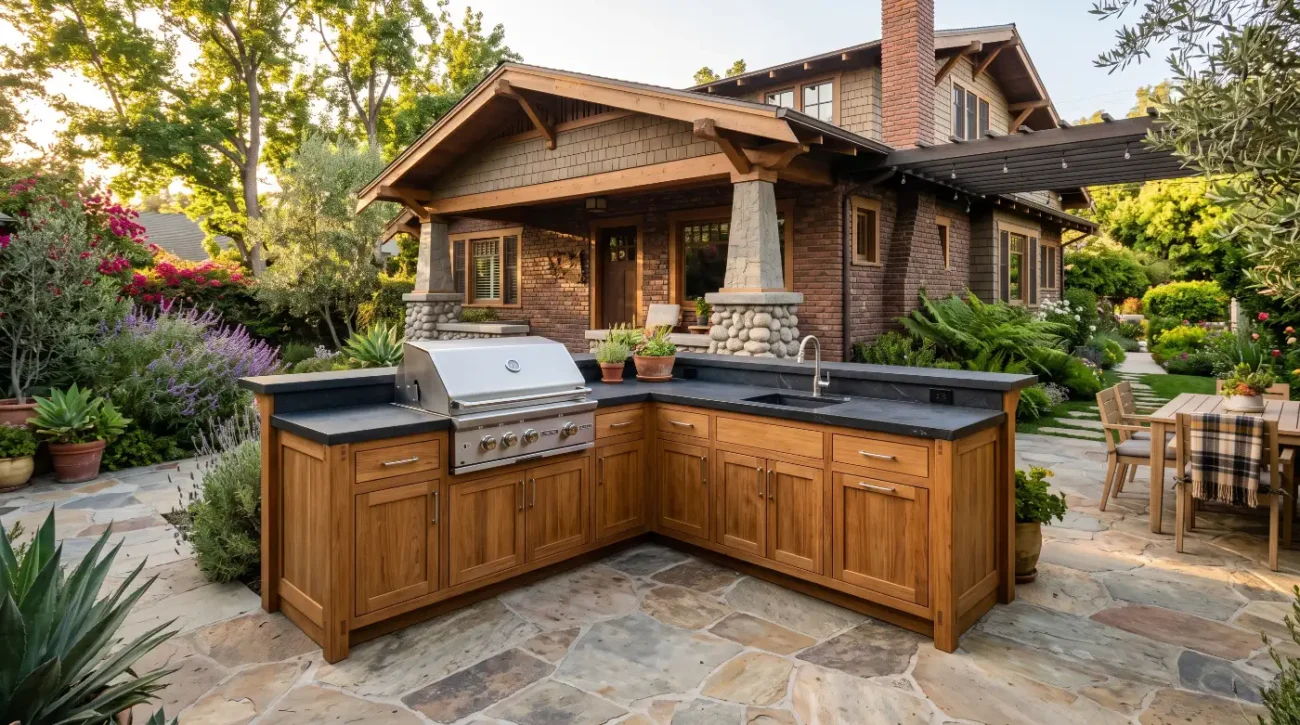
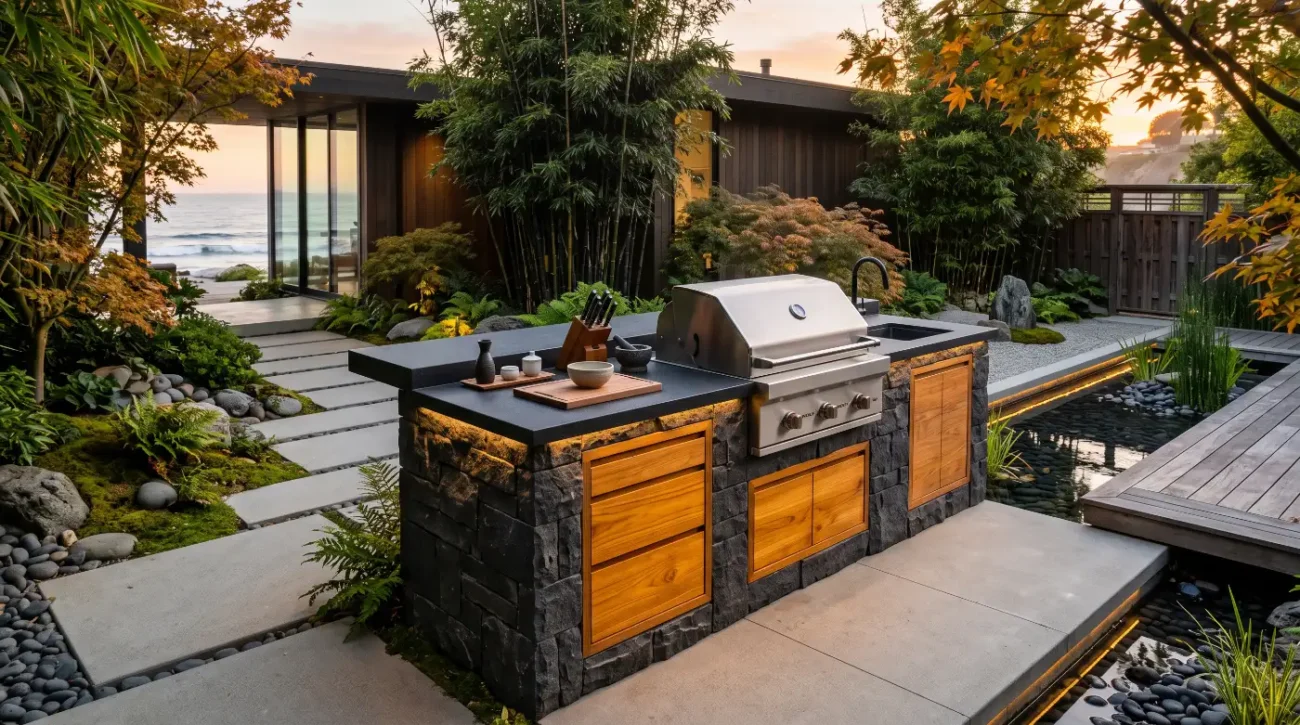
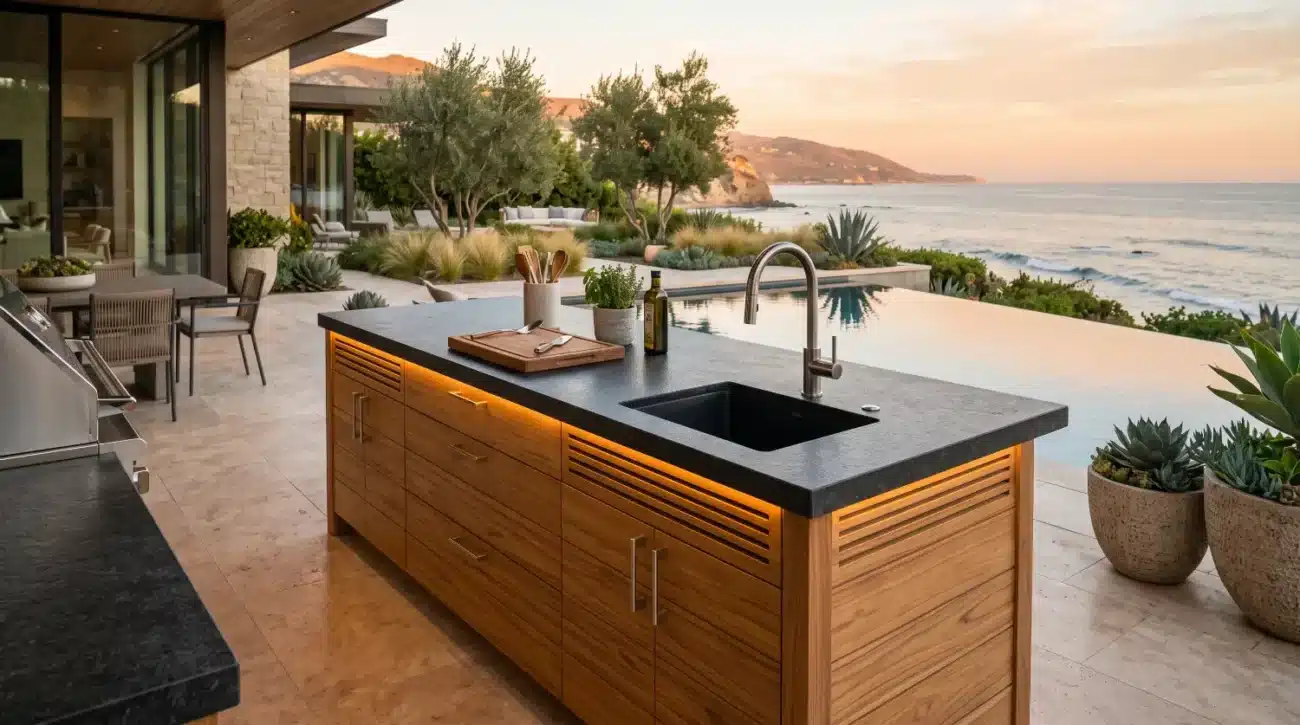
Integrating high-BTU commercial gas appliances with solid teak base cabinetry requires precise thermal isolation, engineered ventilation, structural load distribution, and marine-grade joinery. High-end outdoor kitchens demand careful management of extreme heat, heavy countertop loads, and corrosive coastal environments. Proper execution pairs Grade-A teak millwork with specialized insulated heat jackets, precision CAD planning, and robust 316 stainless steel hardware to deliver enduring structural integrity and elevated architectural aesthetics.
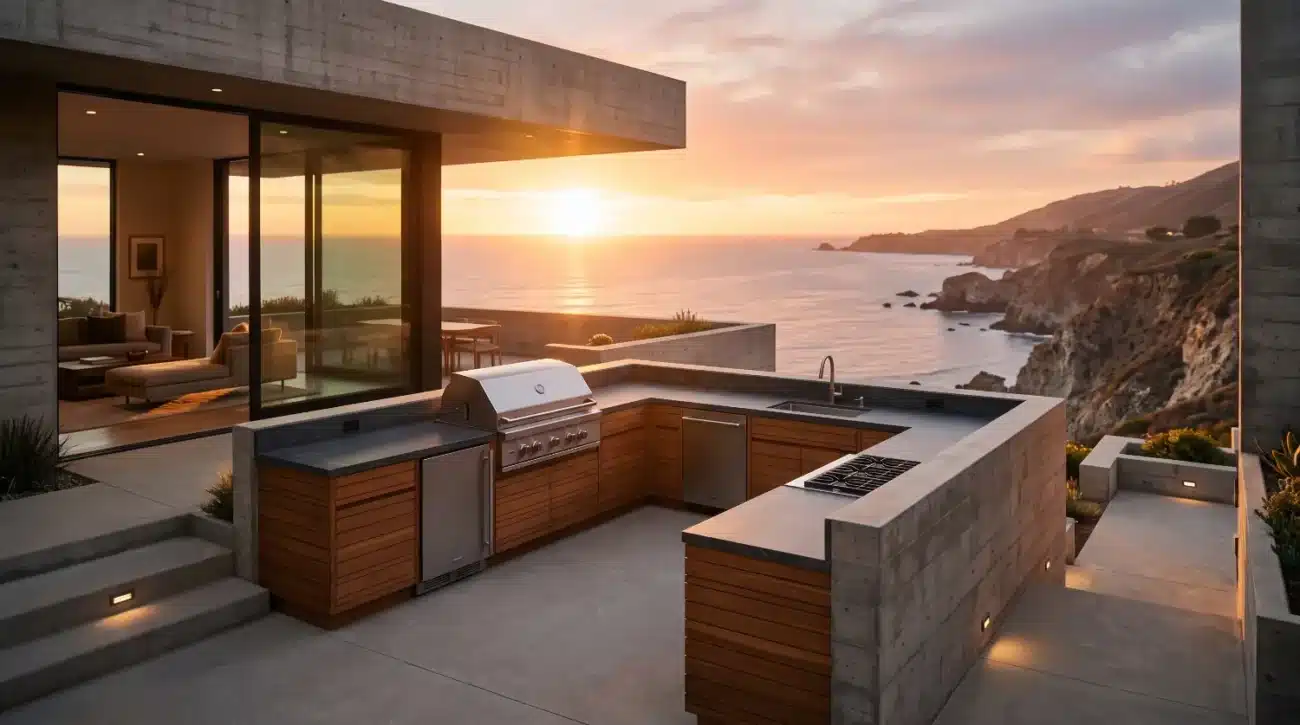
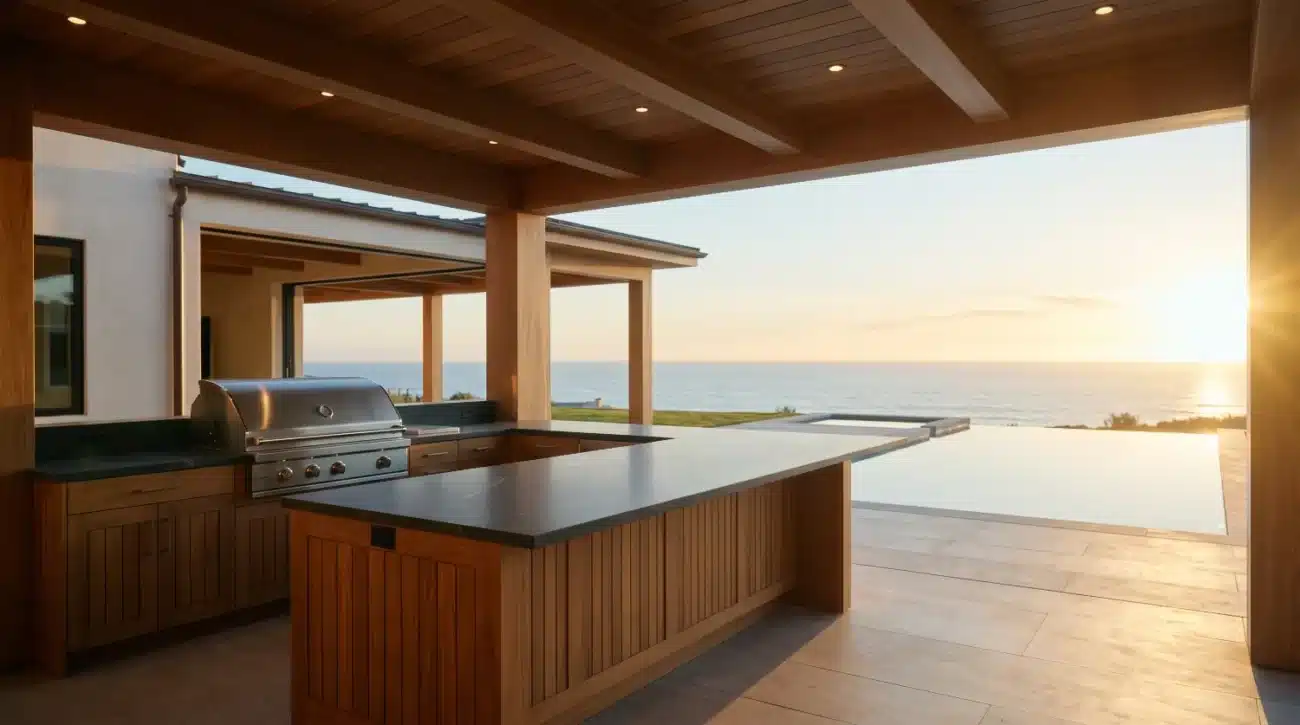
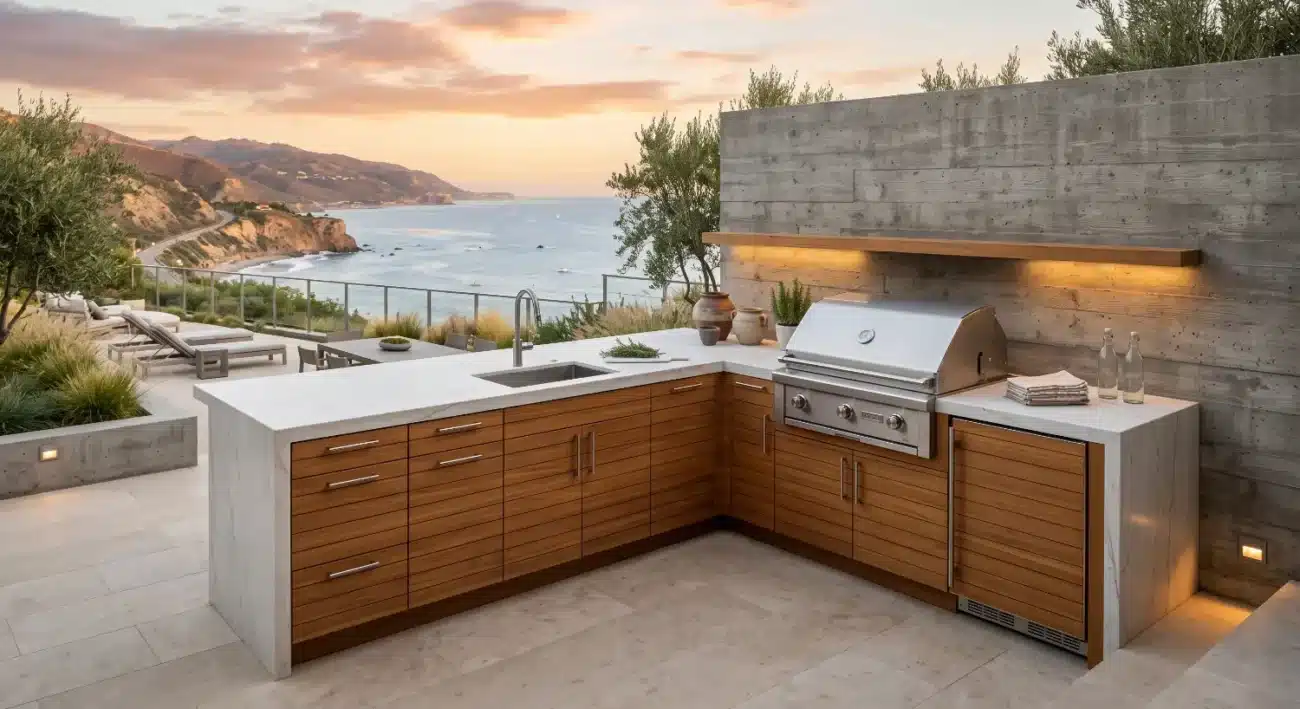
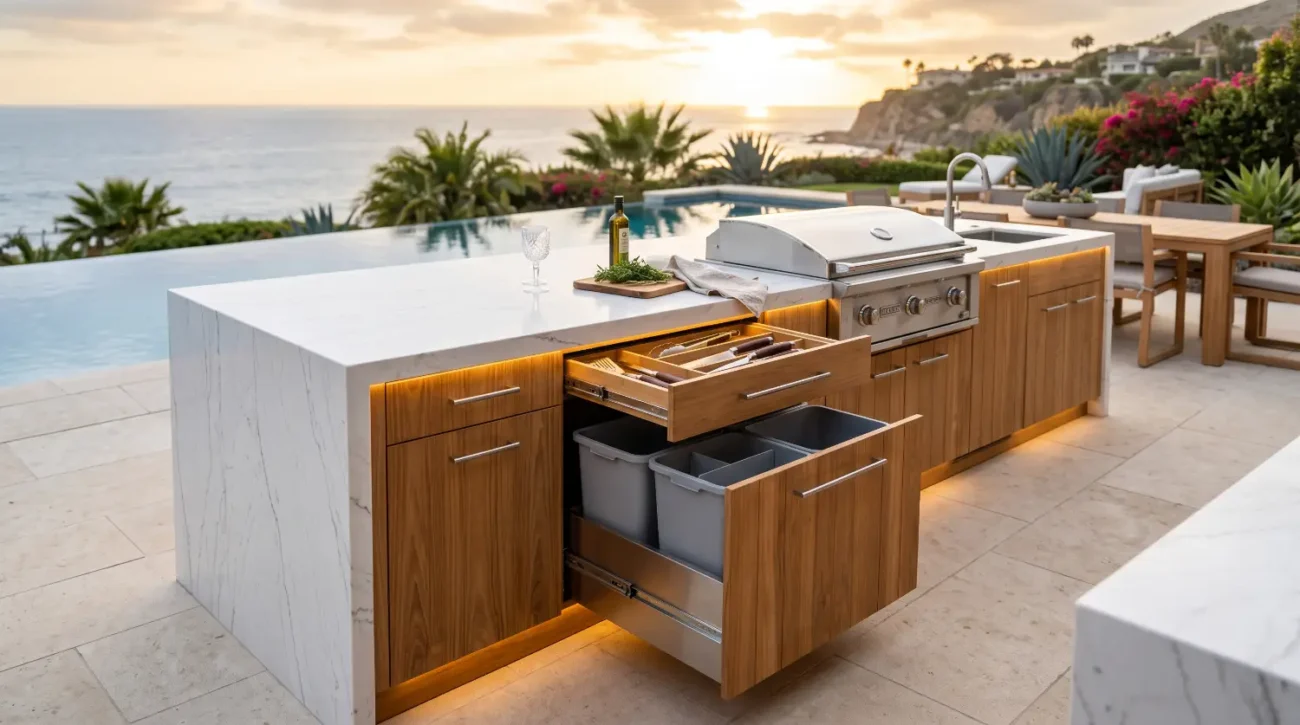
Designing a high-performance exterior kitchen framework requires a layered architectural approach that balances heavy equipment with premium wood joinery. The overarching structural layout connects several vital components to guarantee safety and longevity:
-
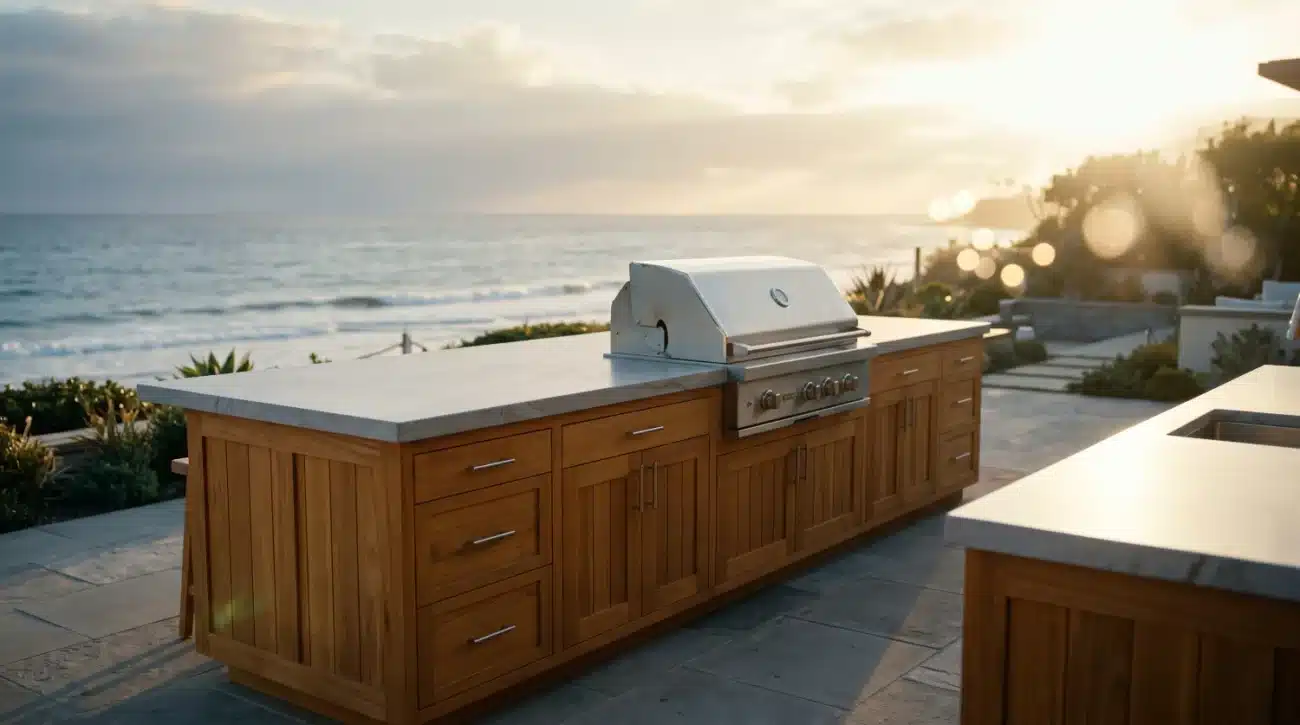
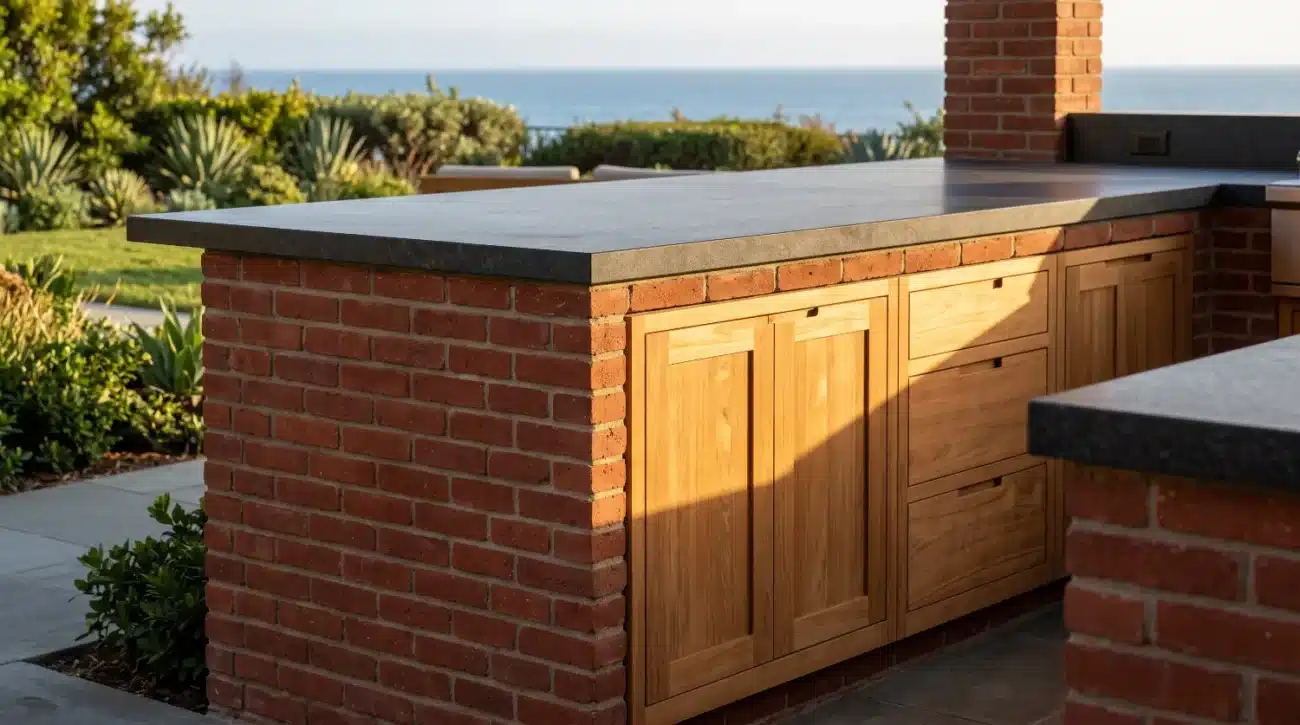
Top Surface Load Support: A heavy-gauge natural stone slab—such as thick granite, quartzite, or pre-cast concrete—serves as the primary working surface and seals the top perimeter of the structure.
-
High-Output Thermal Core: A commercial gas grill generating up to 100,000 BTUs is positioned directly within the millwork bay, flanked by dedicated ventilation cavities to allow continuous convective airflow clearance.
-
Primary Thermal Defense: A double-walled insulated heat shield jacket or zero-clearance sleeve fully surrounds the high-heat grill to isolate thermal transfers from surrounding wooden components.
-
Structural Teak Substructure: Grade-A teak base cabinetry forms the foundational load-bearing skeleton, utilizing deep mortise-and-tenon joinery, natural rubber and tectonic silica resins, and 316 marine-grade stainless steel hardware to anchor the entire build.
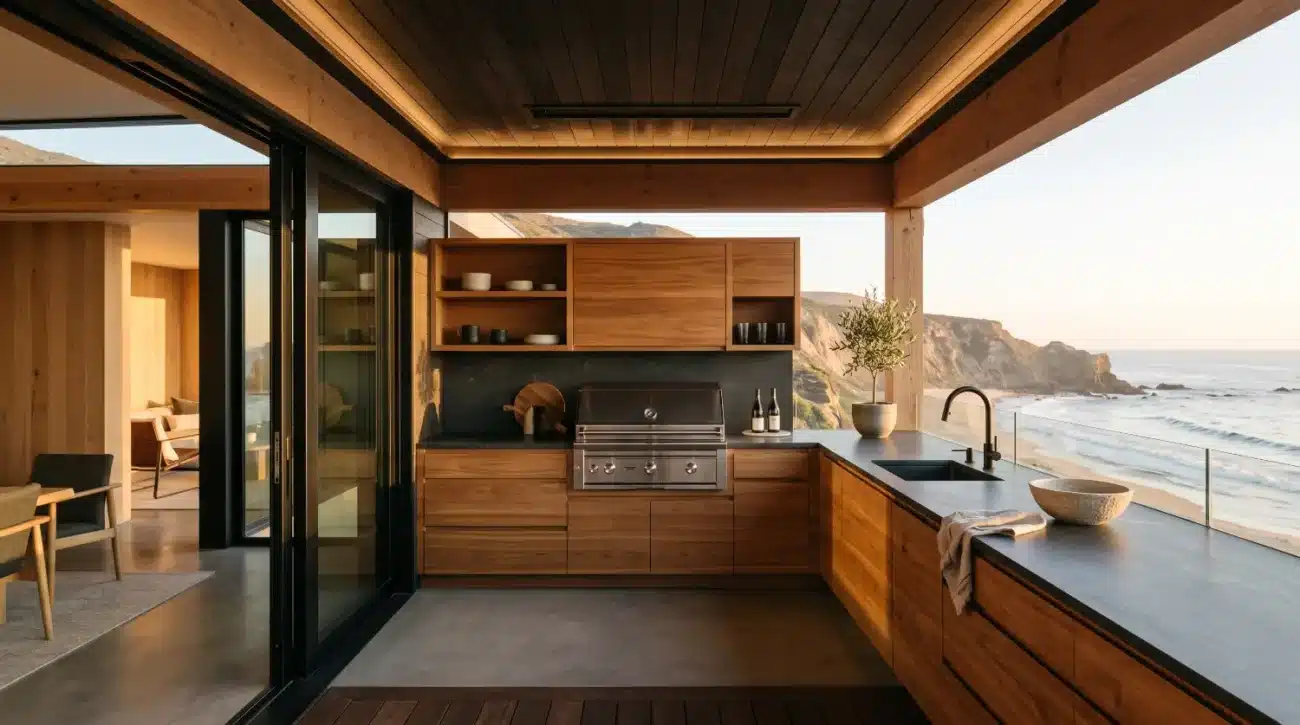
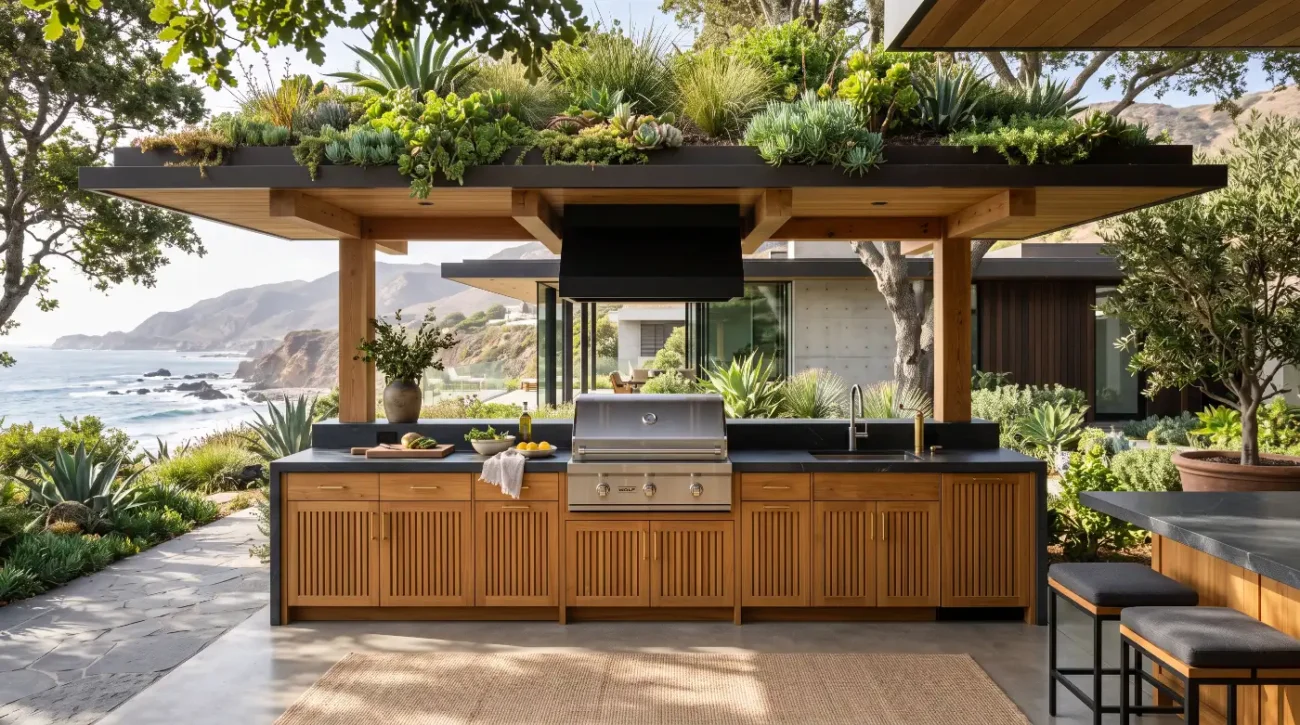
When a custom home build in Malibu or the Hamptons calls for a professional-grade outdoor kitchen, conflicts often arise between appliance heat and natural wood millwork. High-net-worth clients frequently request intense 100,000 BTU gas grills, ceramic kamado cookers, and high-heat power burners housed within custom wood cabinetry. However, standard exterior millwork or cheap modular units can warp, delaminate, or catch fire under extreme thermal stress and marine weather exposure.
A successful build bridges high-heat commercial appliances with luxury timber framing. Solid teak millwork must handle both high temperatures and intense moisture cycles. Combining natural timber with high-BTU appliances requires a deep understanding of thermal dynamics, material science, and trade installation workflows.
The functional relationships within a high-heat outdoor kitchen installation operate through three clear design priorities:
-
Insulated Zero-Clearance Liners: Functioning as the primary thermal barrier, these double-walled liners stop direct heat conduction from high-output burners, shielding the adjacent timber frames from scorch damage.
-
Passive Air Vents and Convection Channels: Engineered air pathways allow trapped combustion heat to vent harmlessly away from the cabinet core, keeping internal gas valves cool and stable.
-
Grade-A Teak Framing with Mortise-and-Tenon Joinery: This structural wood core absorbs heavy downward stone counter weight while naturally resisting decay, rot, and salt-air corrosion.
Thermal Isolation and Fire Safety Engineering
High-BTU outdoor gas grills create intense thermal output that can quickly compromise surrounding building materials. Standard high-performance grills easily surpass 60,000 to 100,000 BTUs, generating internal temperatures over 900 degrees Fahrenheit. Without proper thermal barriers, heat transfers directly into adjacent cabinetry framing, drying out the timber, scorching the finish, or causing structural ignition.
-
Zero-Clearance Insulated Jackets: Specifying double-walled stainless steel insulated jackets is mandatory when dropping a high-heat grill into combustible solid teak framing. These sleeves create a dead-air space paired with high-density ceramic insulation, keeping external jacket temperatures low enough for safe contact with wood face-frames.
-
Convective Heat Dissipation: Trapped heat behind a gas appliance can damage control valves and cause wood movement. Custom rear and side ventilation channels allow heat to vent naturally, preventing localized hot spots.
-
Combustible Material Clearances: Always cross-reference appliance manufacturer specifications with local building codes. Never bypass an insulated jacket, even when working with dense hardwoods like teak.
Material Science: Grade-A Teak in Marine Environments
Teak (Tectona grandis) remains the gold standard for exterior architectural millwork due to its unique natural oil, rubber, and silica composition. Harvested from mature, heartwood portions of sustainably managed plantations, Grade-A teak offers unmatched durability against coastal weather, salt fog, and intense UV exposure.
Raw Grade-A teak timber provides distinct material advantages through its natural chemical makeup:
-
Natural Silica and Rubber Resins: High concentrations of dense organic resins act as a waterproof internal barrier, repelling moisture and blocking wood rot.
-
High Oil Retention: The wood naturally retains deep organic oils that self-lubricate wood fibers, preventing salt fog from drying out the timber core.
-
Tight Growth Ring Density: Slow-grown heartwood yields tight, dense grain structures that resist twisting, warping, and swelling during severe humidity swings.
Unlike domestic hardwoods like oak or maple, which require heavy synthetic coatings to survive outdoors, Grade-A teak contains natural tectonic resins that repel water and block mold or rot. According to testing by the USDA Forest Products Laboratory, teak exhibits low radial and tangential shrinkage, giving it exceptional dimensional stability during severe humidity shifts.
Property owners must choose between two distinct aesthetic aging paths for outdoor teak surfaces:
-
Natural Silver Patina: Exposure to natural UV sunlight oxidizes the surface layer over time, developing a low-maintenance, classic silver-grey coastal appearance without compromising structural integrity.
-
Warm Golden-Brown Finish: Regular applications of deep-penetrating marine teak oil protect the wood’s original warm amber hue, requiring periodic re-oiling to maintain a freshly milled appearance.
When custom builders frame an outdoor island using Pacific Teak Millworks Base Cabinets Collection, the high natural oil content acts as a built-in protective barrier. Applied coatings like polyurethane or film-forming varnishes should never be used on outdoor teak. These synthetic films trap moisture within the wood fibers during rain cycles. Under direct sunlight, trapped vapor expands, blistering the finish, turning it white, and causing internal rot. Instead, teak should be treated with deep-penetrating marine teak oils or allowed to naturally oxidize into an elegant, silvery-grey patina over time.
Understanding how moisture interacts with different finishing methods illustrates why natural wood treatments perform far better than synthetic barriers:
-
Synthetic Film Coatings (Polyurethane): Clear topcoats trap moisture under the surface film. Solar heat causes trapped water to convert into expanding vapor, which blisters the clear coat, turns the wood cloudy white, and induces internal timber decay.
-
Penetrating Marine Oils or Unfinished Wood: Breathable organic treatments allow the wood grain to transpire naturally. Rainwater evaporates freely from the surface fibers, keeping the internal timber dry, healthy, and dimensionally stable.
Joinery Physics and Structural Countertop Support
Outdoor kitchen counter surfaces typically feature thick natural granite, quartzite, or pre-cast concrete slabs weighing over 30 pounds per square foot. Adding a 300-pound stainless steel grill and heavy cast-iron cookware places significant static and dynamic loads on the supporting cabinetry frame.
Supporting heavy masonry tops alongside commercial appliances relies on three structural support principles:
-
Substantial Static Tops: Heavy stone or concrete tops distribute up to 30 pounds per square foot across the upper perimeter of the millwork frame.
-
Concentrated Appliance Loads: High-BTU drop-in grills add up to 300 pounds of localized weight in a centralized bay.
-
Engineered Mortise-and-Tenon Framework: Traditional interlocking wood joinery paired with 316 stainless steel fasteners transfers these combined loads directly into the ground structure without racking or bowing.
-
Mortise-and-Tenon Joinery: Cabinet framing must use deep mortise-and-tenon structural joints secured with waterproof Type III polyurethane adhesives. This mechanical connection distributes heavy downward countertop loads across the full vertical grain of the cabinet walls.
-
Thermal Expansion Allowances: Wood expands and contracts perpendicular to its grain as ambient humidity changes. Fastening stone countertops directly to wood with rigid epoxy causes cracking. Elastomeric marine silicone sealants allow wood to shift naturally under heavy stone without breaking glue joints.
-
Leveling Leg Assemblies: Exterior concrete patios are pitched for water drainage. Base cabinetry needs adjustable 316 stainless steel leveling legs to eliminate sagging, align drawer fronts, and keep doors operating smoothly.
A common site error occurs when trade contractors level cabinetry using simple wooden shims rather than heavy-duty adjustable legs. Wooden shims rot over time from standing water, causing the island to settle unevenly. This puts twisting stress on stone countertops, leading to expensive cracks along appliance cutouts.
Evaluating base support options highlights the structural difference between field hacks and engineered hardware:
-
Wooden Shim Supports: Standard wood shims trap ground moisture against patio slabs, rotting quickly and causing the kitchen island to settle unevenly over time, which cracks expensive stone countertops along cutout stress points.
-
Adjustable 316 Stainless Steel Legs: Corrosion-resistant adjustable feet elevate the wood frame above standing water, allow easy level adjustments on sloping patios, and safely distribute structural weight.
Marine Hardware and Integrated Appliance Specification
Building a durable outdoor chef’s kitchen requires selecting components that resist rust and corrosion. Standard zinc-plated or 304-grade stainless steel hardware degrades rapidly when exposed to salt air, pool chemicals, or acidic cooking vapors.
Hardware metal alloys demonstrate vastly different performance profiles in harsh outdoor settings:
-
304-Grade Stainless Steel: Commonly used in indoor hardware, 304 stainless is prone to severe surface pitting and unsightly tea-staining when exposed to coastal salt spray or pool chemicals.
-
316 Marine-Grade Stainless Steel: Formulated with added molybdenum, 316 stainless steel provides superior resistance to chloride corrosion, rust, and chemical staining in marine microclimates.
-
316 Marine-Grade Stainless Steel: All soft-close hinges, drawer runners, bracketry, and screws must use 316-grade stainless steel. The addition of molybdenum gives 316 stainless high resistance to pitting and tea-staining caused by airborne chlorides.
-
Fully Sealed Cabinet Interiors: Gas lines, electrical conduits, and plumbing connections require neat cabinet penetrations. Sealing cutout edges with outdoor marine epoxy prevents moisture from seated plumbing from soaking into raw end-grain.
-
Integrated Drawer Glides: Heavy cookware requires full-extension drawer glides rated for at least 100 to 150 pounds. Soft-close dampening mechanisms prevent doors and drawers from slamming shut during strong coastal wind gusts.
Protecting wood cutouts for utility penetrations requires precise edge sealing techniques:
-
Unsealed Raw Wood Cutouts: Exposed end-grain fibers absorb standing water and moisture from utility lines, causing local swelling, face-frame delamination, and dark mold growth inside cabinet walls.
-
Marine Epoxy Sealed Cutouts: Coating raw wood cutouts with two-part marine epoxy seals open wood pores, keeping ambient moisture out and preserving structural integrity around utility channels.
When architects incorporate modular units from the Pacific Teak Millworks Island Inserts Collection, custom cutouts can be pre-engineered during CAD design. This guarantees precise clearances for warming drawers, access doors, and side burners, streamlining installation on site.
A streamlined architectural workflow relies on four sequential phases:
-
Phase 1 (Initial CAD Design): Develop comprehensive layout drawings, verify appliance clearances, and specify utility placement.
-
Phase 2 (Factory Fabrication): Precision-craft teak cabinet components using mortise-and-tenon joinery and apply factory sealants.
-
Phase 3 (Site Installation): Level base units using 316 stainless steel hardware, set cabinets, and coat cutouts with marine epoxy.
-
Phase 4 (Appliance and Counter Integration): Drop in insulated jackets, connect gas lines, and mount stone counters using flexible elastomeric silicone.
Navigating the Trade Specification and Installation Workflow
Smooth execution of a custom outdoor kitchen project requires early collaboration between designers, architects, builders, and millwork specialists. Bridging the gap between initial concept sketches and final site installation prevents costly field modifications and delays.
A successful trade specification process progresses through five distinct milestones:
-
Client Mood Boards: Homeowners and designers gather inspiration to define material palettes, layout themes, and appliance requirements.
-
CAD and BIM Layouts: Architectural specifiers convert visual concepts into detailed CAD drawings, establishing exact dimensions and structural load capacities.
-
Thermal Clearance Verification: Engineers review grill specifications to verify cutout clearances and select appropriate insulated zero-clearance jackets.
-
Precision Cabinet Fabrication: Master craftspeople build solid teak cabinetry using mortise-and-tenon joinery and marine-grade assembly materials.
-
On-Site Installation and Leveling: Contractors level the millwork on-site, seal utility cutouts with marine epoxy, and safely set heavy countertops.
-
Early CAD Integration: Incorporating detailed millwork dimensions into initial architectural plans ensures gas lines, electrical outlets, and structural footings align perfectly before pouring concrete slabs.
-
Appliance Clearance Checks: Confirming cutouts and clearance requirements directly with appliance manufacturers prevents spatial conflicts between insulated grill jackets, internal drawer slides, and gas shut-off valves.
-
Trade Program Support: Working with custom manufacturers who offer dedicated specifier resources makes it easier to request material samples, download CAD files, and confirm lead times early in the design process.
Designers can direct clients to the Pacific Teak Millworks Resource Center to review care guides and technical specs. Clear documentation helps manage client expectations around natural wood aging, maintenance routines, and warranty terms.
Technical Specifications and Material Selection Protocols
Navigating trade standards, structural wood tolerances, and thermal clearance requirements ensures long-term performance for luxury outdoor living installations. Custom outdoor kitchens must balance structural safety with material longevity. Reviewing key design decisions—from joinery methods to ventilation specs—helps prevent failures caused by heat exposure, heavy loads, and harsh weather.
Comparing material choices demonstrates why solid teak millwork outperforms modular metal options:
-
Solid Grade-A Teak Cabinetry: Features minimal thermal expansion, requiring simple insulated jackets around heat sources. High natural oil content permanently repels coastal salt air and moisture, while traditional mortise-and-tenon joinery holds heavy stone and concrete counters. Surfaces offer versatile aesthetic options, aging gracefully into a silver-grey patina or maintaining a golden-brown oiled tone.
-
Modular Metal or Composite Systems: Displays high thermal conductivity, expanding and warping under sun and grill heat. Metal surfaces are prone to pitting, tea-staining, and salt oxidation, while thin sheet metal assemblies can sag under heavy stone counters. Applied powder coatings can chip, scratch, peel, or fade when exposed to intense UV rays.
Essential Architectural Specifications Checklist
-
Insulated Jacket Verification: Ensure the high-BTU grill manufacturer offers an approved double-walled insulated sleeve, and confirm its outer dimensions match the cabinet framing cutouts.
-
Ventilation Placement: Design passive airflow vents low and high within the cabinetry island frame to allow gas fumes and trapped heat to clear safely according to fuel type.
-
Weight Load Capacity: Verify that mortise-and-tenon joinery and 316 stainless steel leveling assemblies are specified to support heavy stone or pre-cast concrete counters.
-
Hardware Grade Standard: Confirm all exposed and internal hardware uses 316 marine-grade stainless steel to prevent rust and corrosion in humid or coastal environments.
-
Sealed Wood Penetrations: Ensure all plumbing, electrical, and gas line cutouts through teak panels are sealed with marine epoxy to prevent moisture absorption.
-
Maintenance & Finish Protocols: Determine whether the client prefers a warm golden-brown finish using marine teak oil or a low-maintenance, naturally aged silvery-grey patina.
Common Outdoor Kitchen Design Pitfalls
Addressing design mistakes early preserves the beauty and safety of custom outdoor kitchens:
-
Pitfall 1 (Applying Polyurethane Finishes): Film coatings trap moisture and peel off in direct sunlight. Architectural Solution: Apply deep-penetrating marine teak oils, or allow the wood to oxidize naturally into a beautiful silver-grey patina.
-
Pitfall 2 (Mounting High-BTU Grills Directly into Wood): Direct contact with high heat scorches wood and creates fire hazards. Architectural Solution: Always fit double-walled stainless steel zero-clearance jackets into cabinetry cutouts.
-
Pitfall 3 (Leveling Kitchen Islands with Wooden Shims): Shims rot quickly in standing water, causing the island structure to sag. Architectural Solution: Install heavy-duty, adjustable 316 stainless steel legs to keep cabinetry elevated and level.
-
Pitfall 4 (Rigid Epoxy Bonding for Countertops): Hard epoxies crack when wood expands naturally. Architectural Solution: Secure countertops using flexible, elastomeric marine silicone sealants to absorb expansion movement.
-
Applying Polyurethane or Film Coatings: Synthetic coatings seal the wood surface, trapping internal moisture. Direct heat and sunlight cause these coatings to blister, peel, and turn white, rotting the wood beneath. Use deep-penetrating marine teak oil or let the wood age naturally to a silver patina.
-
Direct Appliance-to-Wood Mounting: Placing high-heat gas grills directly into timber cutouts without an insulated jacket creates a major fire hazard and scorches cabinet face-frames. Always use a dedicated zero-clearance liner.
-
Leveling Islands with Wooden Shims: Wooden shims rot when exposed to standing water on patio slabs, causing the island to settle unevenly and cracking expensive stone countertops. Always use heavy-duty 316 stainless steel adjustable leveling legs.
-
Rigid Epoxy Countertop Installation: Rigid epoxies do not allow for natural thermal expansion between stone counters and wood framing. Use elastomeric marine silicone sealants to absorb expansion movement without cracking joints.
When coordinating complex layouts featuring upper cabinetry, architects can incorporate the Pacific Teak Millworks Wall Cabinets Collection to create clean vertical storage that matches base island units. Aligning material specs across all cabinetry runs ensures consistent finish quality and long-term durability.
External References:
Key Takeaways:
-
Mandatory Thermal Barriers: Always install double-walled insulated zero-clearance jackets when dropping high-BTU gas appliances into solid teak framing to ensure fire safety and protect wood fibers.
-
Grade-A Teak Performance: High natural oil, rubber, and silica content make Grade-A plantation teak exceptionally stable and naturally resistant to rot, saltwater, and harsh weather.
-
Avoid Film Coatings: Never apply polyurethane or varnish to exterior teak. Use penetrating marine teak oils or let the timber age into a low-maintenance, silvery-grey patina.
-
Structural Joinery: Precision mortise-and-tenon joints combined with Type III polyurethane adhesives easily support heavy natural stone and pre-cast concrete countertops without sagging.
-
316 Marine Hardware: Use 316 marine-grade stainless steel for all hinges, drawer glides, and leg levellers to prevent pitting and corrosion in coastal or high-humidity environments.
-
Early CAD Coordination: Aligning appliance cutouts, utility hookups, and cabinetry dimensions early in the design phase prevents costly site modifications and keeps installation running smoothly.
Whether you are a homeowner planning a private coastal resort retreat or an architect drafting CAD specifications for an ambitious luxury build, Pacific Teak Millworks offers the material expertise and millwork quality your project demands. Explore our collection of solid teak cabinetry, download detailed product spec sheets, or contact our team directly to discuss trade program pricing and custom project needs. Reach out through our Contact Us / Trade Inquiries Page or connect with Darin directly at (949) 365-6513 or via email at darin@pacificteakmillworks.com to bring your outdoor kitchen vision to life.