Quick-Read Block
-
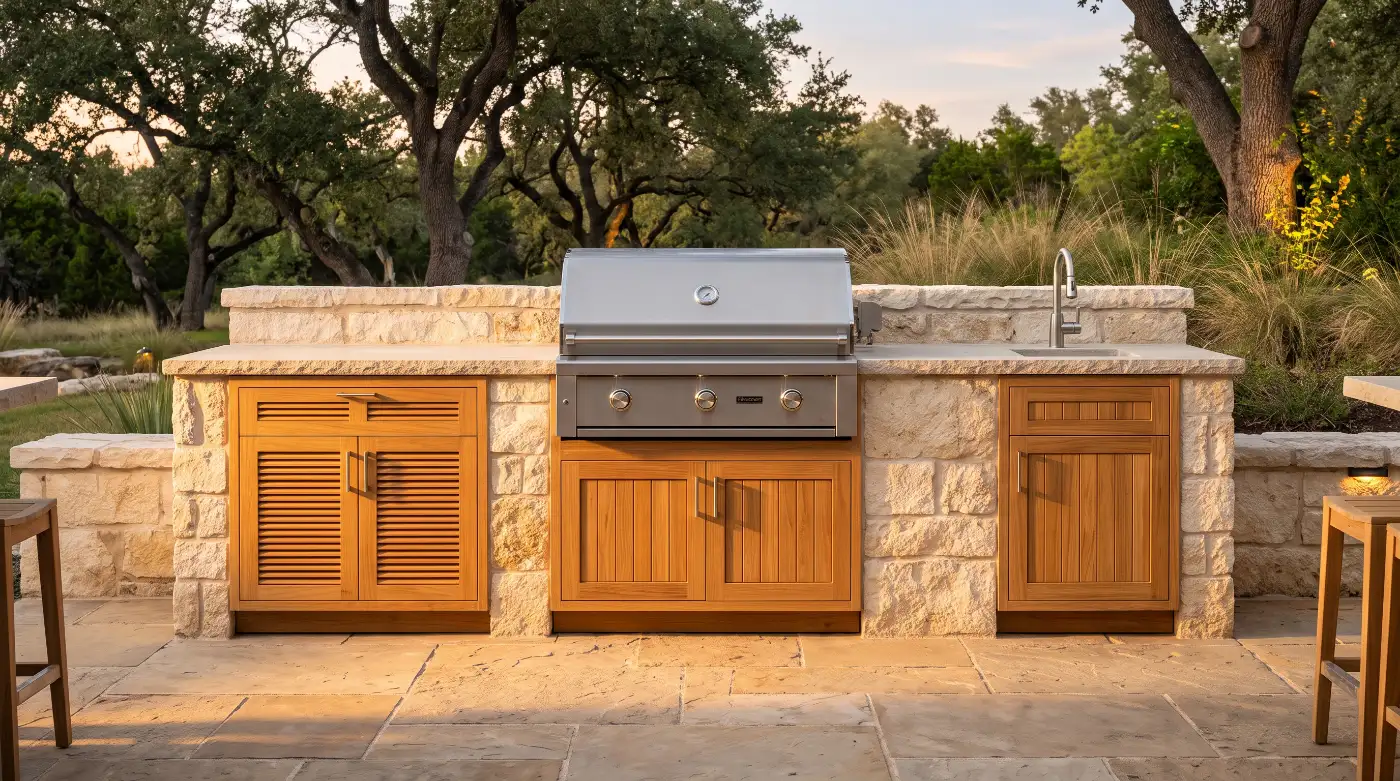
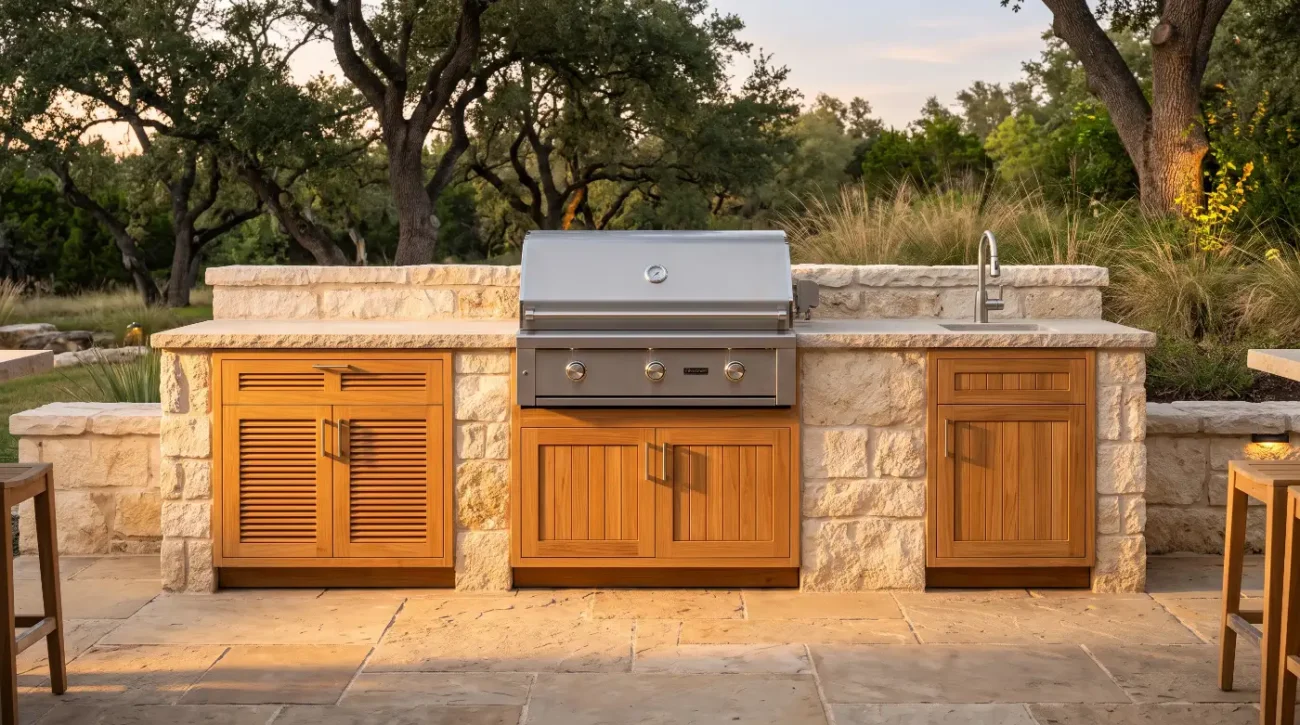
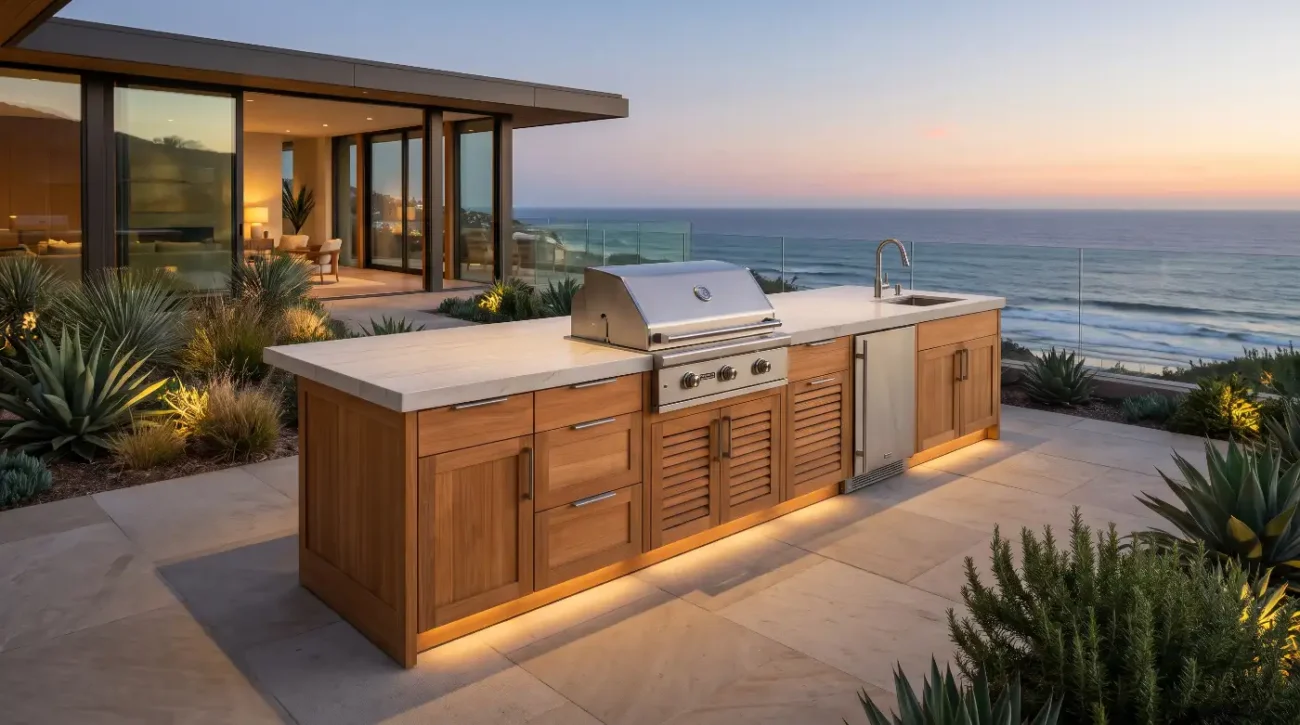
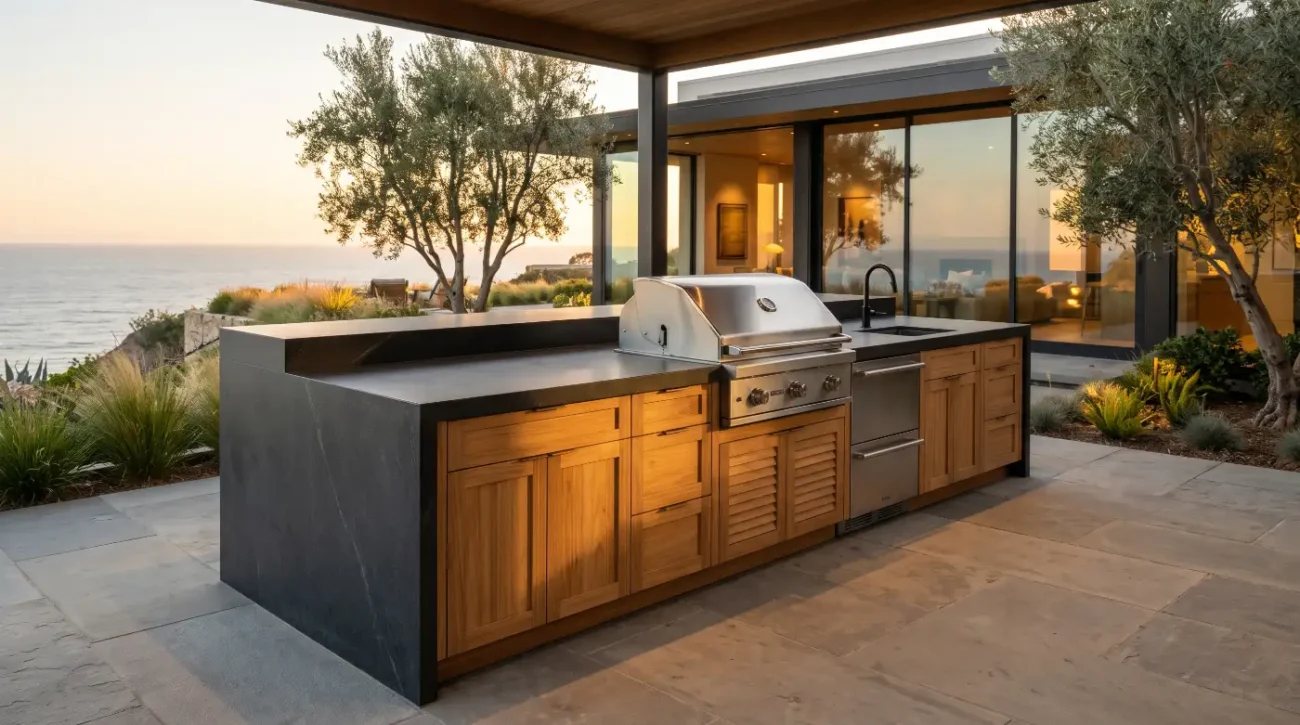
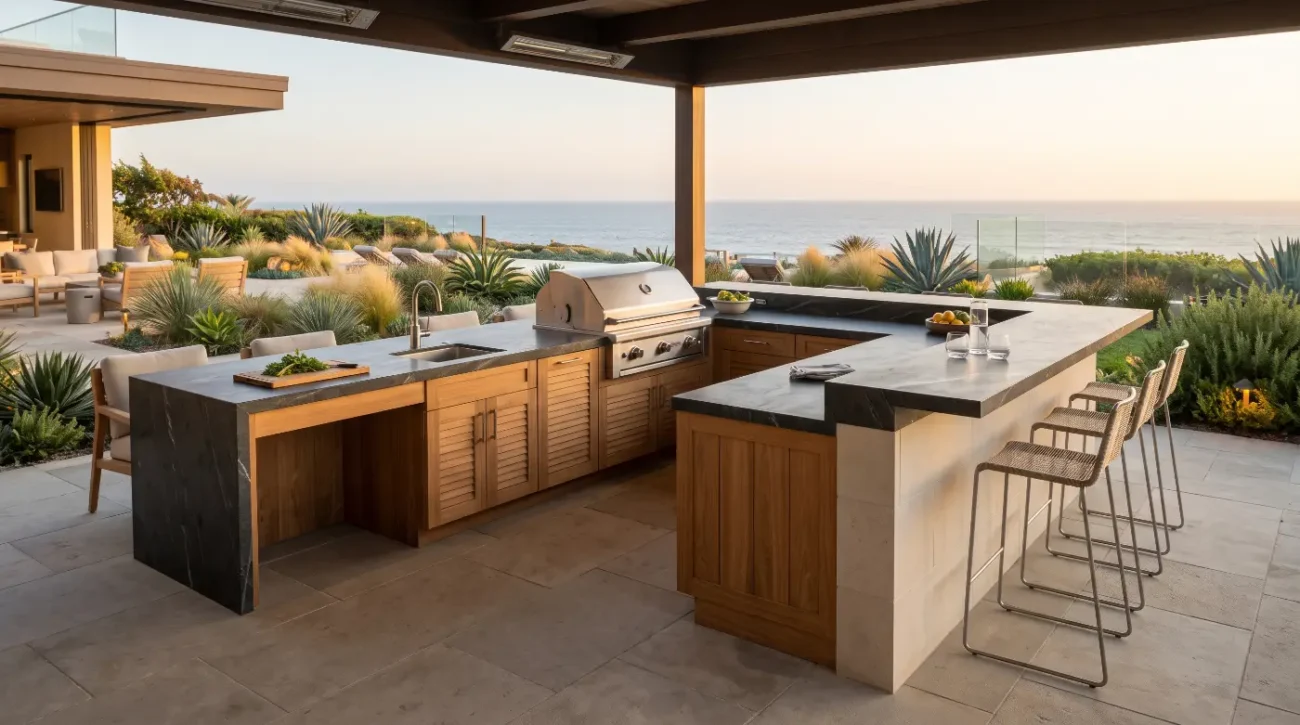
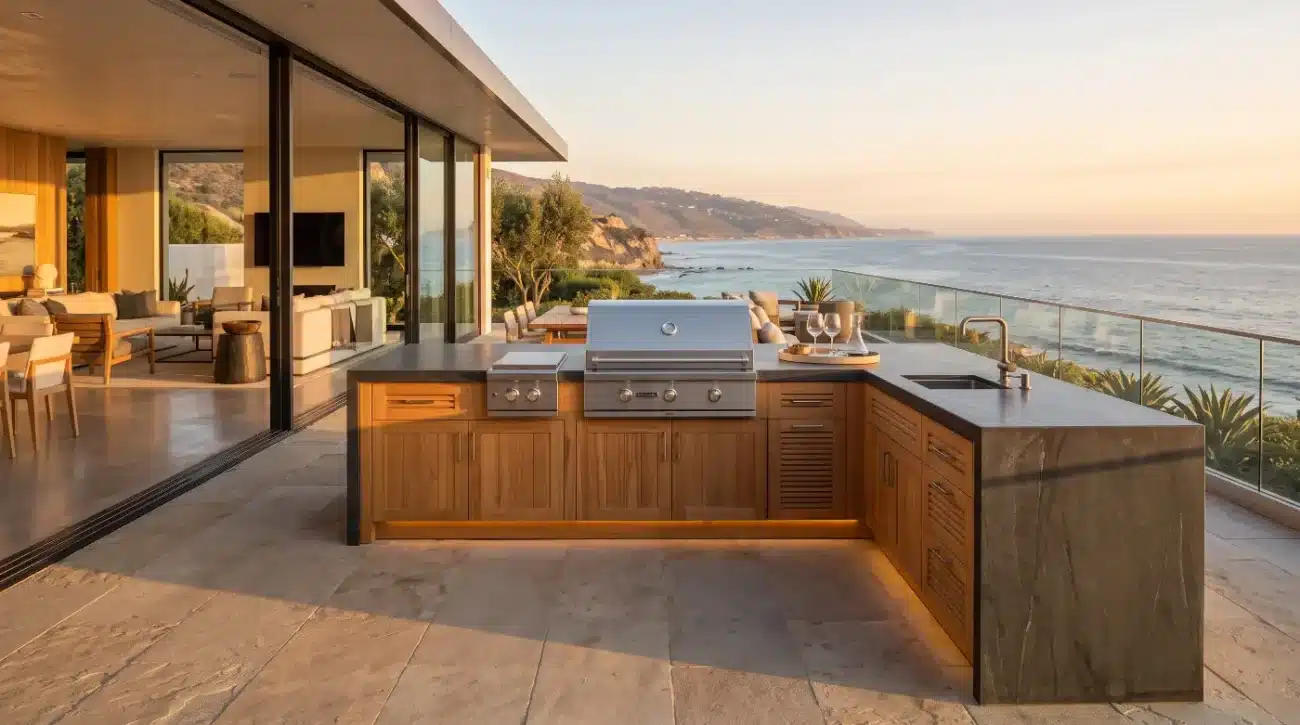
Material Balance: Pairing warm, quarter-sawn Grade-A teak base cabinetry with rough-faced cream Austin chalk limestone softens harsh masonry lines and anchors expansive flagstone terraces in central Texas estates.
-
Thermal and Structural Engineering: Central Texas microclimates demand solid wood mortise-and-tenon joinery, strategic air-gap ventilation, and structural load frames capable of supporting heavy Lueders limestone or quartzite countertops without warping.
-
Hardware Longevity: Specifying 316 marine-grade stainless steel hinges and full-extension drawer glides protects architectural millwork against cedar pollen, hard limestone dust, and dramatic seasonal humidity swings.
-
Patina Harmony: Left unsealed, solid teak naturally oxidizes into a refined silver-grey patina that mirrors weathered Texas limestone, whereas periodic oil treatments preserve rich golden warmth against bright limestone masonry.
Last autumn, a prominent landscape architect in Westlake Hills stood over a newly poured flagstone terrace, staring at a stark, monolithic retaining wall made of quarried cream Austin limestone. The stonework was masterful, yet the space felt cold, acoustically harsh, and visually sterile under the relentless Texas afternoon sun. When the architect initially specified powder-coated aluminum cabinets for the cooking zone, the metallic sheen amplified the glare and clashed with the surrounding live oaks. Replacing those sterile metal boxes with solid, custom teak cabinetry transformed the entire courtyard into a cohesive, organic sanctuary.
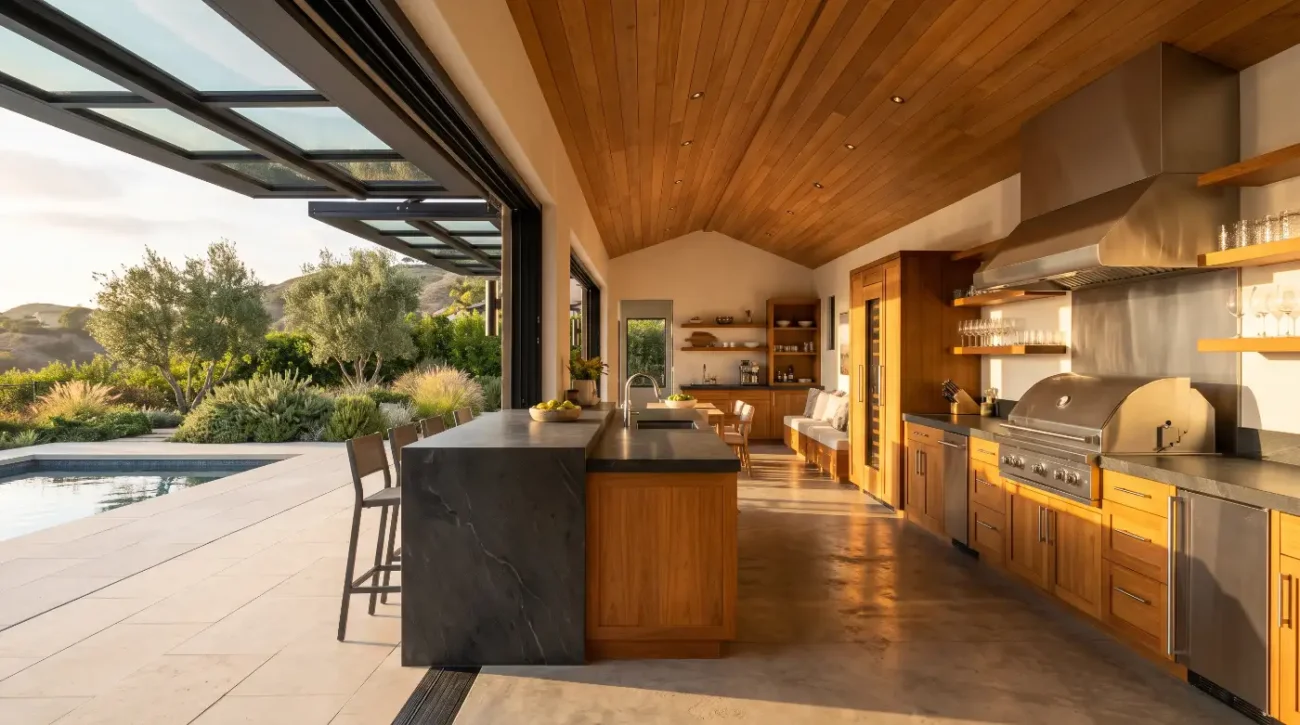
Designing a successful hill country modern outdoor kitchen requires resolving the visual tension between rugged regional geology and refined contemporary architecture. Rough-faced Texas limestone brings undeniable permanence to elevated terraces in Austin, Dripping Springs, and Lakeway, yet excessive masonry quickly overwhelms residential exterior spaces. Introducing solid Grade-A plantation teak cabinetry warms the visual palette, absorbs ambient acoustic bounce, and bridges the transition between glass-walled modern interiors and untamed juniper landscapes.
Fast Track Summary
-
Aesthetic Counterweight: Dense golden teak grain softens the chalky texture and sharp geometric planes of split-face Austin limestone retaining walls.
-
Climate Resilience: High natural silica and rubber concentrations within Tectona grandis resist cracking during 105-degree summers and sudden winter cold fronts.
-
Precision Installation: Custom base cabinetry requires recessed plinths, heavy-duty structural framing, and thermal ventilation buffers to handle thick stone slabs and high-BTU grills.
-
Specification Workflow: Integrating architectural CAD files early in the hardscape phase prevents costly stone masonry adjustments during final millwork installation.
How Solid Teak Base Cabinetry Softens Native Texas Limestone Architecture
Solid Grade-A teak base cabinetry softens native Texas limestone by introducing organic warmth, tactile grain variation, and acoustic absorption against hard masonry surfaces. While rough-faced cream Austin stone reflects intense sunlight and creates visual rigidity, dense Tectona grandis wood fronts absorb glare and establish a grounded,biophilic focal point across sprawling flagstone terraces.
Central Texas architecture thrives on regional authenticity, blending cantilevered steel rooflines with indigenous sedimentary rock. Landscape architects working on sloped lots overlooking Lake Travis frequently rely on terraced retaining walls to carve flat outdoor living zones out of steep limestone escarpments. Without warm timber elements to break up the expanse of pale stone, these terraces risk resembling commercial plazas rather than intimate residential retreats.
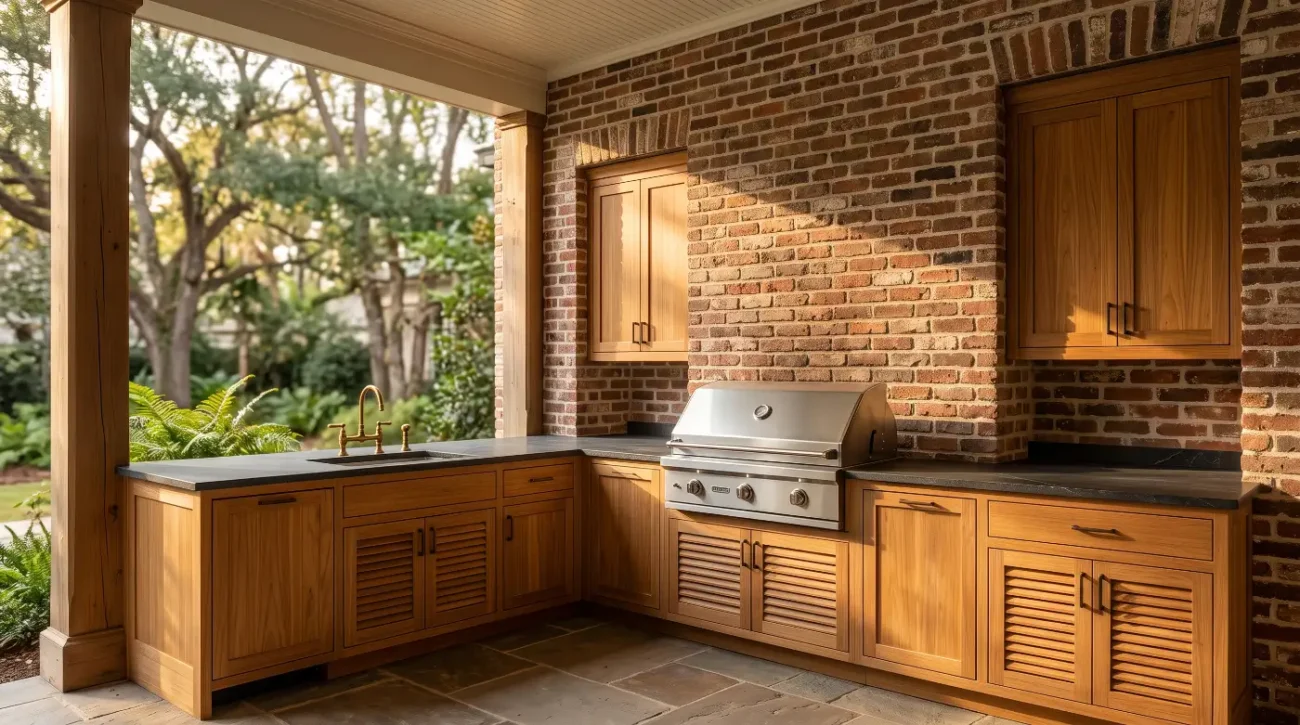
Incorporating custom solid teak base cabinets along the primary masonry wall immediately shifts the spatial psychology of the patio. The rich, honey-brown pigment of freshly milled teak pulls out the subtle ochre and amber mineral veins hidden within local Lueders and Austin chalk stone. Rather than competing with the rugged texture of hand-dressed rock, clean-lined teak slab doors provide a disciplined, modern counterpoint that respects traditional regional materiality.
Balancing Rough Masonry Textures with Precision Millwork
Rough-faced limestone features deep crevices, fossilized imprints, and irregular mortar joints that catch harsh shadows throughout the day. Placing high-gloss composite cabinets or sterile stainless steel doors directly adjacent to this rustic stonework often creates a jarring stylistic disconnect. Custom teak millwork resolves this friction by offering a tactile,matte timber surface that feels equally at home beside hand-chiseled masonry and sleek architectural glazing.
Consider a recent estate project in Barton Creek where a homeowner collected dozens of digital inspiration boards featuring Palm Springs mid-century pavilions and Malibu coastal terraces. When she presented these boards to her landscape architect, the designer noticed an immediate challenge: translating coastal minimalism onto a rugged Texas hillside without losing regional soul. By framing a continuous run of flat-panel teak cabinetry inside an alcove of dry-stacked limestone, the team achieved clean horizontal sightlines while honoring the indigenous landscape.
Managing Sunlight Glare and Thermal Mass on Flagstone Terraces
Pale Texas flagstone and cream limestone possess high solar reflectance, bouncing intense ultraviolet radiation upward beneath covered loggias and open pergolas. Metal cabinetry doors exacerbate this discomfort by radiating trapped heat and reflecting blinding afternoon glare directly into the eyes of guests gathered around the island. Solid wood cabinetry naturally diffuses harsh sunlight, maintaining a comfortable surface temperature even when exposed to western sun angles.
Furthermore, limestone retaining walls act as massive thermal batteries, absorbing daytime heat and radiating it back into the outdoor kitchen well past sunset. Installing properly ventilated solid teak cabinetry along these masonry walls creates an insulating buffer zone. The natural cellular structure of dense hardwood slows thermal transfer, protecting stored glassware, dry goods, and culinary tools from extreme radiant heat buildup.
Patina Evolution Alongside Weathered Sedimentary Stone
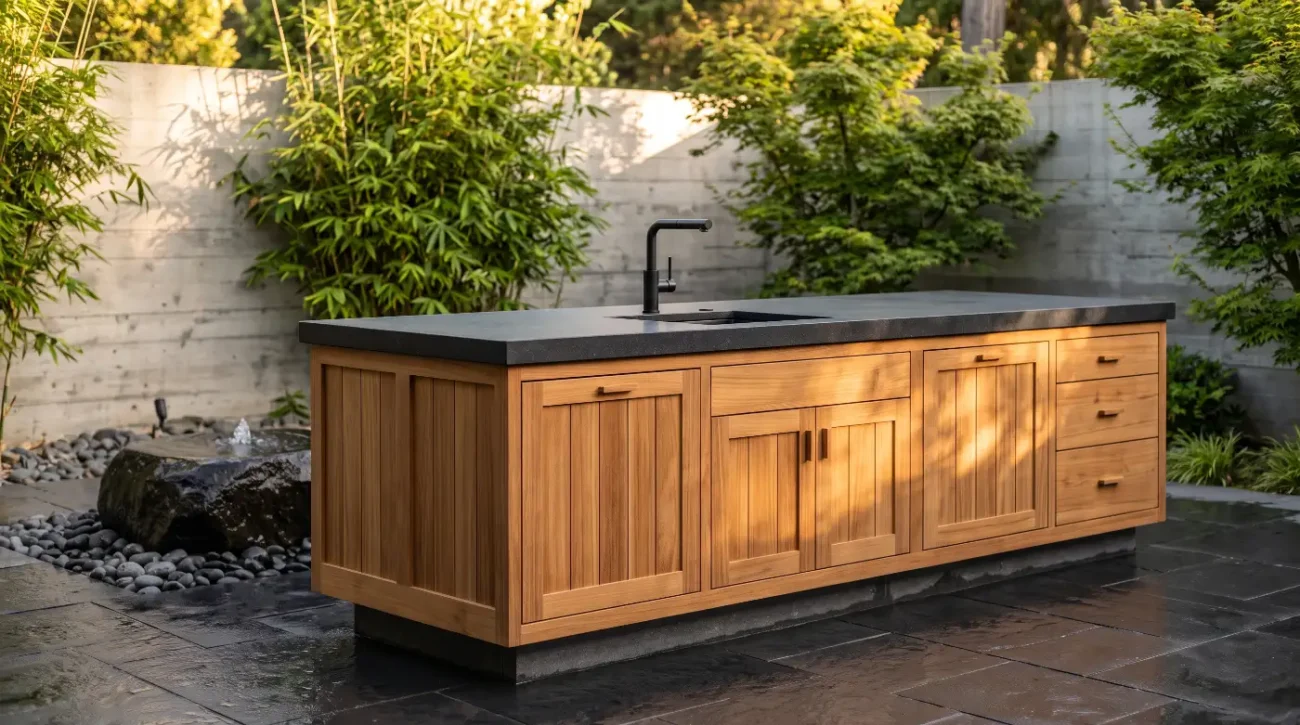
A common misconception among homeowners is that exterior wood must retain its showroom amber tone forever to look intentional. In reality, one of the most compelling design opportunities in Hill Country architecture lies in allowing Grade-A teak to oxidize naturally. Over twelve to eighteen months of exposure to Texas sun and rain,unsealed teak develops a luminous, silvery-grey patina that harmonizes effortlessly with the cool chalky undertones of aged Austin limestone.
For clients who prefer rich, warm contrast against pale stone, periodic oil maintenance preserves the deep golden-brown hue. Applying a breathable, penetrating teak oil twice annually—typically in spring after heavy oak pollen season and again in late autumn—replenishes surface luster without creating a synthetic barrier. Landscape architects should discuss this strategic tradeoff early in the design phase, empowering homeowners to choose between effortless silvering and vibrant timber warmth.
Engineering Teak Cabinetry for Central Texas Microclimates and Heavy Stone
Engineering teak cabinetry for Central Texas requires dense Grade-A plantation heartwood, traditional mortise-and-tenon joinery, and 316 marine-grade stainless steel hardware to withstand extreme thermal swings. Combined with ventilated insulating liners for high-BTU grills and reinforced structural frames supporting heavy limestone slabs, solid teak millwork prevents warping, joint separation, and premature hardware failure.
While Austin lacks the direct salt spray of Malibu or the Florida coast, the Hill Country presents an equally punishing environment for exterior millwork. Summer temperatures routinely exceed 100 degrees for weeks with single-digit afternoon humidity, followed by torrential spring thunderstorms and sudden winter freezes. Inferior wood species,plywood carcasses, and hollow modular frames rapidly delaminate, swell, or crack under these violent atmospheric shifts.
Wood Science and Cellular Resilience in Tectona Grandis
True architectural longevity begins at the cellular level with kiln-dried, Grade-A plantation teak harvested from responsibly managed forests certified by the Forest Stewardship Council. Unlike domestic hardwoods such as white oak or cedar, Tectona grandis contains high concentrations of natural tectonic resins, rubber, and silica embedded directly within its tight grain structure. Research documented by the USDA Forest Products Laboratory confirms that these natural extractives repel moisture intrusion, deter wood-boring insects, and prevent fungal decay without chemical pressure treatments.
Because Central Texas experiences rapid drops in relative humidity, lesser woods shrink abruptly, pulling fasteners loose and splitting face frames. Master craftsmen mitigate this risk by milling quarter-sawn teak boards and engineering floating panel doors with precision expansion tolerances. Traditional mortise-and-tenon joinery locks structural rails and stiles together mechanically, allowing individual wood fibers to expand and contract microscopically across seasons without compromising cabinet geometry.
Countertop Load Distribution for Lueders Limestone and Quartzite
Landscape architects designing in Austin frequently specify thick, bullnose-edged Lueders limestone, leathered granite,or dense Brazilian quartzite countertops to tie the outdoor kitchen into adjacent pool coping. These natural stone slabs impose immense dead loads—often exceeding twenty-five pounds per square foot—directly onto the cabinetry below.Standard residential boxes or lightweight plastic leveling legs will buckle or bow over time, causing stone seams to crack and drawer fronts to bind.
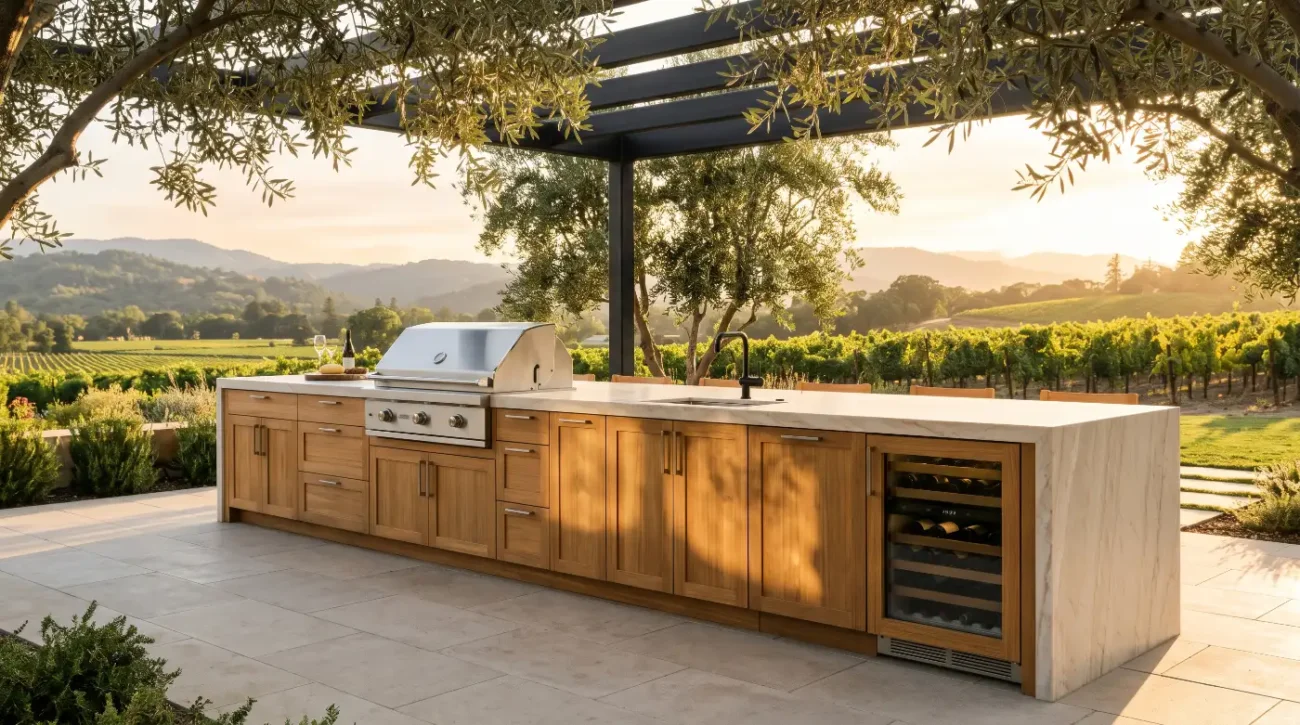
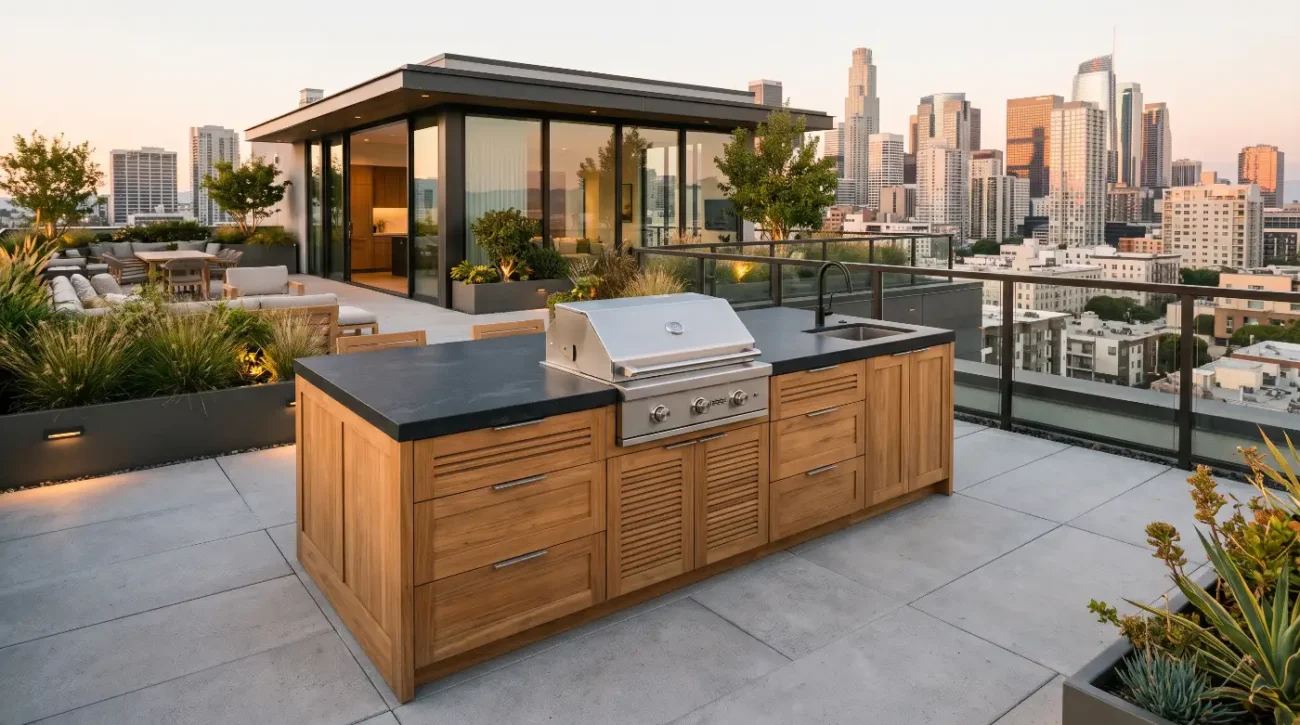
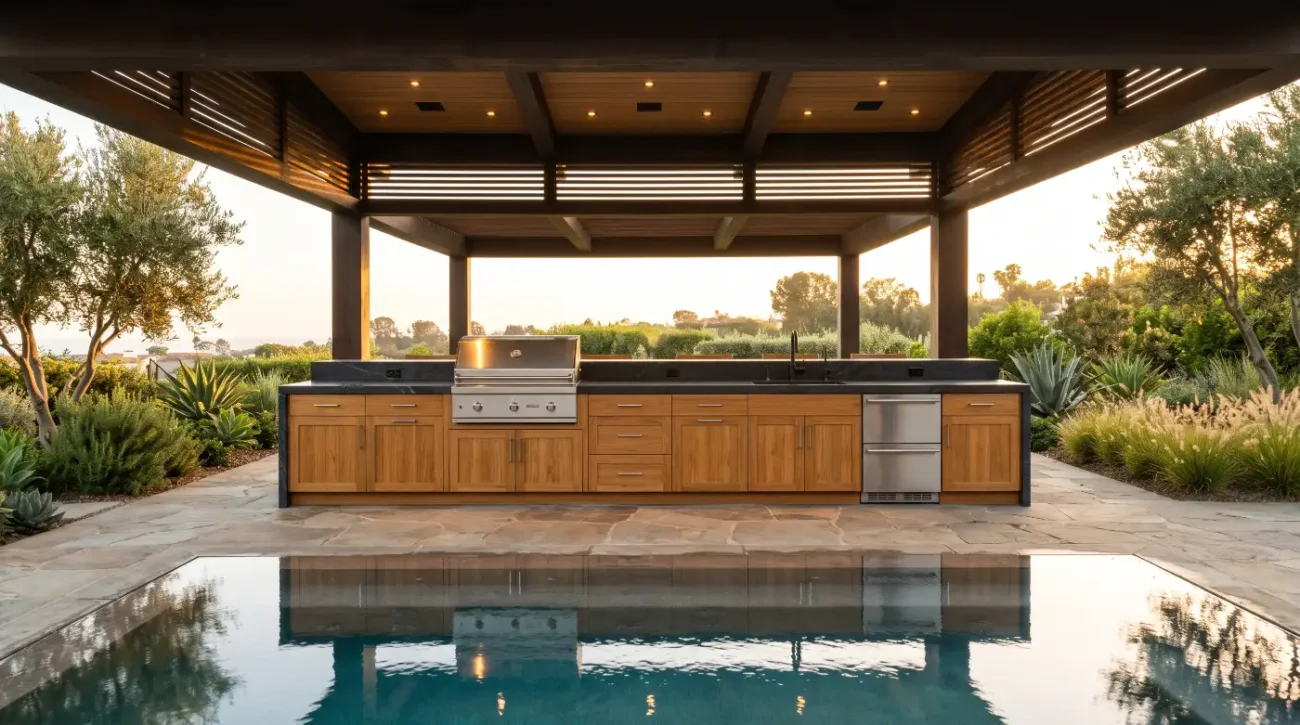
Heavy-duty custom cabinetry solves this engineering challenge through integrated full-depth structural framing and reinforced corner gussets that transfer vertical weight directly to the concrete sub-slab. When specifying long island runs, designers should integrate custom teak island inserts flanked by masonry piers to create uninterrupted architectural lines while maintaining superior load-bearing capacity. Properly engineered toe-kicks and heavy-duty stainless leveling feet ensure the entire stone assembly remains dead-level even as surrounding patio pavers settle slightly over decades.
Ventilation Clearances and Thermal Protection Around High-BTU Grills
An overlooked environmental risk in luxury outdoor kitchens involves trapping radiant grill heat inside unventilated wooden cabinetry enclosures. High-performance built-in gas grills and Argentinian-style wood-fired parillas generate extreme downward and lateral heat that can desiccate nearby timber if improperly isolated. Even dense Grade-A teak requires strict adherence to National Kitchen and Bath Association outdoor clearance standards and appliance manufacturer specifications.
Specifiers must always incorporate double-walled, insulated stainless steel grill jackets whenever setting a high-BTU cooking unit into solid wood base cabinets. Additionally, building discreet louvered ventilation panels or recessed air-gap channels into the rear carcass prevents combustible gas accumulation and allows trapped thermal energy to dissipate safely behind the limestone wall. Following these thermal engineering protocols protects the structural integrity of the millwork and preserves manufacturer warranty coverage.
Why Film-Forming Polyurethane Sealers Fail in Texas Heat
One of the most damaging post-installation mistakes occurs when well-meaning painters or stone sealers apply polyurethane, spar varnish, or acrylic clear coats to outdoor teak cabinetry. While film-forming finishes create a glossy sheen initially, intense Texas UV radiation quickly breaks down the synthetic polymer bonds. Microscopic cracks form across the rigid surface film, trapping rainwater and morning dew underneath where it cannot evaporate.
Because teak is naturally rich in oils, the wood actively rejects synthetic surface coatings, accelerating peeling,blistering, and dark moisture staining beneath the failed finish. Once polyurethane fails on exterior millwork, restoring the wood requires labor-intensive chemical stripping and mechanical sanding that erodes fine architectural reveal lines.Adhering strictly to the protocols outlined in the official Pacific Teak Millworks care and maintenance guide ensures homeowners clean and nourish the timber safely without compromising its natural breathability.
Marine-Grade Hardware and Dust Defense in the Hill Country
Hardware failure frequently ruins an otherwise sound outdoor kitchen long before the cabinetry boxes degrade. In central Texas, fine alkaline limestone dust from nearby stonework, heavy spring cedar pollen, and sudden downpours infiltrate inferior drawer slides and hinges. Standard zinc-plated or 304-grade stainless steel mechanisms rapidly pit,seize, and lose their soft-close damping performance when exposed to abrasive mineral dust and moisture.
Every hinge, concealed soft-close runner, and magnetic catch specified for a Hill Country project must be crafted from true 316 marine-grade stainless steel. Originally engineered for saltwater yacht interiors, 316 stainless contains molybdenum, providing superior resistance to pitting corrosion and mineral abrasion. Pairing marine-grade hardware with continuous weather-sealed perimeter gaskets inside cabinet doors keeps interior storage compartments dry and free of limestone grit and insects.
Navigating the CAD Specification and Stone Fabrication Workflow
Smooth project execution requires close coordination between the landscape architect, custom home builder, stone fabricator, and millwork manufacturer long before site excavation concludes. A common workflow bottleneck arises when masons build rough limestone enclosures without referencing finalized millwork shop drawings, resulting in uneven framing tolerances and awkward filler strips. Downloading exact digital drawings from the Pacific Teak Millworks architectural resource center early in schematic design eliminates guesswork.
Follow these essential specification steps to align stone masonry with custom teak cabinetry:
-
Establish Rough Masonry Openings: Provide the stone mason with exact CAD elevation drawings showing finished cabinet widths, recessed scribe moldings, and required appliance ventilation cutouts before laying the first course of limestone.
-
Verify Slab Pitch and Drainage: Ensure the concrete sub-base beneath the flagstone terrace slopes away from the retaining wall at a minimum of one-eighth inch per foot so rainwater never pools beneath cabinet toe-kicks.
-
Coordinate Stone Template Timing: Schedule the countertop fabricator to laser-template the installation only after all teak base cabinets are anchored, leveled, and fitted with insulated grill liners.
-
Confirm Lead Times Early: Factor custom millwork fabrication schedules into the overall landscape construction calendar alongside stone quarrying and custom steel pergola fabrication.
By treating exterior cabinetry with the same architectural rigor as interior custom millwork—and referencing standards supported by the American Society of Landscape Architects—designers deliver outdoor living spaces that age with effortless grace.
External References
Key Takeaways
-
Aesthetic Balance: Solid Grade-A teak cabinetry introduces warm organic grain and acoustic softness that counterbalance the bright glare and rugged texture of native Austin limestone walls.
-
Material Superiority: Quarter-sawn Tectona grandis resists cracking and joint failure during extreme Texas temperature and humidity fluctuations thanks to high natural silica, rubber, and oil content.
-
Structural Engineering: Reinforced mortise-and-tenon joinery and full-depth structural frames safely support heavy Lueders limestone or quartzite countertops without bowing or binding drawers.
-
Thermal and Hardware Protection: Insulated stainless steel grill liners, rear ventilation gaps, and 316 marine-grade stainless hardware prevent heat damage, corrosion, and mineral dust seizure.
-
Finish Strategy: Avoid film-forming polyurethanes that peel under UV exposure; instead, let the teak weather naturally to a limestone-matching silver patina or maintain its golden tone with breathable teak oil.
Whether you are a landscape architect drafting CAD elevations for an elevated Lake Travis terrace or a homeowner envisioning a seamless limestone-and-timber courtyard, our team is ready to support your project from initial concept to final installation. Reach out to Darin at (949) 365-6513 or email darin@pacificteakmillworks.com to request physical Grade-A teak wood samples, access our trade specification library, or discuss custom dimensions. Visit our trade and homeowner inquiry page today to elevate your next Hill Country outdoor kitchen with enduring architectural craftsmanship.