Executive Summary
-
Diurnal Microclimate Engineering: Napa and Sonoma valleys experience fifty-degree daily temperature swings, demanding Grade-A plantation teak with high natural silica and tectonic resin content to prevent structural checking and joinery failure.
-
Sommelier Appliance Integration: True wine country entertaining requires dual-zone undercounter refrigeration integrated into solid teak base cabinetry with dedicated thermal vents and marine-grade stainless steel hardware.
-
Architectural Load Distribution: Supporting heavy board-formed concrete or monolithic quartzite slabs beneath olive-tree pergolas requires mortise-and-tenon face frames and heavy-duty leveling systems rather than hollow modular boxes.
-
Patina Versus Luster Strategy: Architects must guide estate owners on choosing between periodic oil replenishment for warm golden tones or allowing natural solar oxidation to create a silver-grey patina that harmonizes with limestone and Corten steel.
A custom estate overlooking the Stags Leap District recently suffered a catastrophic millwork failure less than eighteen months after final inspection. The architect had specified a high-end, marine-grade polymer cabinetry line for an expansive terrace shaded by century-old Manzanillo olive trees. When the brutal August sun hit triple digits during harvest season, followed by cool coastal fog rolling up from San Pablo Bay at dusk, the synthetic panels warped,delaminated at the mitered corners, and jammed the integrated sommelier wine drawers.
This costly tear-out illustrates a fundamental truth about wine country outdoor kitchen design. The Napa and Sonoma valleys are not gentle Mediterranean climates; they are extreme diurnal microclimates that punish inferior materials through relentless thermal cycling, intense ultraviolet radiation, and seasonal winter dampness.
Fast Track Summary
-
Material Resilience: Solid Tectona grandis resists fifty-degree diurnal temperature swings through dense cellular oil retention and natural rubber compounds.
-
Entertaining Ergonomics: Sommelier-grade beverage centers, ice makers, and prep sinks require exact framing tolerances and rear ventilation plenums to prevent compressor burnout.
-
Structural Integrity: Monolithic stone countertops demand solid hardwood mortise-and-tenon load paths rather than thin sheet-metal or composite carcasses.
-
Lifecycle Aesthetics: Unsealed teak naturally transitions from rich amber to a refined silver patina, avoiding the peeling and blistering common to film-forming marine varnishes.
How Does Wine Country Microclimate Engineering Dictate Cabinetry Material Selection?
Wine country outdoor kitchen design requires materials capable of surviving fifty-degree diurnal temperature swings,intense ultraviolet radiation, and wet winter fog without warping or delaminating. Grade-A plantation teak (Tectona grandis) outperforms synthetic polymers and domestic hardwoods because its dense grain, natural silica, and tectonic resins regulate internal moisture movement and prevent structural joinery failure across decades of seasonal shifts.
Architects designing contemporary estates in Rutherford, Yountville, or Healdsburg face a unique environmental paradox. A single October day can begin with damp, fifty-degree fog clinging to the vineyard floor, climb to ninety-five degrees by mid-afternoon, and plummet back into the forties after sunset.
Standard exterior cabinetry materials react poorly to this rapid expansion and contraction cycle. Powder-coated aluminum transfers ambient heat directly into interior storage compartments, turning dry-goods drawers into ovens and forcing undercounter wine refrigerators to run continuously.
Even high-density polyethylene (HDPE) exhibits significant thermal expansion coefficients, causing long island runs to bow and soft-close hardware to bind over time. Solid, kiln-dried Grade-A teak solves this engineering challenge at the cellular level.
According to research from the USDA Forest Products Laboratory, Tectona grandis possesses an exceptionally low shrinkage ratio from green to oven-dry states. Its natural rubber and hydrophobic oils act as an internal vapor barrier,preventing moisture ingress during winter rains while keeping the wood fibers supple during arid summer heatwaves.
When specifying solid wood for high-exposure terraces, the distinction between heartwood and sapwood is non-negotiable. True architectural millwork relies exclusively on mature, tight-grained heartwood sourced from certified sustainable plantations overseen by the Forest Stewardship Council.
Consider a recent hillside residence in Calistoga where a homeowner presented a mood board filled with indoor European oak kitchens to their landscape architect. The homeowner wanted that exact monolithic, warm timber aesthetic extended seamlessly onto an infinity-edge terrace overlooking the Mayacamas Mountains.
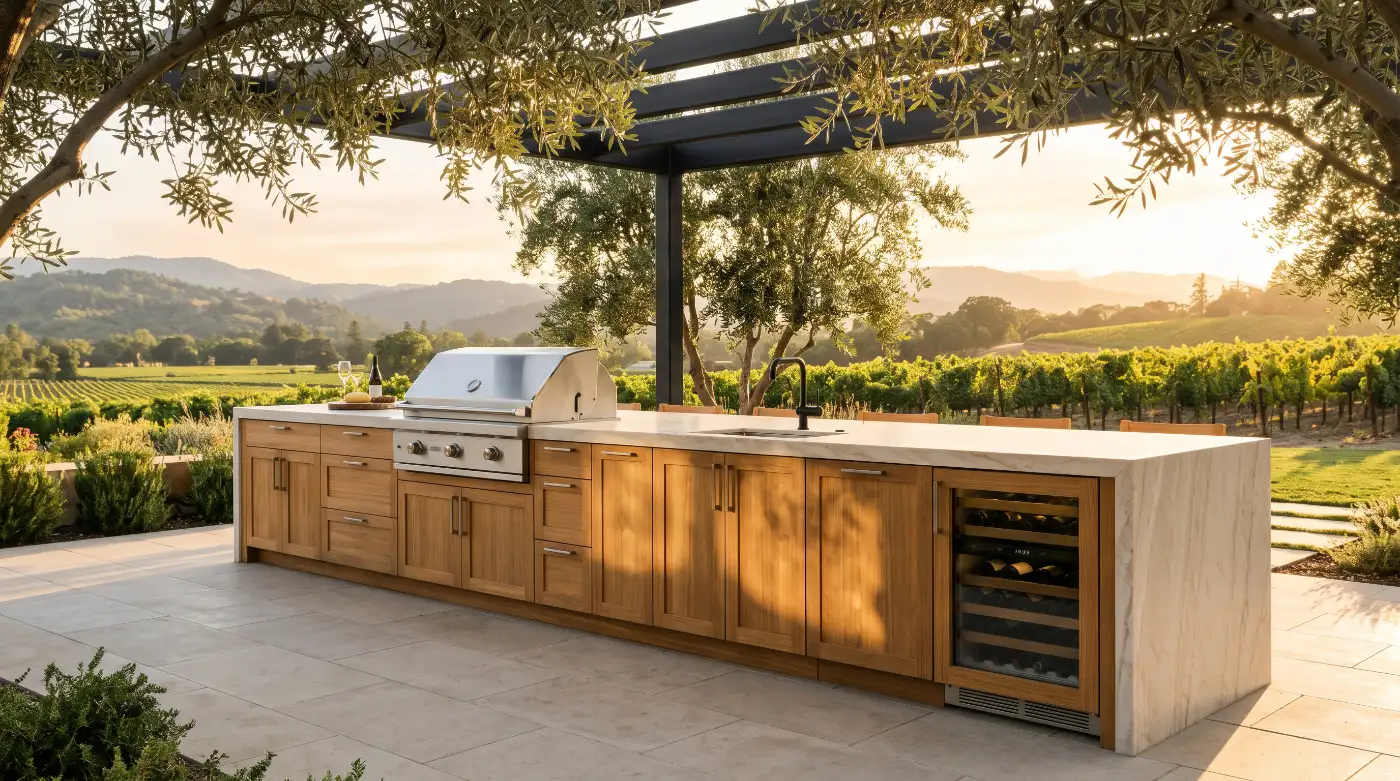
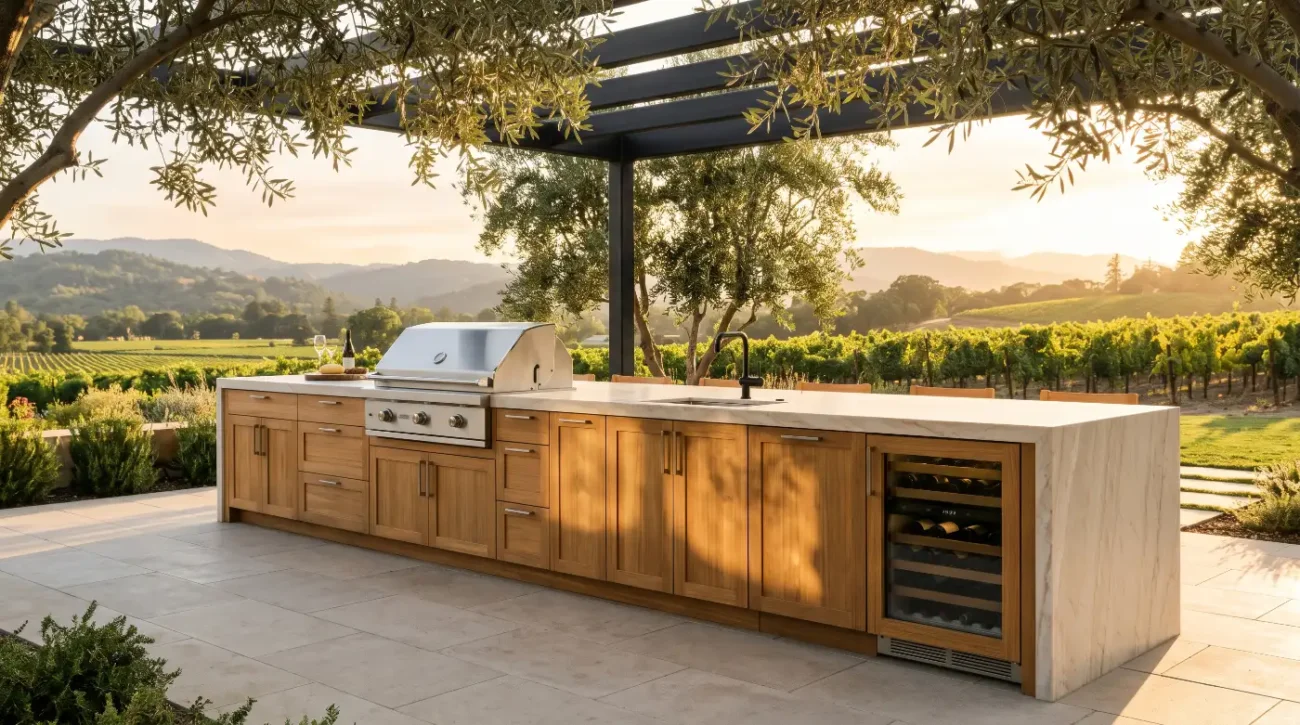
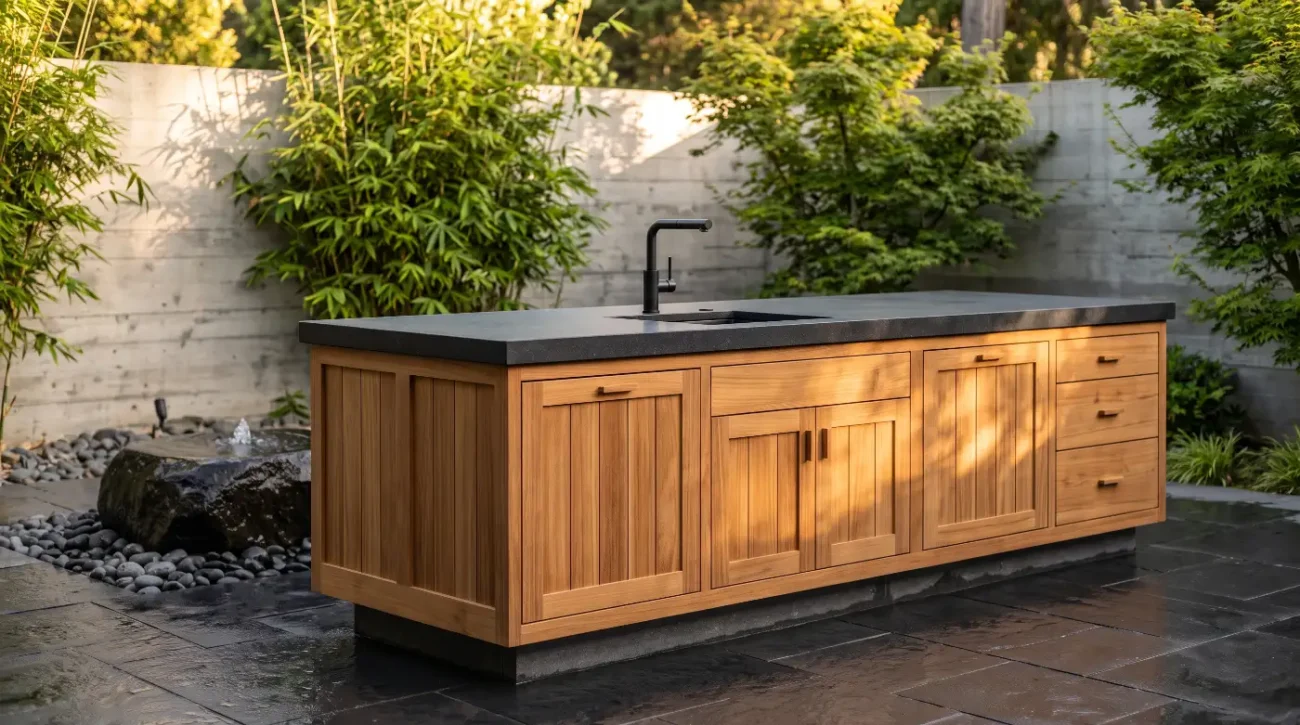
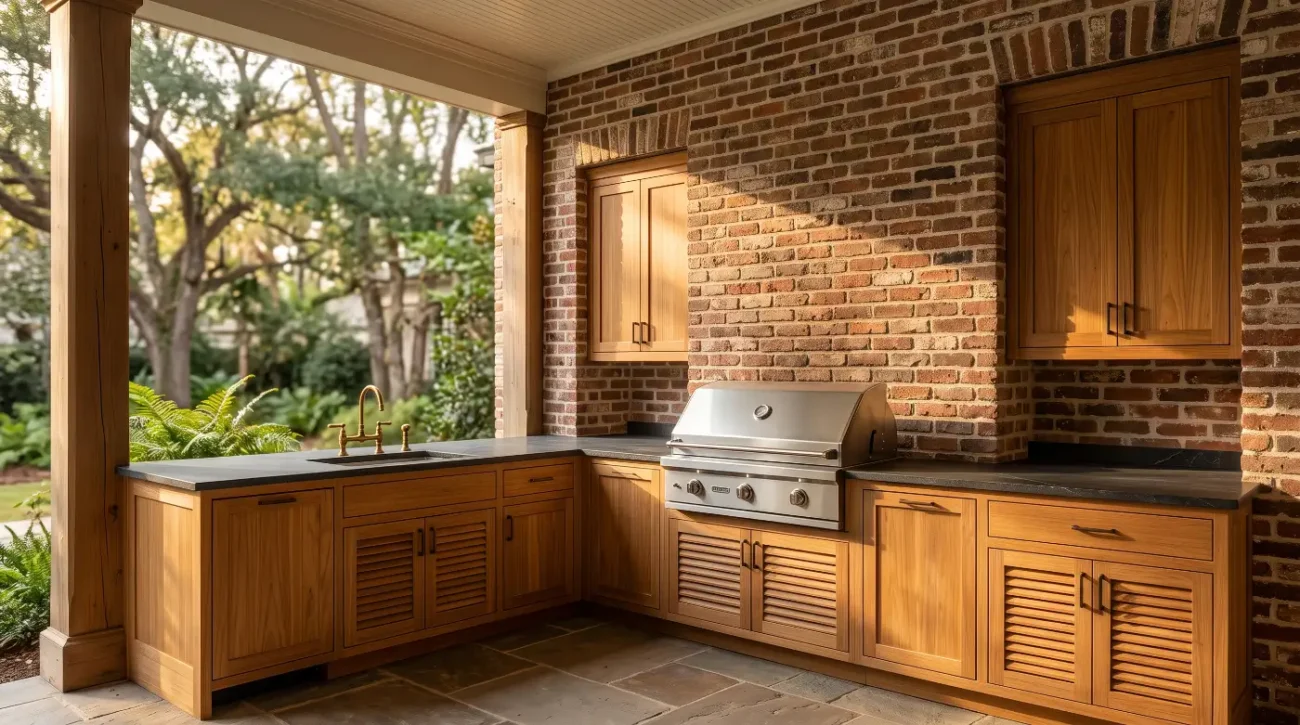
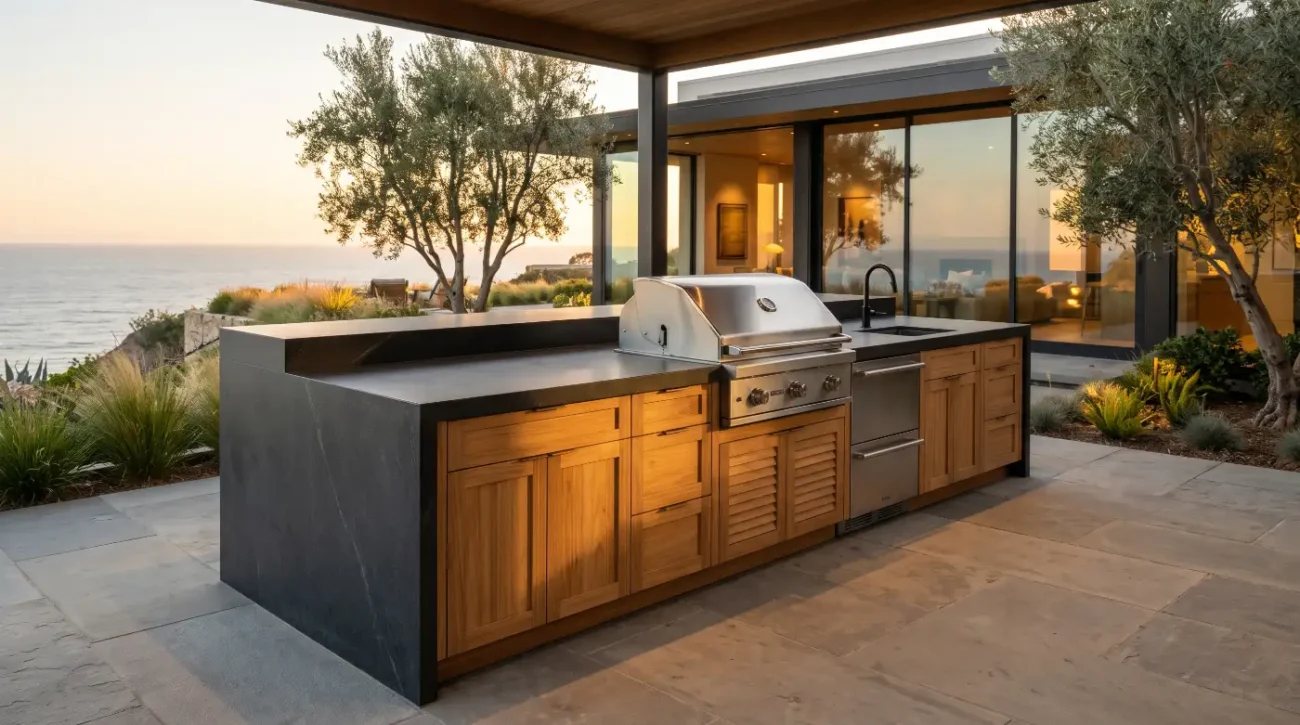
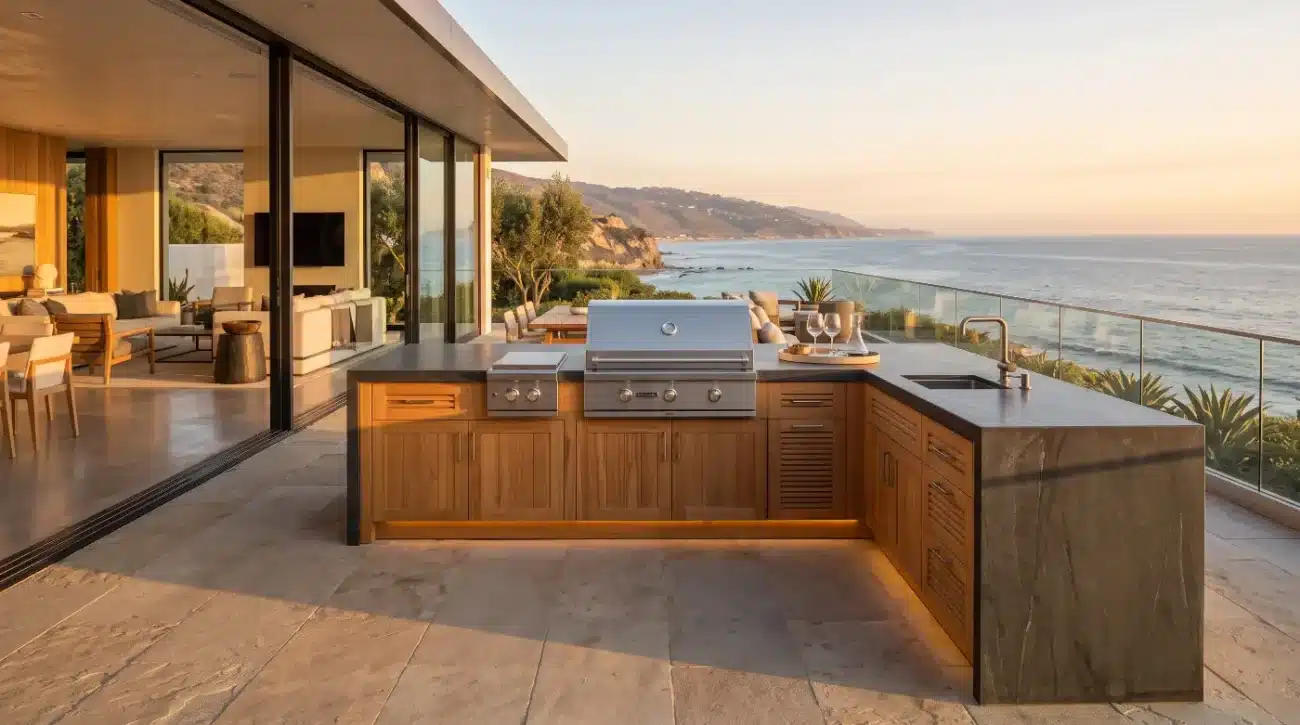
Bridging that vision required translating delicate interior styling into exterior structural reality. Rather than using veneered panels that would bubble under the Napa sun, the architect specified custom solid teak Base Cabinets Collection engineered with floating center panels and hidden expansion joints.
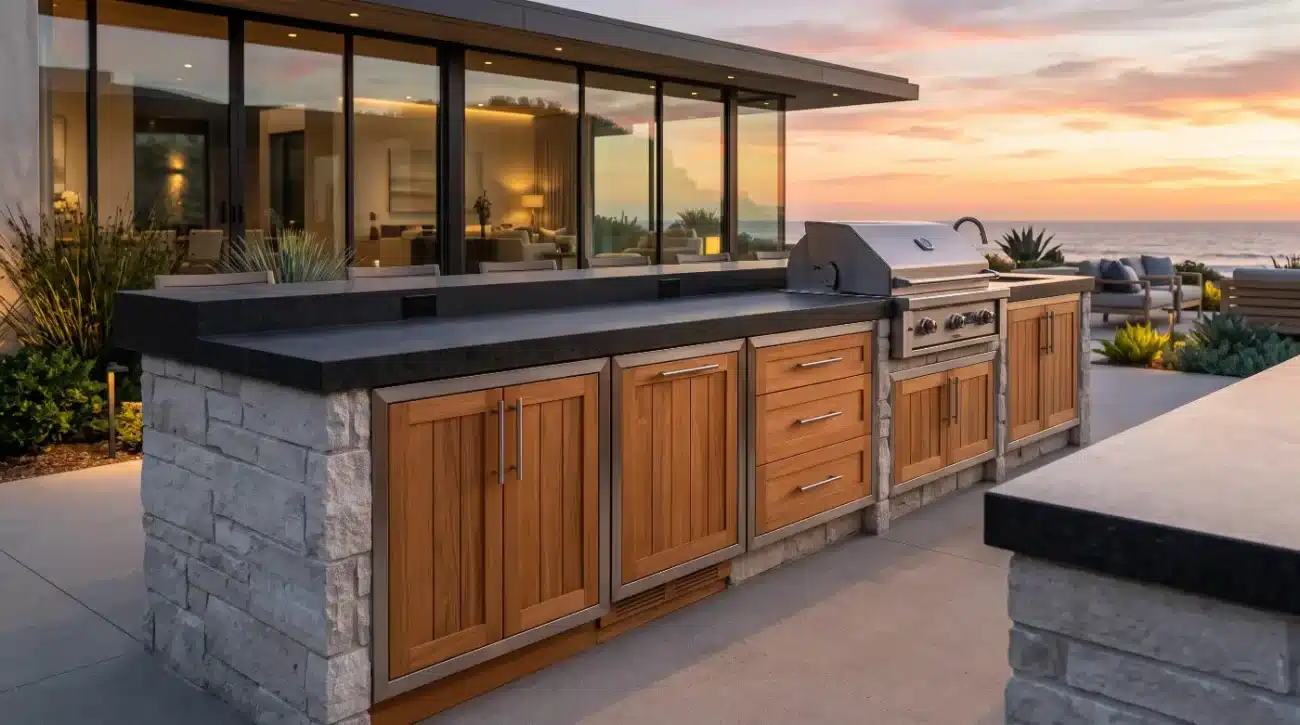
These joinery mechanics allow individual wood stiles and rails to breathe microscopically during afternoon heat spikes without compromising the squareness of the cabinet face-frame. Every joint is secured using traditional mortise-and-tenon construction paired with waterproof marine adhesives, eliminating reliance on mechanical fasteners that eventually loosen under cyclical stress.
Hardware selection is equally critical when bridging indoor luxury with exterior durability. Even though Napa is inland, morning coastal fog carries trace salinity and high humidity that rapidly pits standard 304 stainless steel.
All hinges, full-extension drawer glides, and structural leveling feet must be fabricated from 316 marine-grade stainless steel. This molybdenum-alloyed steel resists crevice corrosion, ensuring heavy drawers loaded with stoneware plates and Riedel crystal glide effortlessly for decades.
A common counterintuitive mistake in wine country millwork is applying polyurethane, lacquer, or film-forming marine spar varnishes to new teak cabinetry. While these coatings initially produce a glossy, furniture-grade sheen,intense California ultraviolet rays break down the chemical film within twelve months.
Once micro-cracks form in a synthetic sealer, moisture becomes trapped beneath the coating, leading to dark fungal staining, peeling, and surface degradation. True architectural teak must remain free of surface films, allowing the timber’s natural oils to migrate freely to the surface.
Property owners and designers face a strategic aesthetic tradeoff regarding long-term appearance. Left completely untreated, exposed teak undergoes natural solar oxidation, transitioning over six to nine months into a luminous,silvery-grey patina that pairs effortlessly with board-formed concrete, Sonoma fieldstone, and weathered Corten steel.
Alternatively, if the architectural palette calls for rich, golden-amber warmth to complement warm limestone paving,the cabinetry requires periodic cleaning and application of a breathable, penetrating teak oil. Detailed protocols for both aesthetic paths can be found in the Pacific Teak Millworks Teak Care & Maintenance Guide, allowing design teams to align maintenance realities with client expectations before fabrication begins.
What Architectural Workflows Optimize Sommelier Entertaining and Appliance Integration?
Optimizing a wine country outdoor kitchen requires integrating dual-zone sommelier refrigeration, high-BTU grills,and prep stations into an ergonomic entertaining zone while maintaining strict thermal clearances. Architects must coordinate CAD/BIM framing tolerances, rear ventilation plenums, and structural load paths to support monolithic stone slabs and heavy appliances without trapping destructive heat inside wooden cabinetry.
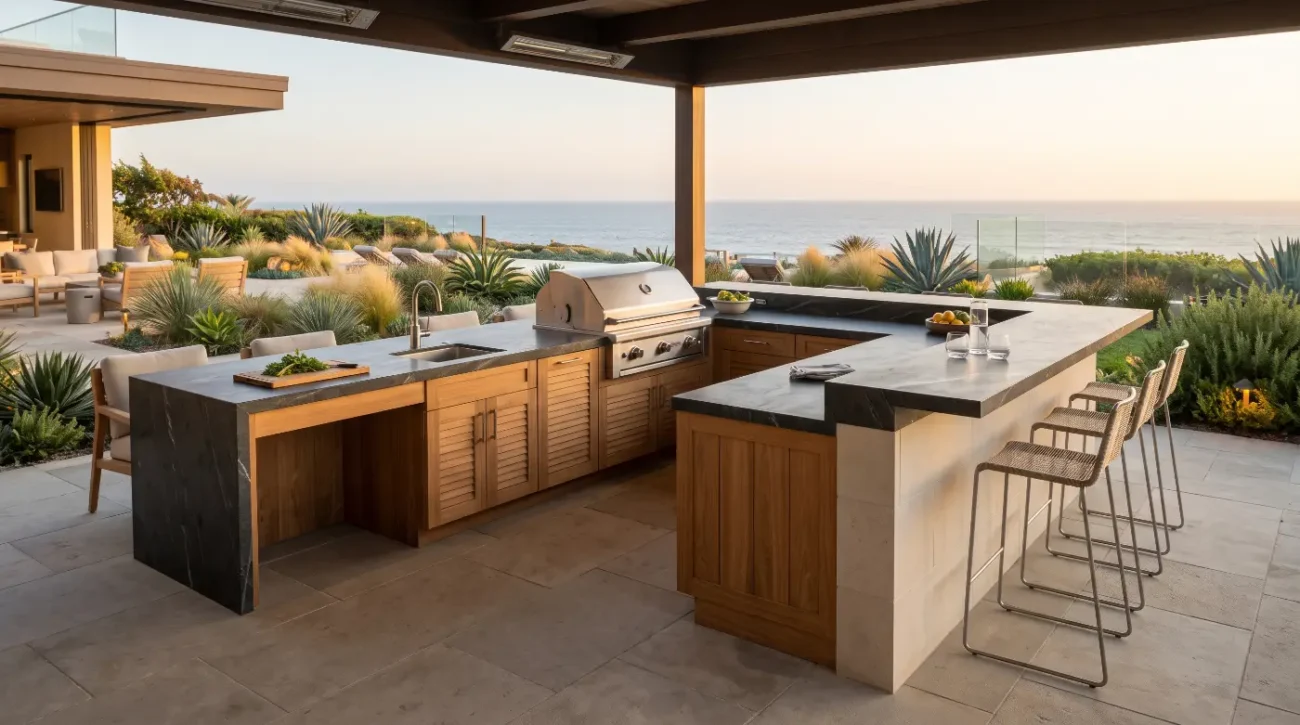
Entertaining in Napa and Sonoma revolves around wine service, al fresco tasting flights, and multi-course dinners prepared alongside guests rather than behind closed doors. Unlike suburban backyard grill islands, a wine country culinary terrace functions as a secondary grand room that anchors the estate’s indoor-outdoor flow.
Achieving this level of hospitality requires separating the space into distinct functional zones: a hot cooking line, a cold sommelier beverage bar, and an interactive plating peninsula. Placing a dual-zone wine column directly beside a high-output built-in gas grill is a frequent layout error that leads to premature compressor failure.
Radiant heat from a forty-two-inch grill firebox can easily exceed four hundred degrees, overwhelming the cooling coils of adjacent refrigeration units. Architects should establish a minimum thirty-six-inch buffer zone—typically occupied by a solid teak trash pull-out or spice storage base—between heat-generating appliances and cold-storage units.
When integrating built-in grills, side burners, or wood-fired pizza ovens into solid wood islands, thermal isolation is paramount. Combustible framing clearances mandated by the National Kitchen & Bath Association require non-combustible insulated grill jackets whenever a high-heat appliance is housed within wooden cabinetry.
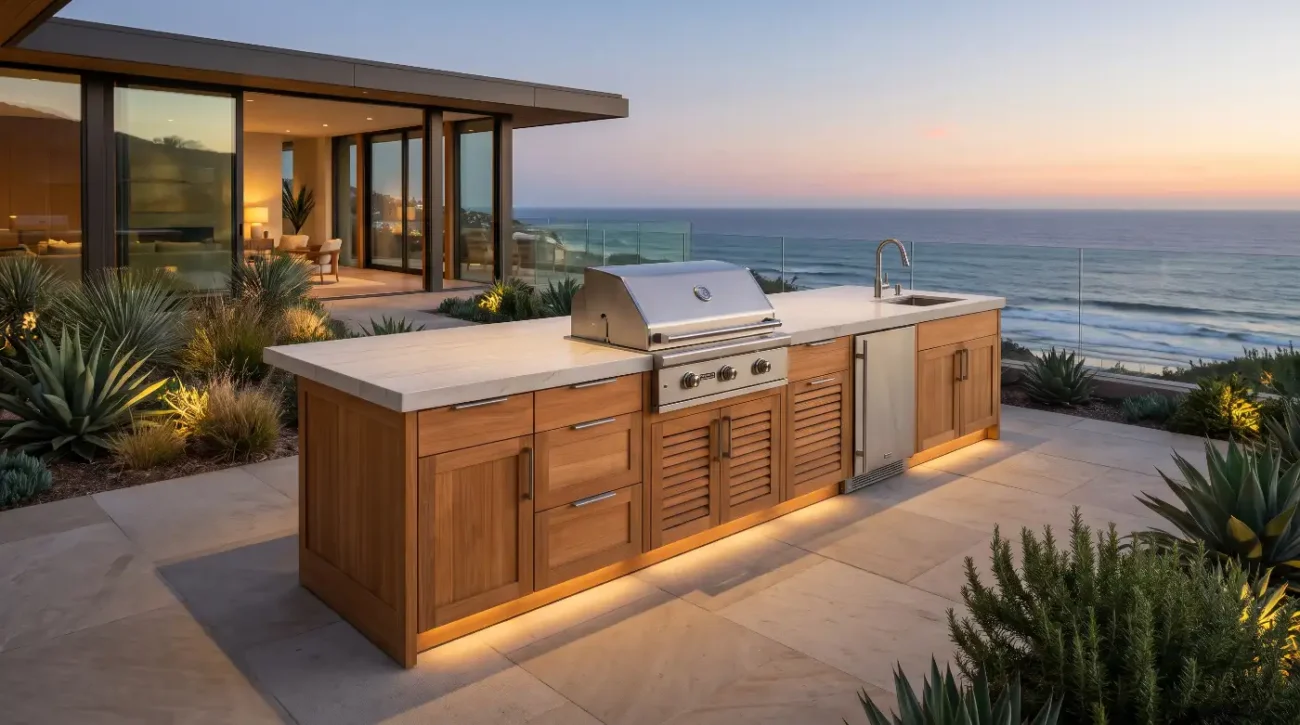
Integrating custom Island Inserts Collection allows builders to frame masonry or steel-stud fireboxes while wrapping the exterior facade in precision-milled teak doors and access drawers. This hybrid construction method provides complete fire safety while preserving uninterrupted horizontal wood grain across a twenty-foot entertaining bar.
Overlooked environmental risks frequently emerge around appliance ventilation and plumbing winterization.Undercounter wine coolers, nugget ice makers, and kegerators require dedicated front-breathing intake vents or rear air-exchange plenums to dissipate condenser heat during ninety-degree harvest parties.
If a cabinet box is sealed tightly against a stucco wall without an air-gap chase, trapped exhaust heat will warp surrounding woodwork and void appliance warranties. Furthermore, estates in higher elevations like Howell Mountain or Spring Mountain experience occasional winter freezes, requiring sloped water supply lines and accessible shut-off valves hidden behind removable teak service panels.
To eliminate job-site friction, custom millwork must be engineered directly within the project’s architectural CAD workflow. Reviewing a comprehensive scenario illustrates how trade collaboration prevents costly field modifications:
-
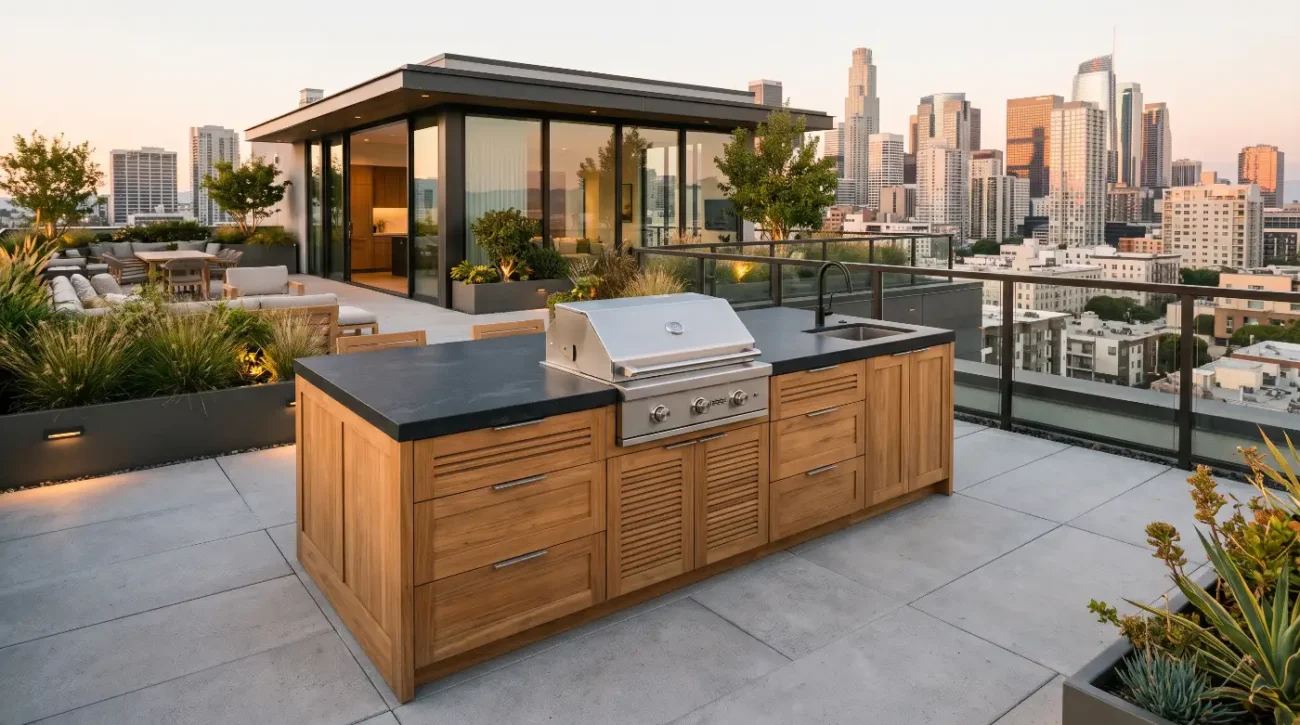
Initial Concept Phase: A landscape architect in St. Helena designs a cantilevered, twenty-four-foot entertaining bar shaded by an architectural steel pergola and mature olive trees.
-
Load Path Engineering: The design specifies a three-inch-thick waterfall countertop fabricated from honed Taj Mahal quartzite, weighing nearly two thousand pounds across the span.
-
Structural Reinforcement: Rather than relying on standard adjustable plastic legs that would crush or sink into terrace pavers, the millwork engineering team incorporates solid teak structural end-panels and concealed steel torque plates into the cabinet carcasses.
-
Appliance Cutout Verification: Specifiers submit exact manufacturer rough-in sheets for a twenty-four-inch panel-ready wine fridge, an outdoor dishwasher, and a flush-mount induction wok burner before shop drawings are finalized.
-
Sub-Contractor Scheduling: Precision-milled cabinets arrive on site fully assembled and pre-drilled for 316 stainless hardware, allowing the stone fabricator and plumber to complete final templating and hookups within forty-eight hours.
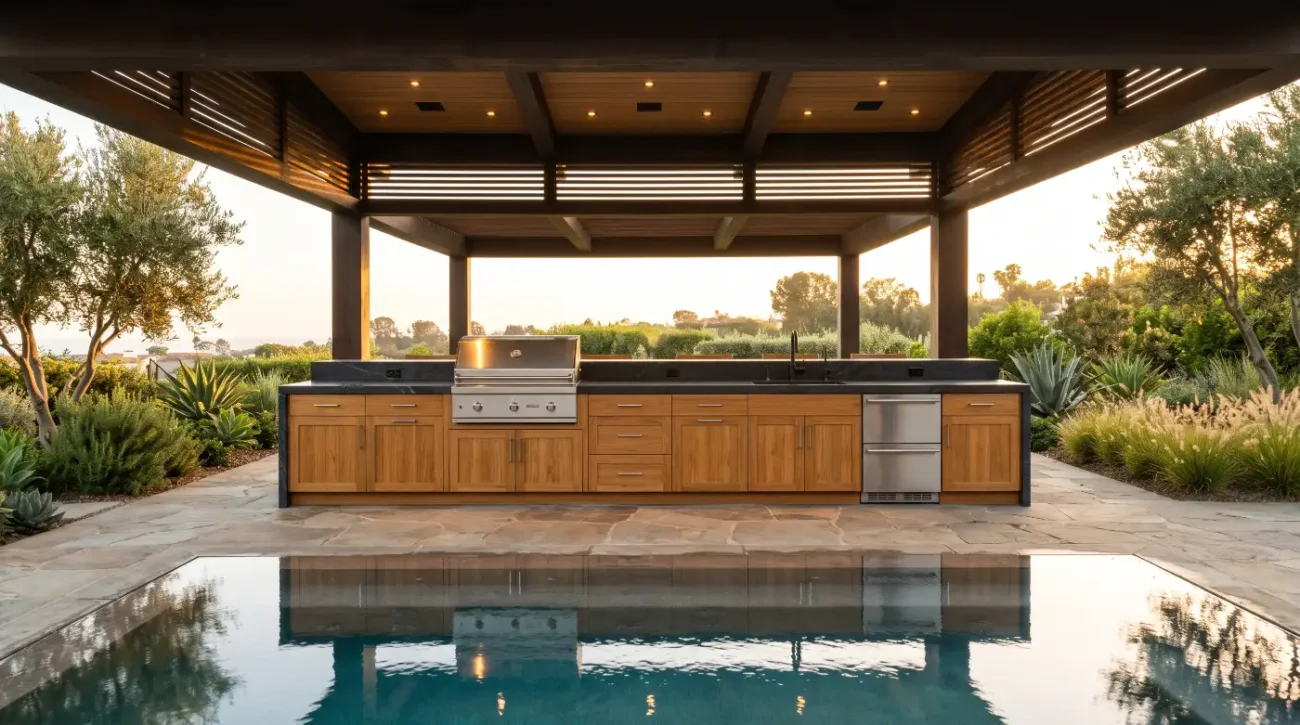
Overhead architectural framing also plays a decisive role in cabinetry longevity and spatial comfort. Open-air pergolas filtered by olive foliage create dappled shade that reduces ambient surface temperatures on dark countertops by up to twenty degrees, though falling olives and pollen require regular sweeping to prevent organic tannin staining on light stone.
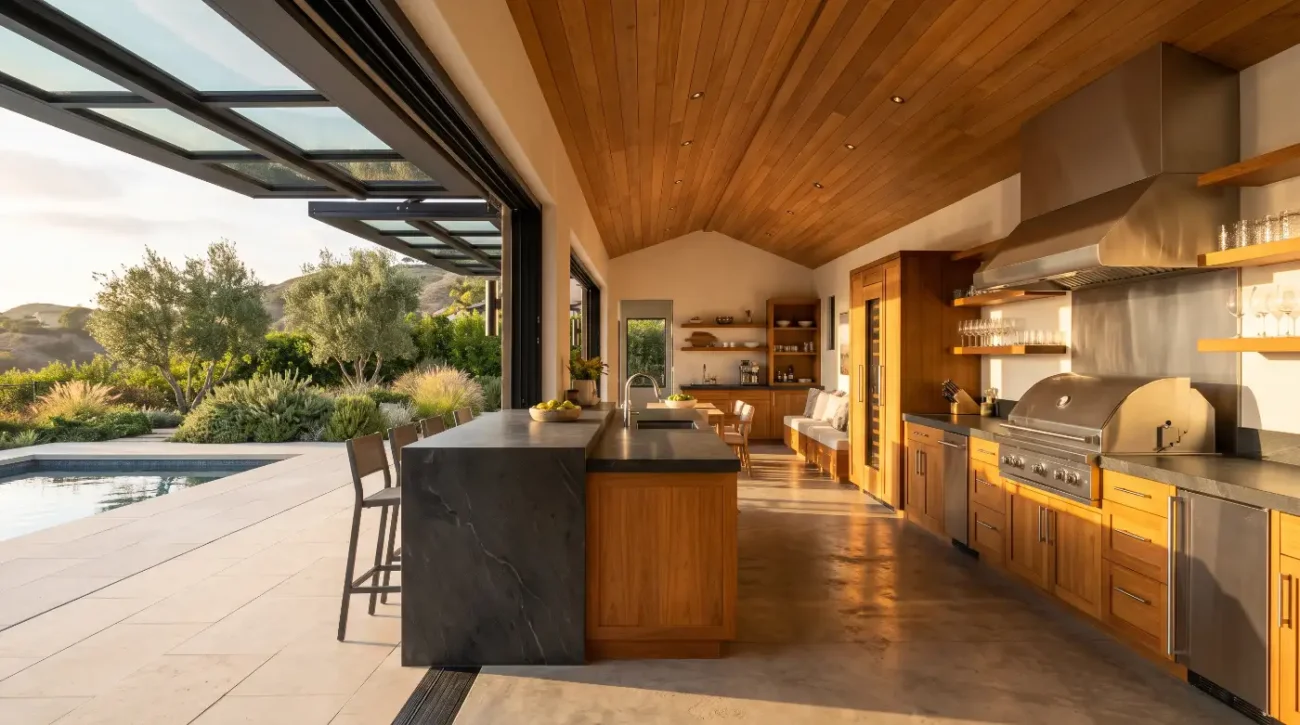
Where estates feature covered rooftop loggias or deep timber pavilions, upper storage becomes viable without blocking vineyard views. Incorporating weather-sealed Wall Cabinets Collection against solid masonry feature walls keeps stemware, decanters, and linen napkins pristine and dust-free between weekend gatherings.
Designers specifying these custom installations can streamline procurement by accessing the Resource Center to download technical specification sheets, framing guidelines, and warranty coverage details. Aligning architectural intent with master woodworking tolerances ensures the outdoor kitchen ages with the same architectural permanence as the main residence.
Authoritative Industry Standards & Scientific References
Key Takeaways for Architects & Estate Designers
-
Specify Solid Heartwood Only: Reject veneered composites, hollow aluminum, and PVC cabinetry in favor of kiln-dried Grade-A plantation teak to survive fifty-degree Napa and Sonoma diurnal temperature swings without delamination.
-
Enforce Thermal Zoning: Separate high-BTU grills from sommelier wine refrigerators by at least thirty-six inches, and always specify insulated metal grill jackets when housing heat appliances inside wooden islands.
-
Mandate 316 Marine Hardware: Protect long-term mechanical operation against coastal morning fog and humidity by specifying 316 marine-grade stainless steel hinges, drawer glides, and structural leveling feet.
-
Avoid Film-Forming Finishes: Never apply polyurethane or marine spar varnish to exterior teak; allow the wood to oxidize naturally to a silver-grey patina or maintain golden tones exclusively with breathable penetrating oils.
-
Engineer for Monolithic Stone Loads: Account for the extreme dead weight of thick quartzite or poured concrete countertops by integrating solid wood load paths and concealed structural bracing into initial CAD drawings.
Collaborate on Your Next Wine Country Estate
Whether you are drafting a contemporary vineyard compound in Napa Valley, a hillside retreat in Sonoma, or a coastal residence requiring marine-grade durability, precision millwork begins at the specification stage. Connect directly with Darin and the architectural engineering team at Pacific Teak Millworks to request physical Grade-A teak finish samples, review custom CAD shop drawings, or establish a trade account through our Contact Us portal, or call (949) 365-6513 to discuss your project’s framing tolerances and lead times.